
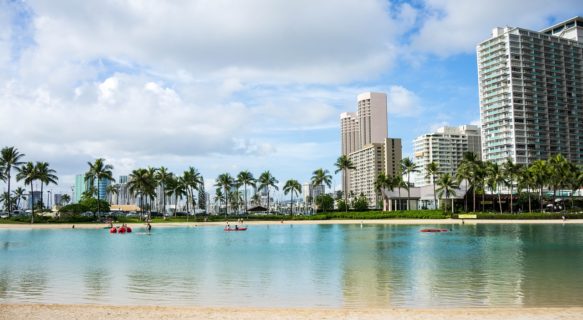
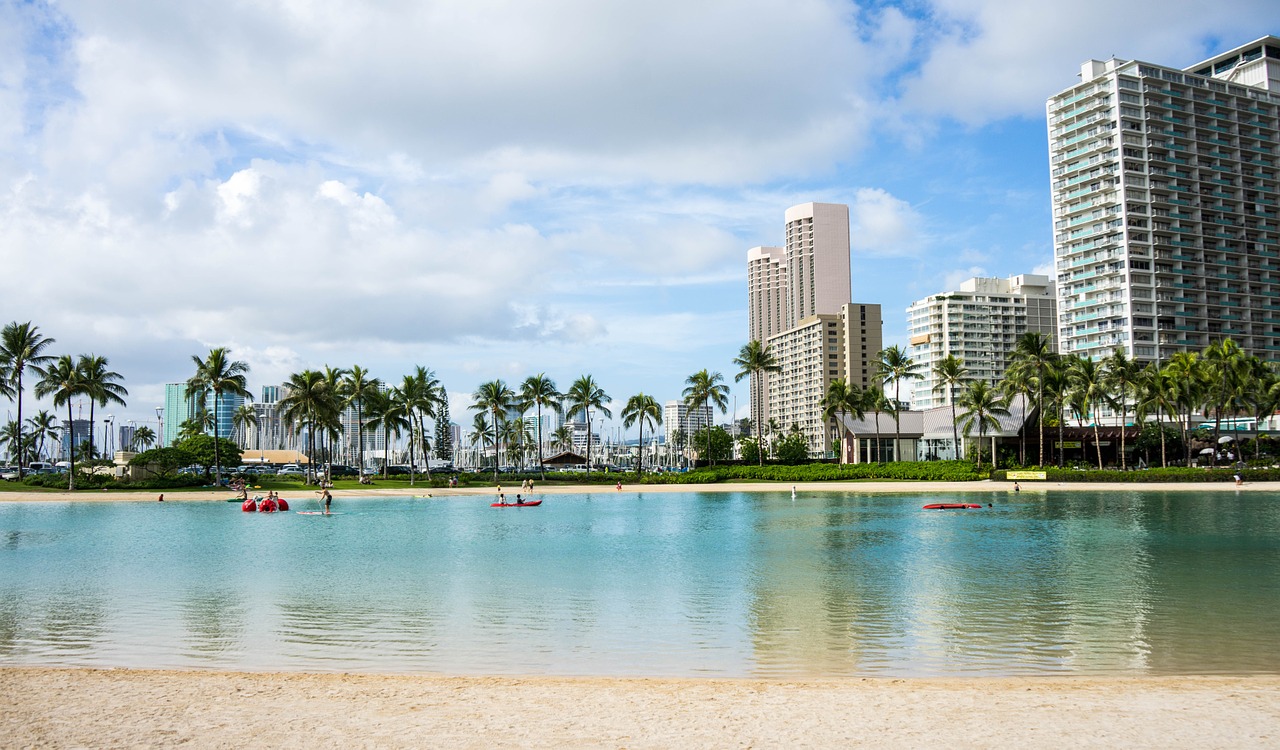
The capital of Hawaii and its primary point of entry, Honolulu is by far the state’s largest city, with nearly one million people—two-thirds of the state’s population—residing within the metro area. Situated on the southern shore of the island of Oahu, Honolulu serves as the center of government and commerce for the state, as well as the home of the largest airport in the Hawaiian Islands and the state’s best known tourist destination: Waikiki Beach.
Given the city’s size and its prominence as a traveler destination, this is definitely not the place to go for a “get-away-from-it-all” Hawaiian vacation. Honolulu is as fast-paced and dynamic as any large city, with all the associated problems such as heavy traffic, crime, and homelessness. But Honolulu still has the charm of the islands’ laid-back atmosphere and culture, with some of Hawaii’s best museums, the historic sites of Pearl Harbor and former palaces of Hawaiian royalty, splendid beaches, and striking natural scenery, all set amidst a dynamic mix of cultures which hail from all corners of the Pacific Ocean.
Districts
Honolulu extends inland from the southeast shore of Oahu, east of Pearl Harbor to Makapu’u Point, and incorporates many neighborhoods and districts. You’ll most often hear people refer to these districts by name—Waikiki, Manoa, Kahala, Hawaii Kai and so on—as though they’re not part of the same city.

| Downtown The historic heart of the city, home to the state capitol, several museums, the harborfront, and the commercial center of the Hawaiian Islands. |
| Waikiki The tourist center of Hawaii: white sand beaches, crowds of surfers and sunbathers, and block after block of highrise hotels. |
| Manoa-Makiki A quieter area in the foothills north of Downtown, home to the University of Hawaii at Manoa, the National Memorial Cemetery of the Pacific in the Punchbowl crater, and the tropical scenery of the Koolau Mountains behind the city. |
| Eastern Honolulu A mostly residential area which extends from Diamond Head to Makapu’u Point, the very southeastern corner of the island and home to rocky shorelines, scenic beaches, and the popular snorkeling spot Hanauma Bay. |
| Western Honolulu Another major residential area, home to the airport, the Bishop Museum, and the military memorials of Pearl Harbor. |
Understand

History
The name Honolulu means “sheltered bay” or “place of shelter” in Hawaiian, and its natural harbor catapulted this humble village to importance when King Kamehameha I moved his royal court from the island of Hawaii to Oahu in 1809, shortly after conquering Oahu to unite the Hawaiian Islands. Eventually, in 1845, Kamehameha III officially moved the kingdom’s capital from Lahaina on Maui to Honolulu.
Honolulu’s ideally located port made the city a perfect stop for merchant ships traveling between North America and Asia, and through the 1800s, descendants of missionaries who arrived in the early 1800s established their headquarters in Honolulu, making it the center of business and the main seaport for the Hawaiian Islands.
The late 1800s and early 1900s brought the overthrow of the Hawaiian monarchy and subsequent annexation by the United States. Under American rule, Honolulu saw the rise of tourism and the first hotels were constructed in Waikiki. The U.S. military also built numerous bases in the islands, including nearby Pearl Harbor. Pearl Harbor later became known for the surprise attack by the Japanese in 1941, which brought the U.S. into World War II in the Pacific.
Statehood for the islands brought rapid economic growth to Honolulu, with all the state’s major businesses headquartered in the city, the Honolulu airport as the primary entrance point for visitors, and Waikiki as the center of the island’s tourism industry.
Climate
Honolulu has a very moderate climate, with very little change of temperature throughout the year – the average high is 80-90°F (27-32°C) and the average low is 65-75°F (19-24°C) any time of the year. Water temperature averages 82°F (27°C) in the summer months and 77°F (25°C) in the winter months.
The only noticeable variation in seasons is in terms of rainfall. Honolulu is on the sunny, leeward side of the island, and where you are in the city will affect the chances for rain – areas like Waikiki, downtown, and the western side of the city will usually be sunny, while the hills or eastern side of the city may get some passing clouds and very brief rainfall. On average, Honolulu gets less than half an inch of rain in the summer months to almost three inches in the winter months.
Get in
By plane
Daniel K. Inouye International Airport (HNL IATA) is the main aviation gateway for the Hawaiian Islands. The main terminal is served by most major American airlines from the mainland U.S., and by many international airlines from other countries around the Pacific Rim. Its Inter-Island Terminal is the home base of Hawaiian Airlines which offers frequent local service to the other Hawaiian islands. It is quite a walk between terminals, so be sure to take the free Wikiwiki Shuttle that runs every few minutes. It’s easy to miss it so be sure to ask somebody where it is.
The Airport Waikiki Express provides shuttle service to hotels in Waikiki every half hour ($9/$15 one-way/round-trip). City buses #19 and #20 ($2.50 per adult and $1.25 per child or senior, exact change required, bills and coins accepted) also come to the airport once every half-hour, going through downtown and on to Waikiki. You can catch them on the outside second level of the international and domestic departure terminals.
The best way to get to Waikiki by rental car is to follow signs for H-1 east, then follow H-1 east about 2 miles to exit 18A (Waikiki/Nimitz Highway). Follow Nimitz Highway (which turns into Ala Moana Boulevard past downtown Honolulu) straight into Waikiki. You will pass through Honolulu’s industrial district, along Honolulu Harbor, and past downtown Honolulu and the Ala Moana Shopping Center. You can also follow H-1 east into downtown Honolulu, take either exit 22 (Kinau Street) or 23 (Punahou Street), and follow signs to Waikiki.
By ship
Cruise ships frequently link Honolulu with the U.S. mainland. These voyages are designed for tourists, and are rarely used as one-way passenger service.
Get around
Unlike many cities on the U.S. mainland, Honolulu is not laid out in a strict compass-point grid. Its street system conforms in large part to the shorelines, valleys, and ridges, with lots of twists and turns. It can be confusing for people used to straight grid systems. However, at the same time, it is not that difficult to navigate in, as long as you are familiar with the major arterials and terminology below.
Because it is difficult to differentiate north and south on an island, directions are normally given in terms of local landmarks. The most common terms that you will run into are mauka (Mow-kah) meaning “toward the mountain” and makai (mah-KAI) meaning “toward the sea”. In the case of Honolulu, which is on Oahu’s south shore, “mauka” is a rough north, and “makai” roughly south. You will also hear Ewa-bound (Eh-vah) and Town-bound used a lot, in relation to downtown Honolulu, the former roughly means “west” (toward the town of Ewa on the southwest shore of Oahu) and the latter roughly means “east” (towards Honolulu; locals refer to Honolulu proper as “town”). Highway signs, however, will use standard compass directions, so if you are asked to go Ewa-bound on the freeway, look for the on-ramp to H-1 west.
It is a very good idea to invest in a good map of Honolulu before doing extensive driving. Members of the American Automobile Association (AAA) can request fold-out maps for free from their local office. Rand McNally paper fold-out maps are available in many stores; for more extensive coverage you can also purchase Bryan’s Sectional Maps (a popular choice among locals) at most bookstores for about $9.50. GPS-enabled devices can also be used to navigate around Honolulu, and Oahu.
Streets in Honolulu can be extremely narrow compared to the mainland. Locals are used to this lack of space on roads but if you are coming from the mainland and are used to wide roads, prepare yourself for driving very close to the cars around you. Just take a little extra caution and you should not have any problems. Once outside of Honolulu proper, the roads will be a bit wider.
Please take note that many intersections on busy streets in town do prohibit left turns, especially intersections on Kapiolani Boulevard, due to flow of traffic and other various reasons.
If coming from the mainland, speed limits on roads in Honolulu are generally lower than you may be used to. For example, six-laned King Street is 25–30 miles per hour for its entire length. Most streets are no more than 25 miles per hour. In addition to this, many people disregard the speed limit, instead driving slower, which may be frustrating.
During periods of rain at night, the lane markings on the roads will not be easily visible even to people with excellent vision. Take extreme caution during these times.
Rules of the road
There are a few rules to take note of, especially if you come from a foreign country and are not used to driving in the United States:
- City and County ordinance prohibits using or simply holding any electronic device while behind the wheel. This includes (but isn’t limited to) a cell phone or iPod. Mounted GPS is permitted. Hands-free use is required, otherwise do not use them at all. If pulled over, you may want to hide (discreetly) any electronic devices to avoid fines. Using your in-car radio, however, is allowed.
- You can assume that if there is no sign posted, you may turn right on a red light.
- Pedestrians always have the right of way, even if not in the crosswalk.
- During the morning and afternoon rush-hour, some streets have contra-flow lanes. Lanes from the direction less heavily traveled will be blocked off with cones and cars traveling in the other direction will allowed to use the lane. During these times, there are no left turns allowed against heavy traffic.
- On busier streets, cars may not be parked on the side of the road during rush hour. This is heavily enforced, and often results in a parking ticket with fine and immediate towing at the expense of the driver.
- Many streets allow street parking on one side and traffic to travel on the other. When on these streets, most times the road is not wide enough to allow two way traffic. In this case, cars traveling opposite the direction of the parked cars have the right of way, and cars traveling the same direction as the parked cars must pull over to allow the other cars to pass.
Major arterials
Most major streets in Honolulu run Ewa–Diamond Head (as described in the preceding section, roughly east-west). There are two main highways in Honolulu: Nimitz Highway (Hawaii 92) which runs from Pearl Harbor past Honolulu Airport to downtown Honolulu and Waikiki; and Interstate H-1 which runs mauka (mountain-ward) of downtown and runs the entire length of the south shore of Oahu.
H-1 is some distance away from Waikiki itself and you need to go onto surface streets to and from Waikiki. If you need to access H-1 west from Waikiki to go someplace outside of the city, there are three main routes:
- Go mauka to Ala Wai Boulevard and follow it ‘Ewa-bound to McCully Street. Follow McCully mauka for about 1 mile; it will take you over H-1. At the foot of the bridge, turn left on Dole, then left again onto Alexander to the freeway onramp.
- Follow Kuhio or Kalakaua Avenue Diamond Head-bound to Kapahulu Avenue. Follow Kapahulu mauka for about 1 mile, it will take you under H-1 and lead you to the freeway onramp.
To get back to Waikiki from H-1 east, take any of these routes:
- Take exit 22 (Kinau Street). Turn right on Ward Avenue and follow it to Ala Moana Boulevard. Turn left on Ala Moana and follow it into Waikiki.
- Take exit 23 (Punahou Street). Turn right on Punahou, and stay in lane #3 from the left. This lane is right-turn only onto the left side of Beretania. Take an immediate left onto Kalakaua Avenue from Beretania. Follow Kalakaua into Waikiki.
- Take exit 25A (King Street). After merging onto King Street, stay to the right. Take the second right onto Kapahulu Avenue (follow signs to Waikiki). Follow Kapahulu into Waikiki.
- Take exit 23 (Punahou Street). Stay straight to merge onto Bingham Street. Turn right onto McCully Street and keep left to merge into traffic from the overpass. Follow McCully to Waikiki.
There are also several routes from H-1 to downtown and back. To get to downtown from H-1 east, use one of these routes:
- Take exit 21B (Punchbowl Street). This will take you to the Capitol area.
- Take exit 21A (Pali Highway). Turn right onto Pali Highway, which will curve to the left and become Bishop Street. This will take you to the downtown business district and Aloha Tower.
- Take exit 22 (Kinau Street). Turn right onto Ward Avenue, then turn right onto Beretania Street. This will take you to the Capitol area and Chinatown.
- Take exit 20B (Vineyard Blvd). This will take you to northern downtown.
To get to H-1 west from downtown, use one of these routes:
- Go north on Punchbowl Street (from the Capitol area), which will merge into a ramp at the end of the street. At the fork at the end of the ramp, keep left.
- Go north on Alakea Street (from Chinatown), turn left onto Beretania Street, turn right onto Pali Highway, turn left onto School Street, and keep left onto the H-1 ramp.
- Go east on Kinau Street, turn left onto Piikoi Street, turn left onto Lunalilo Street, then keep left onto the H-1 ramp.
- Go west onto Vineyard Blvd, which will become Halona Street after the H-1 overpass. Keep left onto the H-1 ramp.
In central Honolulu, the two main streets are King Street and Beretania Street. The two streets are one-way for most of their route; King Street runs from ‘Ewa to Diamond Head, and Beretania Street from Diamond Head to ‘Ewa. Both streets run parallel through downtown Honolulu. Despite their rough west to east orientation, addresses on these streets are designated North and South respectively (the streets form an S curve, running north-south through downtown). The dividing line between North and South designations is Nuuanu Avenue in downtown Honolulu, which runs mauka-makai. Ala Moana Boulevard is a key route leading out of Waikiki to Downtown Honolulu. Past Honolulu Harbor, Ala Moana becomes Nimitz Highway and runs all the way to the airport and beyond. Tree-lined Kapiolani Boulevard is another major thoroughfare traversing east-central Honolulu, linking the Waikiki district and points east with downtown Honolulu, becoming Waialae Avenue in Kaimuki. Dillingham Boulevard runs from Middle Street in Kalihi to Aala Park right outside of Chinatown, then continues as Liliha Street into Liliha. McCully Street runs from Waikiki to the H-1 Freeway, an easy route to get to the interstate and out of town, or just to get out of Waikiki. Two major streets from Ala Moana to residential Makiki and the H-1 are Pensacola Street and Piikoi Street, running makai to Ala Moana and mauka to Makiki, respectively. Downtown, Pali Highway from the Windward side of the island becomes Bishop Street, a major one-way thoroughfare through the compact downtown running makai to Aloha Tower, and it’s counterpart Alakea Street is one block east, running from Aloha Tower to Vineyard Boulevard, which forms the unofficial northern border for downtown. Through working class Kalihi is Kalihi Street, which becomes Likelike Highway running to Kaneohe on the windward side.
In Waikiki, the three main streets, from makai to mauka, are Kalakaua Avenue (one way Ewa to Diamond Head, along Waikiki Beach), Kuhio Avenue (two-way), and Ala Wai Boulevard (one way Diamond Head to Ewa, along the Ala Wai Canal).
Traffic
Traffic in Honolulu, and on Oahu in general (in particular the southern shore), is a persistent problem. In fact, Honolulu’s rush hour has been ranked among the worst in the nation. There are almost one million people living in a relatively small space, and only a few main routes connecting the major populated areas on the island to each other and to downtown Honolulu. As a result, a single traffic incident has the potential to induce gridlock across the entire island. You are unlikely to encounter a traffic jam of that magnitude, but someone visiting Oahu and traveling during a weekday should be aware of traffic problems.
Normal weekday rush hour in Honolulu is 5AM to 8AM going inbound and 3PM to 6:30PM going outbound. Expect heavy traffic on Interstates H-1 and H-2, Nimitz Highway/Ala Moana Boulevard, and the surface streets in downtown Honolulu and Waikiki. However, traffic congestion is the norm for most of the daylight hours, often crawling along at less than ten miles per hour on the freeway, and often congested near onramps and offramps on the surface streets. There is almost always a slow down during the day on the H-1 between the Likelike and Punahou exits, often in both directions. On the H-1 eastbound (toward downtown Honolulu), the interchange at Middle Street (H-1 & H-201), the Vineyard Boulevard and Ward Avenue onramps, and the H-1/H-2 Merge are some of the worst bottlenecks, especially during rush hour. The merge at Middle Street has been named the single most congested section of freeway in the United States. Traffic is less heavy during the summer and over the holidays when the University of Hawaii at Manoa and public and private schools are not in session. Maybe a unique thing about Honolulu is that while traffic congestion is high, drivers are generally courteous and will let you in front of them if you signal beforehand and wave after.
All in all, though, driving on Oahu is pleasurable once you get off of the Interstates. Having a car on Oahu gives a visitor a chance to visit the whole island in just a few days. Once you get a little ways inland, the traffic is not too bad, and in the agricultural areas there is little traffic. Unless you are familiar with this climate, convertible tops should be up when the sun is intense.
By bus
The local bus service in Honolulu is called, with remarkable succinctness, TheBus. Fares are $2.50 for adults, $1.25 for children and seniors (no change given). TheBus runs intercity services to other parts of Oahu as well. Ask for a free transfer ticket, good for two hours, if you are continuing on another bus or returning on the same route. Monthly bus passes are available at 7-Elevens and supermarkets. Monthly bus passes begin on the first of each month and cost $60 (all-you-can-ride) regardless of which day of the month you purchase the pass. A $35 4-day pass, can be purchased at an ABC Store. You scratch off the Month and day of your first use and each subsequent day (up to four total days) and enjoy unlimited rides. You can use the pass to take any bus including the Circle Island route and see the entire island. Yearly bus passes are also available for $660. All buses in the fleet are equipped with bike racks that can hold two or three bikes. Buses are also wheelchair accessible. A map of Waikiki Beach shows TheBus routes to various points of interests. Larger groups may want to tour the city via charter bus; there are several chartering companies available on the island.
In Waikiki, there are tourist buses that will take you to local attractions, most notably Waikiki Trolley. Beware the trolley-style “Free Shopping Shuttles” which pick up around Waikiki Beach and claim to take passengers to the Ala Moana Center; these shuttles first take you to the Hilo Hattie’s tourist shop west of the center, where you’ll be forced to wait for half an hour before going to the Ala Moana Center; while it is technically free, your other options will be much more convenient.
By taxi
A taxi ride from Honolulu International Airport to Waikiki will cost around $30 to $40 plus tip. Taxis are locally regulated, so fares will be the same regardless of the company. Some taxi companies also offer tours around the island of O’ahu.
See
Beaches

Naturally, when most visitors think of beaches here, they think of the famous Waikiki Beach. As the tourist center of the Hawaiian Islands, this white sand beach, framed by hotels and Diamond Head as a backdrop, is easily the most crowded. Waikiki is popular with a wide crowd, as it’s an excellent place for swimming, sunbathers, catamaran and outrigger canoes, as well as a great spot for beginner surfers and body boarders (and there are plenty of surf schools set up in Waikiki for lessons). Remarkably, even in Waikiki, you can find a fairly quiet beach; it’s just a matter of knowing where to look.
But if you really need to get away from the crowds, there are plenty of other beaches. Just to the west, near Downtown, is Ala Moana Park, a green space with plenty of trees and grass as well as a nice sandy beach that’s popular with the locals and is perfect for families or a calmer swim.
The area surrounding Makapu’u Point in Eastern Honolulu has several excellent beaches, the most popular being Hanauma Bay, which is set in the crater of an extinct volcano, now open to the sea and filled with a coral reef. This is not the place for a good swim and certainly not the spot for surfing, but the calm water and abundance of marine life makes it excellent for snorkeling and scuba diving. Even if you don’t get in the water, the scenery makes it a great place to sunbathe or picnic, although you may find parking to be an issue.
Just near Hanauma Bay is the Halona Beach Cove, known as “the Peering Place”. It is a small, rocky cove that has good swimming when the surf is calm, but no lifeguards here means it’s at your own risk. Nearby Sandy Beach does have lifeguards, and has been popular with surfers and bodyboarders for decades. On a calm day, it can be good for a fun day of swimming. Makapu’u Beach, just a little further up the road, is quite scenic. It tends to have very large waves, meaning it may not be the best place to swim but a fantastic place to surf.
Military memorials
.jpg)
Pearl Harbor, located in Western Honolulu, is well-remembered for 7 December 1941, a day that lives in infamy, when an attack by Japanese forces killed over 2,000 personnel and brought the U.S. military into World War II. Today the harbor, still functioning as a Navy base, is the site of several memorials honoring the fallen of that day and the rest of the war. The centerpiece is the USS Arizona Memorial, which was built over the sunken hull of the USS Arizona battleship; the resting place of many who died that day. The memorial itself is accessed after an introductory movie and a short ferry ride, and lists the names of those lost as well as a chance to view the wreck.
Next to Pearl Harbor’s visitor center is the USS Bowfin, a WWII submarine that’s open for tours and offers a glimpse at life aboard a submarine. Ford Island, in the middle of the harbor, is home to the Pacific Aviation Museum, which has plenty of WWII fighter planes to view. The island is also home to the Battleship Missouri Memorial, a battleship best known as the site where World War II ended when the Japanese military formally surrendered to the Allied forces. The ship is open for tours and watches over the USS Arizona, marking the end of the war at the site where it began for the U.S.
Also in Honolulu is the National Memorial Cemetery of the Pacific, located within the Punchbowl Crater near Downtown, just above Makiki. The cemetery is the final resting place of over 45,000 Americans who served their country in the military, and has a memorial to those missing in action in World War II as well as panoramic views of Honolulu. The memorial contains a series of time-line and map-based wall paintings that tell the story of the Pacific Theater of WWII.
Museums

Of all the museums in Honolulu, none approach the size of the Bishop Museum in Western Honolulu; a complex of buildings with a large collection of Hawaiian artifacts. Much of the museum is dedicated to Hawaiian history, with a growing number of science-based exhibits, including a planetarium, a large natural history hall, and an area centered around volcanology. The museum is huge, so give yourself a few hours to take it all in.
Downtown is home to several museums. On the state capitol grounds is the gorgeous `Iolani Palace, which was the official residence of the Hawaiian Kingdom’s last two monarchs and is now open for tours. Nearby is the Mission Houses Museum, which has three 19th century Honolulu houses restored for viewing, and the Hawaii State Art Museum, which displays visual art by Hawaii artists.
Makiki has two major art museums worth a look: the Honolulu Museum of Art is the largest art museum in the city and houses one of the largest collections of Asian art in the United States, along with an impressive Western collection to boot, including Van Gogh, Picasso, Gauguin, Cézanne, Monet, Modigliani and other masters. Just up the hill and operated by the Museum of Art is the Spalding House, which occupies an old estate overlooking the city and is devoted exclusively to contemporary art. Further east along the Pali highway is Queen Emma’s Summer Palace, the summer home of King Kamehameha IV and his family that is now transformed into a museum commemorating its past residents.
Kapiolani Park in Waikiki is home to the city’s zoo and aquarium. The Honolulu Zoo is fairly small but quite enjoyable, with plenty of exotic animals including the big-name ones like lions, elephants, rhinos, zebras, giraffes, etc. The also small but rather impressive Waikiki Aquarium holds a spot on the beach and has marine life from all over the Pacific Ocean, including sharks, octopus, colorful reef fish, jellies, and an outdoor exhibit with seals. On the far east part of the island lies Sea Life Park which includes exhibits of marine life as well as entertaining dolphin, sea lion, and penguin shows.
Scenic

It’s Hawai’i, so there’s no shortage of natural scenery, even near the big city. For those looking for expansive vistas, Diamond Head is a good starting point – this ancient volcanic crater in Eastern Honolulu dominates over Waikiki and the top offers an incredible view over the city. Along the trail leading up to a World War II-era bunker are two sets of stairs, one with 99 steps and the other with 76 steps, so the climb can be challenging for the average couch potato. Other than a 225-foot unlit tunnel, there is no shade – so schedule an early hike and bring water.
If you’re looking for a vista that doesn’t require a long hike, look no further than the hills above Makiki. The Punchbowl crater, home to the National Memorial Cemetery of the Pacific, offers a panoramic view closer to Downtown. Pu’u Ualaka’a State Wayside, also above Makiki along Tantalus/Round Top Drive, is the site of a lookout with sweeping view of southern O’ahu from Diamond Head to Pearl Harbor, including Honolulu and Manoa Valley. Picnic shelters are available, and trailheads for a network of hiking trails can be found at various points along the drive. Another popular overlook is the Nu’uanu Pali Lookout, located 6 miles north of Downtown on State Route 61 (Pali Highway). The scenic vista, set between two incredibly high cliffs, provides a panoramic view of Windward O’ahu. The overlook is often buffeted by high winds, but the view is more than worth it.
If ocean scenery is more your speed, the rocky shoreline of the Makapu’u Point area is an excellent bet. In addition to the scenic beaches, the Makapuʻu Point State Wayside is a roadside stop which offers an excellent view of Makapu’u Point and the Windward O’ahu coast – and if you’re lucky, off-shore humpback whales in the winter months. Hike the Makapu‘u Point trail for magnificent views of the offshore islets, as well as the historic red-roofed Makapu‘u Lighthouse built in 1909. Nearby is the popular Halona Blowhole, one of the many blowholes (an underwater cave with a hole in the top, so ocean water blasts out the top) in this area, but the easiest to view from the large parking area overlooking it.
Near Downtown are two beautiful gardens. The Foster Botanical Garden has a collection of rare and beautiful plants from the tropical regions of the world, while the Liliuokalani Botanical Garden nearby is the only one of the five botanical gardens that contain only plants native to Hawaii. Portions of this 7.5 acre garden belonged to Queen Liliuokalani, the last reigning Monarch of Hawaii.
Do
Outdoor recreation
On land
Hawaii’s year-round tropical weather provides perfect running weather all year, so bring your running shoes. Kapiolani Park and Ala Moana Beach Park are where most joggers in Honolulu congregate; the 4-mile loop around Diamond Head is also a popular and scenic route. If you’re up for a challenge, Tantalus Drive above Makiki is a winding, two-lane road that is relatively safe for joggers. The Honolulu Marathon, held annually on the second Sunday in December, is a huge event that attracts from 20,000-25,000 runners annually.
Cycling around Honolulu’s streets and bike paths can be a great way to see the city and stay in shape. There are several bike shops in the city that rent various types of bikes. You can also take Highway 72 to Waimanolo, east of Honolulu, if you want to get out on the open road.
Ice skating is probably the last thing you’d expect to be able to do in a tropical city, but the Ice Palace in Western Honolulu makes for the perfect getaway if the hot climate is too much for you.
On water
There are great surfing beaches around Waikiki. For lessons, beach boys give private surfing lessons daily at Waikiki Beach. A one hour lesson includes dry land and in-the-water instruction. Instructors teach paddling, timing and balance skills. No reservations required, just sign up at the stand on the beach located Diamondhead of the Waikiki Police Station. You can also try one of the many surfing schools in Waikiki.
Performing arts
In addition to the traditional luaus and hula shows, Hawaii has a thriving scene of theatre, concerts, clubs, bars, and other events and entertainment. Honolulu has two major theatre complexes. The oldest and most popular one is Diamond Head Theatre. They have been entertaining audiences with broadway style performances since 1919, and has been called “The Broadway of the Pacific”. Another theatre is the Hawaii Theatre in Downtown Honolulu. They have similar performances to that of Diamond Head Theatre and have been performing since 1922. Other performances are also held at the Neil S. Blaisdell Arena and Concert Hall, and the Waikiki Shell.
Buy
There are several shopping centers in Honolulu, ranging from your typical large strip malls to more unique areas popular with tourists. The International Market Place in Waikiki is one such spot, filled with market stalls and shops laid out amongst a jungle-like backdrop of banyan trees. Also in Waikiki is the Royal Hawaiian Shopping Center, the duty-free T Galleria by DFS, and the Waikiki Shopping Plaza, also very popular with tourists.
Downtown also has a few shopping areas. The Aloha Tower Marketplace on the harborfront next to Aloha Tower is popular with tourists. Between Downtown and Waikiki is the Ala Moana Center, the largest shopping mall in Hawaii and the largest open-air shopping center in the world. There are also the Victoria Ward Centers. For something truly unique, Chinatown has food and seafood markets, as well as many Lei (the ornamental flowered necklace) makers on the street corners.
Eastern Honolulu has a couple of regional malls, Kahala Mall and Koko Marina Center, with various large stores and movie theaters. In Western Honolulu, Aloha Stadium is home to the Aloha Stadium Swap Meet every Wednesday, Saturday, and Sunday, and offers a chance to buy from local merchants and artists and get things for far cheaper than you can anywhere else. Past Western Honolulu in the suburb of Aiea is the Pearlridge Center, the largest indoor mall in the state, with the upscale outlet center Waikele Premium Outlets further afield in the suburb of Waipahu.
Eat
See the Districts articles for more listings.
For general information on the kind of food available in Hawaii, see the Eat section in the Hawaii article. Honolulu and Waikiki in particular offer a vast array of dining options for tourists. The local farmers markets are a great place for fresh and local food.
Scattered around Oahu are various locations of the local Zippy’s chain. It’s the island equivalent of Denny’s; but much more popular with the locals. They provide a wide variety of food, including plate lunches at reasonable prices. Most are open 24 hours and as such are very popular late-night spots to hang out. Zippy’s signature dish is their chili, which they prepare in many different ways: served over rice, or over a burrito, or over french fries, to name a few. Another popular chain is Genki Sushi, a Japanese-style eatery with employees shouting “irrashaimase!” when you enter, which is the Japanese word for “welcome.” Very popular with the younger crowd; the eatery offers many types of sushi, often served on a sushi conveyor belt.
Drink
See the Districts articles for more listings.
There are several places open till 2AM. Some are open until 4AM. Most of Honolulu’s bars and night clubs can be found along Kuhio Avenue and are covered in the Waikiki article.
Sleep
Not surprisingly, most hotels in Honolulu are found in Waikiki or its vicinity. Generally Hawaii is most popular when the weather is the worst on the U.S. mainland. High season in Hawaii is mid-December to March (high rates and tight booking), and June to September (high rates but somewhat easier booking). Low season is from spring (April to June) and fall (September to mid-December), when the best bargains are available.
Connect
The area code for Honolulu, and the rest of Hawaii, is 808.
Stay safe
Although Honolulu is relatively safe as far as violent crime goes, the risk of property crime is much greater. Take particular care when parking vehicles in popular tourist spots, especially Diamond Head and the Halona Blowhole near Sandy Beach; always lock your vehicle; and do not leave ANY valuables in your car. Keep all valuables within sight and within reach at all times. Your car is not a safe place to store anything: Thieves have commonly dismantled locks and broken into vehicles, or conversely will just bash open your window to get in. Use extra caution when visiting less savory parts of town, including the Chinatown district after dark, but during the day you should have no problem. Effective 25 October 2017, it’s illegal in the city for pedestrians to look at their cell phones while crossing the street. (Talking on phones is permitted, and the law doesn’t apply to sidewalks.)
Cope
There’s a popular bumper sticker here: “Slow down, brah. This ain’t the mainland.” Drivers rarely use horns here, even if someone is stopped at a green light, or just going slow. Drive with some Aloha; leave room for others to change lanes and take your time. Whether you’re visiting or a long-time kama’aina (local resident), there’s little sense in driving fast on a small island.
Consulates
 Australia, Penthouse, 1000 Bishop St, ☎ +1 808 529-8100, fax: +1 808 529-8142.
 Belgium (Honorary), 600 Ocean View Center, 707 Richards St, ☎ +1 808 533-3999, fax: +1 808 533-0144.
 Denmark (Honorary), 3615 Harding Avenue #304, ☎ +1 650 575-6226.
 Japan, 1742 Nuuanu Ave, ☎ +1 808 543-3111, fax: +1 808 543-3170.
 Netherlands (Honorary), ☎ +1 808 531-6897, fax: +1 808 531-6898.
 Portugal (Honorary), 530 S King St Rm 202, ☎ +1 808 523-4580, fax: +1 808 545-2024.
 New Zealand (Honorary), 3929 Old Pali Rd, ☎ +1 808 595-2200, fax: +1 808 595-3409.
 Philippines, 2433 Pali Hwy, ☎ +1 808 595-6316, fax: +1 808 595-2581.
 Taiwan (Taipei Economic and Cultural Office), 2746 Pali Hwy.
Go next
Don’t spend all your time on Waikiki Beach; the whole island of Oahu, with more secluded beaches, hiking opportunities, and the sight of huge waves in the winter, awaits you. Most of the island’s major attractions can be seen in a day trip, or spread out over several days. Check out:
- Kailua – Lanikai beach is a much quieter and beautiful alternative to Waikiki
Sights and Sounds of Honolulu Hawaii