

Rome (Italian: Roma), the ‘Eternal City’, is the capital and largest city of Italy and of the Lazio (Latium) region. It’s the famed city of the Roman Empire, the Seven Hills, La Dolce Vita (sweet life), the Vatican City and Three Coins in the Fountain. Rome, as a millennium-long centre of power, culture and religion, having been the centre of one of the globe’s greatest civilizations ever, has exerted a huge influence over the world in its circa 2500 years of existence.
The Historic Center of the city is a UNESCO World Heritage Site. With wonderful palaces, millennium-old churches and basilicas, grand romantic ruins, opulent monuments, ornate statues and graceful fountains, Rome has an immensely rich historical heritage and cosmopolitan atmosphere, making it one of Europe’s and the world’s most visited, famous, influential and beautiful capitals. Today, Rome has a growing nightlife scene and is also seen as a shopping heaven, being regarded as one of the fashion capitals of the world (some of Italy’s oldest jewellery and clothing establishments were founded in the city). With so many sights and things to do, Rome can truly be classified a “global city”.
Districts
Central Rome
Rome can be divided into several districts. The so-called historical center (centro storico) is quite small, being only around 4% of the city’s area. This mainly consists of the area inside the Aurelian walls, and is protected by UNESCO. Districts are explained below:

| Modern Center Where many of the hotels are, as well as shopping and dining galore along the Via Veneto; home to the Quirinale, Trevi fountain, Barberini, Castro Pretorio, and Repubblica areas. |
| Old Rome The center of the Roman medieval and Renaissance periods, with beautiful plazas, cathedrals, the Pantheon, and plenty of laid-back dining; includes the Navona, Campo de’ Fiori, and the Jewish Ghetto neighborhoods. |
| Vatican The Papal City State and its endless treasure troves of sights, relics, and museums, as well as the surrounding Italian neighborhood. |
| Colosseo The heart of ancient Rome, the Colosseum, the Roman Forum, the Forum of Augustus, the Forum and Markets of Trajan, the Capitoline and its museums. |
| North Center Situated in the north part of Rome, home to the Villa Borghese, the Spanish Steps, and the elegant neighborhoods of Parioli and Salario. |
| Trastevere The land to the south of the Vatican, on the west bank of the Tiber River, full of narrow cobbled streets and lonely plazas that served as the inspiration for artists such as Giorgio de Chirico. Now arguably the center of Rome’s artistic life. |
| Aventino-Testaccio Off-the-beaten-path neighborhoods of Rome with plenty of surprises waiting for interested travelers, as well as some truly great food. |
| Esquilino-San Giovanni South of Termini, with an indoor market, Piazza Vittorio Emanuele, and the Cathedral of Rome Saint John in Lateran. |
| Nomentano Municipio III, the neighborhoods “behind” the train station. Vibrant night life in San Lorenzo. |
Outskirts
| North the vast suburban neighborhoods to the north of the center (Municipi 4, 15-20) |
| South home of the Appian Way park, several catacombs, fascist monumental architecture at EUR and extensive suburbs. (Municipi 5-13) |
| Ostia Rome’s beach resort and the impressive ruins of Ancient Rome’s harbour. |
Understand

Situated on the River Tiber, between the Apennine Mountains and the Tyrrhenian Sea, the “Eternal City” was once the administrative center of the mighty Roman Empire, governing a vast region that stretched all the way from Britain to Mesopotamia. Today it remains the seat of the Italian government and home to numerous ministerial offices. Rome has 2.7 million inhabitants while the metropolitan area is home to around 4.5 million.
Architecturally and culturally, Rome has some contrasts – you have areas with pompously huge majestic palaces, avenues and basilicas, which are then surrounded by tiny alleyways, little churches and old houses. The centre of Rome is mainly ancient, and modern buildings are usually concentrated in the suburbs, unlike Milan (where new and old architecture is combined both in the centre and the outskirts). You may also find yourself walking from a grand palace and tree-lined elegant boulevard, into a small and cramped Medieval-like street.
The abbreviation “S.P.Q.R” is ubiquitous in Rome, short for the old democratic motto “Senatus Populusque Romanus” (Latin), i.e. “The Roman Senate and People”.
For two weeks in August, many of Rome’s inhabitants shut up shop (literally) and go on their own vacations; many stores, restaurants and other amenities will be closed during this time. The temperature in the city centre at this time of year is not particularly pleasant. If you do travel to Rome at this time, be prepared to see Chiuso per ferie (Closed for holidays) signs on many establishments. Even in these weeks the city is very beautiful and if you are looking for a less overcrowded vacation in Rome, this is not a bad time. You will always be able to find somewhere to eat.
History


Rome’s history spans over two and half thousand years, which have seen its transformation from a small Latin village to the center of a vast empire, through the founding of Catholicism, and into the capital of today’s Italy. Rome’s history is long and complex. What follows is merely a quick summary.
Rome is traditionally thought to have been founded by the mythical twins Romulus and Remus, who were abandoned as infants in the Tiber River and raised by a mother wolf before being found by a shepherd who raised them as his own sons. Rome was founded as a small village sometime in the 8th century BC surrounding the Palatine Hill, including the area where the Roman Forum is found. Due to the village’s position at a ford on the Tiber River, Rome became a crossroads of traffic and trade.
The settlement developed into the capital of the Roman Kingdom, led by a series of Etruscan kings, before becoming the seat of the Roman Republic at around 500 BC, and then the center of the Roman Empire from 27 BC on. For almost a thousand years, Rome was the largest, wealthiest, most powerful city in the Western World, with dominance over most of Europe and the Mediterranean Sea. Even after the fall of the Roman Empire in the 5th century AD, Rome maintained considerable importance and wealth.
Beginning with the reign of Constantine I, the Bishop of Rome (later known as the Pope) gained political and religious importance, establishing Rome as the center of the Catholic Church. During the Early Middle Ages, the city declined in population but gained a new importance as the capital of the newly formed Papal States. Throughout the Middle Ages, Rome was a major pilgrimage site and the focus of struggles between the Holy Roman Empire and the Papacy.

With the Italian Renaissance fully under way in the 15th century, Rome changed dramatically. Extravagant churches, bridges, and public spaces, including a new Saint Peter’s Basilica and the Sistine Chapel, were constructed by the Papacy so that Rome would equal the grandeur of other Italian cities of the period. In the 19th century, Rome again became the focus of a power struggle with the rise of the Kingdom of Italy, which wished to see a reunification of Italy. The Papal States remained in control of Rome under French protection, but with the outbreak of the Franco-Prussian War of 1870, French troops were forced to abandon Rome, leaving it clear for the Kingdom of Italy to capture. Rome became the capital of Italy, and has remained such ever since.
Rome today is a contemporary metropolis that reflects the many periods of its long history – Ancient times, Middle Ages, the Renaissance and the Modern Era. With the rise of Italian Fascism following World War I, Rome’s population grew. This trend was stopped by World War II, which dealt relatively minor damage to Rome. With the dismantlement of the monarchy and the creation of the Italian Republic following WWII, Rome again began to grow in population and became a modern city. The city stands today as the capital of Italy and one of the world’s major tourist destinations.
Climate
| Climate | Jan | Feb | Mar | Apr | May | Jun | Jul | Aug | Sep | Oct | Nov | Dec |
|---|---|---|---|---|---|---|---|---|---|---|---|---|
| Daily highs (°C) | 12 | 13 | 15 | 18 | 23 | 27 | 30 | 31 | 27 | 21 | 16 | 13 |
| Nightly lows (°C) | 3 | 4 | 5 | 8 | 12 | 15 | 18 | 18 | 15 | 11 | 7 | 4 |
| Precipitation (mm) | 70 | 73 | 58 | 81 | 53 | 34 | 19 | 37 | 73 | 113 | 115 | 81 |
Rome has a Mediterranean climate, with hot, dry summers and mild, wet winters. In the winter months, daytime temperatures are usually pleasant and range from 10-15 °C, while nighttime temperatures tend to stay slightly above freezing. That being said, the occasional cold snap can cause temperatures to fall below freezing, and it is not unheard of for light flurries of snow to fall on occasion, though accumulation is rare, and major snowstorms are known to occur once every 20-25 years.
Background reading
At last count there were close to 1700 novels set in Rome in days gone by. [1] Most easily available in bookshops are those by Lindsey Davis and Steven Saylor. Both are good storytellers and excellent at portraying life in Ancient Rome. Particularly interesting if you are visiting Rome may be Saylor’s “Roma: The Novel of Ancient Rome”, which traces the first thousand years or so of Rome’s history by following the fictional fortunes of two families. Each chapter begins with a map showing the state of Rome’s development at the time of the chapter.
The classic work on Ancient Rome remains Edward Gibbon’s “History of the Decline and Fall of the Roman Empire”. This was written in 1782 but is still being reprinted. A marvelous book that covers Rome’s fortunes from Romulus and Remus to the 1970s is “Rome: The Biography of a City” by Christopher Hibbert (Penguin). An excellent guide book, too, although perhaps a bit too heavy to carry around. “Rome” by Robert Hughes (Orion Books) concentrates on the city’s art history and provides fascinating insights into the things you will see while walking around. “SPQR”, written by Cambridge University professor and British TV personality Mary Beard, and published in 2015, offers a detailed analysis of Rome’s first 1000 years and attempts to answer why Rome expanded from a small village on the Tiber to the centre of a major empire.
English-language bookshops in Rome are:
- The Lion Bookshop, Via dei Greci, 36, close to Piazza di Spagna. Lots of books and a small cafe.
- Anglo-American Bookstore, Via delle Vite, 102, also close to Piazza di Spagna. A large store, with specialist sections. Strong on non-fiction.
- The Almost Corner Bookshop, Via del Moro 45, Trastevere. Small but very well-stocked store on the other side of the river.
Some Italian bookstores also have English-language sections. Try the large selection of English books (but also French, Spanish and more) at Feltrinelli International in via Vittorio Emanuele Orlando – or the smaller selection at its store in Largo Argentina.
Get in
By plane
Rome (ROM IATA) has two main international airports:
Leonardo da Vinci Fiumicino Airport
Rome’s main airport FCO IATA is modern, large, rather efficient, and well connected to the center of the city by public transportation. However, late-night arrivals may limit you to an irregular bus into town unless you can afford a taxi.
Ciampino International Airport
1 Ciampino International Airport (Rome Ciampino, CIA IATA) (Located to the southeast of the capital), ☎ +39 0794941. this is the city’s low-cost airline airport, serving Ryanair and Wizzair flights. This small airport is closer to the city center than Fiumicino but has no direct train connection. There are plans to move the low-cost airport much further out of Rome, but this is unlikely for some years. Note that at Ciampino cash machines are available only in the departures area. This is a relatively small airport and it closes overnight. You will be locked out of the airport until it opens again for the first check-in around 4:30 or 5AM. Flying into Ciampino try to sit on the right of the plane, which will fly just to the east of the centre of the city. Reaching Rome you first see the River Tiber and then the Olympic Stadium, Castel Sant’ Angelo, St Peter’s and the Vatican and the Colosseum. Before touchdown you fly parallel with the old Appian Way, the tree-lined road on a slight incline about 1 km to the right of the flightpath. 

There are a few direct bus services from Ciampino, all of which go to the Termini in downtown Rome:
- SITBusShuttle runs a line that costs €4 one-way to the centre (€6 one-way from the centre) or €8 with return (approx. 40 min, with about 25 services a day).
- Terravision. Please note that this is a dedicated airport-city transfer only for the major low cost airlines. The price is €4 one-way or €8 return when booked online (approx. 40 min, with a service every 30 min). Passengers on the return trip from Termini are advised to board the bus 3 hours before their flight’s departure time. For the trip to the airport from the centre you need to get a boarding pass (in addition to your printed ticket) from the Terracafè up to 20min before the scheduled bus departure.
- RomeAirportBus (by Schiaffini) offers buses from the airport to Termini (at Via Giovanni Giolitti) in the city centre. Ticket prices depend on the direction of travel. Tickets from the airport to the city cost €4.90 single and €7.90 return. Tickets from the city to the airport cost €3.90 single and €7.90 return.
- COTRAL’s direct line costs €5 one-way (approx. 40 min), but has far fewer departures than Terravision. This bus may be useful if you arrive at a time when the Metro is closed.
There are two indirect bus services from Ciampino airport:
- You can take the local bus from the stop located outside the terminal building to Metro Line A Anagnina station (ticket: €1.20). A metro ticket to central Rome costs another €1.50. The bus takes about 20min and the metro another 30min to the main train station (Termini). Going towards the airport, the bus departs from platform 1.
- There are also buses at the same price to Ciampino local train station; from there there are infrequent trains to Rome Termini station (ticket: €2).
These indirect buses operate roughly every hour or 30 minutes during the Italian work day (8-12 and 16-20), and you should count on at least 45 minutes travel time for either route. The Metro can get very crowded. Timetable booklets are available in some information booths.
A shared airport shuttle can be hired for around €15 per person to take you from Ciampino airport. However, since the shuttle is shared, it may take longer to reach your destination if other customers are dropped off before you are.
At Ciampino there is supposed to be an organized taxi queue but the drivers will often negotiate among themselves if you are going somewhere the cab at the front doesn’t want to go to. There are reports that late at night licensed cab drivers in the rank at Ciampino are asking €100 to take you into town, so try to avoid late flights or take the bus that connects with the flight. The fixed price to the city center (within the Aurelian Walls) is €30 and includes luggage and up to four people. If you have to take a cab just pay the legal fare at your destination. If you have no stomach for the resulting argument then you can phone a cab from one of the numbers listed under Get Around.
Rental cars are available from all major companies at both airports. Providers can be reached easily in the Arrivals Halls at both Fiumicino and Ciampino.
Another option, is to book a licensed limousine or minicab in advance online. For example, a sedan, usually a Mercedes E-class, from Fiumicino Airport to Rome Centre and hotels can be booked for €45 or a minivan for €55 [2]. The same prices also apply from Ciampino Airport. From Fiumicino Airport to Civitavecchia Port the fare is 100€ [3].
By train
Rome’s main railway station is 2 Termini Station which is locked between 00:30 and 04:30. Most long-distance trains passing through Rome between these times will stop at Tiburtina station instead. See also “By boat” below.
Other main stations include Ostiense, Trastevere, Tuscolana, Tiburtina.
When traveling between major cities or to/from another country, trains will be designed for passengers and luggage. Most others (e.g., between nearby towns and cities) are often designed to serve commuters.
- For enroute stations, they stop for only 1–2 minutes.
- Most cars have a middle platform close to the station’s boarding level, but with a significant gap. Seating areas may be at levels different from the middle platform, with narrow/clumsy steps for moving large luggage and little space to store them. Large pieces must often be left on the middle platform, with someone to guard them.
By car
Driving to Rome is quite easy; as they say, all roads lead to Rome. The city is ringed by a motorway, the Grande Raccordo Anulare or GRA. If you are going to the very centre of the city any road leading off the GRA will get you there. If you are going anywhere else, however, a GPS or a good map is essential. Signs on the GRA indicate the name of the road leading to the centre (e.g. Via Appia Nuova, Via Aurelia, Via Tiburtina) but this is useful only for Romans who know where these roads pass.
By boat
Most cruise ships dock in Civitavecchia, to afford their passengers opportunity to visit the area and/or Rome. Many ships arrange shuttle buses to and from the pedestrian port entrance. From there you can walk 10–15 minutes along the shore to the Civitavecchia train station. Purchase of a B.I.R.G. round trip train ticket for Rome costs €9 (as of Fall 2009), and also entitles you to unlimited use of Rome’s Metro/underground and city bus lines. Trains for commuters leave every hour or so, more often during rush hours, and take about 80 minutes. You can get off near St. Peters (Trastevere station), or continue to the Termini station right downtown, where countless buses and the Metro await. If you’re carrying luggage, see “About luggage” in “By train” above.
At some ten times the cost, cruise ships often offer bus transport to Rome as well, taking 2 hours or so to reach some location downtown depending on traffic.
It is now possible for modest- to large-sized yachts to dock in the new Porto di Roma, Ostia marina, located 20 kilometers from Rome and linked by train and metro. Their stations are not within practical walking distance of the marina or riverside boat facilities.
Ferry services
In Civitavecchia:
- Grimaldi Lines. Provides ferry service to/from Barcelona, Tunis, Toulon (France), Porto-Vecchio (Corsica).
- Moby. Provides service to/from Olbia, Sardinia.
Get around
.jpg)
By car
In a nutshell: Don’t do it. Well, some people actually enjoy it as a master class in defensive driving. Roman traffic is chaotic (and has been since the first century BC), but it is possible to drive there. However, the roads are not logical, the signs are few and the condition of the roads gets worse daily. It will take a few weeks to understand where to drive, to get where you want to go. When driving in Rome it is important to accept that Italians drive in a very pragmatic way. Taking turns and letting people go in front of you is rare, but pedestrians are usually grudgingly yielded to. Motorbikes and scooters are driven fearlessly, darting in and out of traffic and splitting lanes. There is little patience so if the light is green when you go into the intersection and you are too slow they will let you know. A green light turning to amber is a reason to accelerate, not brake, in part because the lights usually stay amber for several seconds. If you brake immediately when the light changes you are likely to get rear-ended. Parking is so scarce, that in some areas you may have to leave your car kilometers away from your destination. Rome is plagued with people who demand money to direct you to a space, even on the rare occasions when there are many places available, however the locals can make anywhere a parking space by flashing their hazard-lights, even if it looks like they are getting away with it, do not try this. While in Rome, it is far better to travel by bus or metro, or (in extremis) take a taxi.
If you are driving in the centre, note that many areas are limited to people with special electronic passes. If you go into these areas (which are camera controlled and marked with the sign ZTL) you will end up with a large fine, particularly if your car has Italian plates.
By taxi
|
Fake taxis Some private citizens dress up their cars to look like cabs. These people strategically locate themselves at airports and railway stations waiting for travelers. Beware of operators who don’t display a licensed meter and ID. Use only authorized taxis (white vehicles with a taximeter) that are available in the arrivals areas of the terminals. Also, some airport employees may direct you to a ‘Taxi’ driver if you ask where you find them when you are inside the airport terminal. The ‘Taxi’ could end up being a Mercedes limo, costing you double the fare of a real taxi, and a tricky situation to get out of as your luggage is locked away in the limo’s trunk. |
Taxis are the most expensive way to get around Rome, but when weighed against convenience and speed, they are often worth it. Roman taxis run on meters, and you should always make sure the driver starts the meter. Taxis will typically pick you up only at a taxi stand, which you will find at all but the smallest piazzas, as well as at the main train station or when called by phone. Flagging down a taxi is possible but quite rare as the taxi drivers prefer to use the stands. When you get in the cab, there will be a fixed starting charge, which will be more for late nights, Sundays and holidays. Supplements will be requested for bags that the driver has to handle, typically €1 per bag. So, if you have a limited amount of luggage that wouldn’t need to go in the trunk, you may decline when the driver offers to put your bags in the trunk. Drivers may not use the shortest route, so try to follow the route with a map and discuss if you feel you’re being tricked.
Be warned that when you phone for a taxi, the cab’s meter starts running when it is summoned, not when it arrives to pick you up, so by the time a cab arrives at your location, there may already be a substantial amount on the meter. A major problem is that taxi drivers often leave the previous fare running on the meter. So you may find the cab arriving with €15 or even more on the meter. If you are not in a hurry you should tell him (there are very few female cab drivers in Rome) to get lost, but if you are desperate to get to the airport it’s a different matter. You can get a taxi pretty easily at any piazza though, so calling ahead is really not required. A trip completely across the city (within the walls) will cost about €11 if starting at a cab rank, a little more if there is heavy traffic at night or on a Sunday. Taxi drivers can often try to trick customers by switching a €50 note for a €10 note during payment, leading you to believe that you handed them only €10 when you have already given them €50. The main taxi companies may be called at 060609, 063570, 065551, 064994, 066645 and 0688177.
On foot

Once you’re in the center, you are best off on foot. What could be more romantic than strolling through Rome on foot holding hands? That is hard to beat!
Crossing a street in Rome can be a bit challenging. There are crosswalks, but they are rarely located at signaled intersections. Traffic can be intimidating, but if you are at a crosswalk just start walking and cars will let you cross the street. While crossing watch out for the thousands of mopeds. As in many European cities, even if the cars and trucks are stationary due to a jam or for another legal reason, mopeds and bikes will be trying to squeeze through the gaps and may be ignoring the reason why everyone else has stopped. This means that even if the traffic seems stationary you need to pause and look around into the gaps.
By public transport (ATAC)
Tickets must be bought (from a ‘Tabacchi’ – look for the big ‘T’ sign, these shops are plentiful, or from a kiosk selling newspapers), before you board the bus, Metro, or tram. Metro stations have automated ticket kiosks, and major Metro stations have clerked ticket windows. Some of the rare trams have single ticket machines as well. Tickets for regular ATAC buses, Metro, and trams are the same fares and are compatible with each other. Ticket options are as follows:
- a single ticket ride (‘Biglietto Integrato a Tempo’ or BIT) – €1.50 – you can change buses or into and out of the metro on one journey (valid for 100 minutes)
- 24 hours Ticket (‘Biglietto 24 ore’) – €7 (Valid for 24 hours).
- 48 hours Ticket (‘Biglietto 48 ore’) – €12.50 (Valid for 48 hours).
- 72 hours Ticket (‘Biglietto 72 ore’) – €18 (Valid for 72 hours).
- Integrated Weekly Ticket (‘Carta Integrata Settimanale’) – €24 (Valid for 7 days).
- Monthly Pass (‘Abbonamento Mensile’) – €35
- Annual Pass (‘Abbonamento Annuale’) – €250
When you board the bus or metro you have to validate the ticket (‘convalidare’) in the little yellow machine. The last four types of ticket on the list above must be validated the first time you use them only. On the whole, the integrated passes are not economical. Unless you take many rides spread all over the day, the single ticket ride option is preferable. Calculating if a pass is worth it is easy since a single ticket ride costs €1.50. For example, for a daily ticket (€6) to be worth it, you would have to make 5 or more trips at intervals greater than 100 minutes apart on a single day. Many visitors just walk through the city in one direction and take a single ride back.
ATAC polices the buses, Metro, and trams for people riding without tickets. Inspectors can be rare on some buses, although they tend to increase their presence in the summer. Inspectors are present on the Metro as well, and you should keep your validated ticket throughout your journey as proof-of-payment. If you don’t have sufficient money on you to pay the fine, they will actually escort you to an ATM to pay the fee. If you don’t have an ATM card to withdraw money, you will be asked to pay by mail, and the fee goes up to €140. Inspectors can also fine you for getting in and out of the wrong door, even if the bus is empty! The entrances are the front and rear doors and the exit in the middle. Many Romans ignore this distinction.
The Roma Pass includes full access to the public transport system. There is also an alternative pass called OMNIA Vatican and Rome which includes the services provided by Roma Pass. Read the See section for details.
Journey planner
You can find real-time information about bus waiting times, as well as a journey planner, at Muoversi a Roma or it’s lighter version (perhaps an older one). Also Muoversi a Roma quotes Moovit and Waze as their official partners.
Bus
Roman buses are reliable but crowded. They are the best way to get around the city (except walking). Free maps of the bus system are available. Others can be purchased (€3.5 at Termini). Signs at the bus stop list the stops for each route. Ask for assistance. (In Rome, there is always somebody nearby who speaks English).
Some bus lines have arrivals every ten minutes or so. Less popular routes may arrive every half hour or less. If heading outside the center beware that bus schedules can be seriously disrupted by heavy traffic. Quite often trips just get cancelled.
Useful bus lines are:
- 23 San Paolo – Ostiense – Piazza Risorgimento (St. Peter and Vatican Museums).
- 40 Stazione Termini – St. Peter. The 40 arches from the Termini station through the historic center and then up to the Castel Sant’Angelo, near the Vatican. It is considered an express route, so its stops are spaced about 1/2 mile (2/3 km) apart; but it is also very frequent, very convenient for most places that the Metro does not go to, and very fast, especially compared to other routes.
- 64 Stazione Termini – Corso Vittorio Emanuele II – St. Peter. The 64 also goes from Termini to the Vatican. Beware, it is a favourite with pickpockets.
- 75 Stazione Termini – Forum Romanum – Colosseum – Testaccio – Trastevere.
- 81 San Giovanni in Laterano – Colosseum – Piazza Venezia – Piazza Risorgimento (St. Peter and Vatican Museums).
- 115 Largo Fiorentini (near Vittorio Emanuele bridge) – Gianicolo – Trastevere.
- 116 Via Veneto – Campo de Fiori – Piazza Navona – Terminal Gianicolo (St. Peter).
- 117 San Giovanni in Laterano – Colosseum – Piazza di Spagna – Piazza del Popolo.
The 116 and 117 are little electric buses which wind through the Centro Storico; 117 does not work on holidays.
- Night buses could be useful due to the closing of the Metro stations at 23:30 and the stopping of regular lines of buses and trams at midnight. During the summer (until 23 September) and on Fridays and Saturdays, the frequency of the rides is halved, which can vary among 10, 15, 30 and 35 minutes depending on the line. In any case they are much more punctual than during the day, as traffic is much less jammed. This makes the drivers drive at high speeds, allowing passengers to experience a strange mixture of adrenaline and (the city’s) classical views. Hubs of the night buses are Termini and Piazza Venezia. All the bus lines have the prefix “N”; N1 and N2 routes are similary to metro line A and B respectively, N28 for line C.
Tram

Rome metro network
The Tram routes mostly skirt the historic center, but there are stops convenient for the Vatican, the Colosseum, and the Trastevere area. The number 8 does run into the center to Largo Argentina, not far from the Pantheon, and terminate at Piazza Venezia. If you want to catch a soccer game at one of the stadiums in the north of the city, catch the tram (2) just north of the Piazza del Popolo. Number 19 links the Vatican with Villa Borghese.
Metro
There are two lines that cross at Termini station: line A (orange line) runs northwest past the Vatican and southeast, and line B (blue line) runs southwest past the Colosseum and northeast in one direction, but also splits at the “Bologna” station to go due north until Jonio. The first part of the under construction Line C (green line) was opened in November 2014 and extended in June 2015. It’s run from Lodi (near San Giovanni station of line A) to eastern suburbs.
All lines open at 5:30AM. Until November 30, 2015, line A/B stops running at 10:30PM (instead of 11:30PM, as usually) for maintanance works, except Saturdays, when the last trains leave from the stations at 1:30AM. Line C stops every day at 11:30PM. The Metro is the most punctual form of public transportation in Rome, but it can get extremely crowded during rush hour. See safety warning in the Stay Safe section.
By commuter rail
There is a network of suburban rail lines that mostly connect to smaller towns and conurbations of Rome. Tourists are unlikely to use these, except when arriving from Fiumicino, but they can be very convenient if you fancy a day-trip out of Rome (see Get Out)
By moped
There is the possibility to hire motor bikes or scooters. Many Romans prefer this way of transportation, even in winter you can see them driving scooters equipped with raincoats, blankets, and rain boots Motorbikes are not particularly safe in Rome and most accidents seem to involve one (or two!). Nevertheless, Roman traffic is chaotic and a scooter provides excellent mobility within the city. Scooter rental costs between €30 and €70 per day depending on scooter size and rental company. The traffic can be intimidating and the experience exciting but a bit insane.
Some of the main rental shops:
- Scoot A Long noleggio scooter, via Cavour 302, tel: 06 6780206
- Centro Moto Coloseo, strada statale Quattro, 46, tel: 06 70451069
- Eco Move Rent, Via Varese 48/50, tel: 06 44704518
- Rent & Rent, v. Capo d’Africa 33, tel: 06 7002915
By bicycle
There is the possibility to hire any kind of bike in Rome: from tandem, road bikes, children bikes to trekking bikes. Some shops are even specialized only on high quality ones while street stands will hire you cheaper and heavy ones. Bicycling alone can be stressful because of the traffic. The best way is to discover first how to move around and avoid traffic and stress with a guide thanks to one of the tours offered by almost all rental shops. There are different itineraries offered from the basic city center, panoramic Rome tour to the Ancient Parks (from €29 for 4h). The experience is well worth it and you would reduce also your impact on the city environment and on the traffic.

Even moderately experienced cyclists, however, may find that cycling through Rome’s streets offers an unparalleled way to learn the city intimately and get around very cheaply and efficiently. While the Roman traffic is certainly chaotic to someone from a country with more regimented and enforced rules of the road, Roman drivers are, generally speaking, used to seeing bicycles, as well as scooters and motorcycles, and one may move throughout the city relatively easily. If you are in a car’s way, they will generally let you know with a quick beep of the horn and wait for you to move.
A particularly spectacular, and relaxing, cycle trip is to pedal out along la Via Appia Antica, the original Appian Way that linked much of Italy to Rome. Some of the original cobblestones, now worn by over 2 millennia of traffic, are still in place. With exceptionally light traffic in most sections, you can casually meander your bike over kilometres of incredible scenery and pass ancient relics and active archaeological sites throughout the journey. (Rome/South)
Some of the many rental shops:
- Punto Informativo, Via Appia Antica 58/60, ☎ +39 06 5126314. From Monday to Saturday from 9.3AM to 1:30PM and from 2PM to 5:30PM (4.30 in wintertime) and on Sundays and holidays from 9:30AM to 5:30PM non stop (4.30 wintertime). Price: €3/hour and €10/day.
- Comitato per la Caffarella (Largo Tacchi Venturi), ☎ +39 06 789279. Sundays from 10AM to 6PM. Price: €3/hour and €10/day.
- Catacombe di San Sebastiano, ☎ +39 06 7850350. Every day except Sundays. Price: €3/hour and €10/day.
- TopBike Rental & Tours, Via Labicana 49 (500 meter-far from the Colosseum), ☎ +39 06 4882893, e-mail: info@topbikerental.com. Everyday from 9.30 to 19 non-stop. Bike tours in Rome and surrounding areas; quality bicycle rental in Rome
Rom radtouren und qualität fahrradverleih in Rom auf Deutsch mit erfahrenen Guides
Fietsen in Rome: fietsen huren en Rome fietstocht met Nederlandse gidsen
Alquiler de bicicletas en Roma; Rutas en bicicleta en Roma con guías en español
Location de vélos à Rome: Visites à vélo à Rome en français
- Bici & Baci, Via del Viminale, 5 (Termini Station), ☎ +39 06 4828443.
- Roma Rent Bike, Via di San Paolo alla Regola 33 (Campo de Fiori), ☎ +39 06 88922365.
- Collalti, Via del Pellegrino, 82 (Campo de’ Fiori), ☎ +39 06 68801084.
- Romarent, Vicolo dei Bovari, 7/a (Campo de’ Fiori), ☎ +39 06 6896555.
- Bikeaway, Via Monte del Gallo, 25 A (Stazione FS S. Pietro), ☎ +39 06 45495816.
By Segway Pt
It is now possible to rent a Segway in Rome. It is a fast and convenient way to get around in the city center. In Rome, a person on a Segway is considered a pedestrian, not a motorist, so Segways are only allowed on the sidewalks, not in the streets with vehicles. Segway rental costs between €25 and €50 per hour, or between €70 and €100 for an accompanied tour of 2–4 hours.
Some of the main rental shops:
- Rome on Segway, via Labicana 94, tel: 06 97602723, 39 3486121355
- Rex-Tours and Rent, Via dei Balestrari 33, tel: 06 87690040
- Ecogo Segway, Piazzale Ammiraglio Bergamini 10, tel: 39 3409345441
Moreover, it is possible to book online several Segway Tour in Rome, focused on certain attractions or itineraries. Some of the main rental websites are:
See

Italians are very fond of their landmarks; in order to make them accessible to everyone one week a year there is no charge for admittance to all publicly owned landmarks and historical sites. This week, known as “La settimana dei beni culturali“, typically occurs in mid-May and for those 7 to 10 days every landmark, archaeological site and museum belonging to government agencies (including the Quirinale presidential palace and gardens, the Colosseum and all of the ancient Forum) is accessible and free of charge. Also, government-owned museums and historical sites have free admission on the first Sunday of every month.

Roma Pass
If you’ll be staying in Rome for at least 3 days, consider purchasing the Roma Pass. It is valid for 3 days and costs €38.5. It entitles holders to free admission to the first two museums and/or archaeological sites visited, full access to the public transport system, and discounts for the other museums, tourist sites, exhibitions, music events, theatrical and dance performances. This pass gets you in to the Colosseum (Colosseo), Palatine Hill (Palatino Hill), the Baths of Caracalla (Terme di Caracalla), and the catacombs as well as the Terme di Diocleziano, Palazza Massimo alle Terme, Crypta Balbi, Palazzo Altemps, Villa dei Quintili, and the Tomb of Cecilia Metella.
A Roma Pass 48-hours is also offered for €28 and is valid for 2 days. For this pass only the first museum and/or archaeological sites visited is free.
Check the expiration date at the back of the Roma Pass card. If the card’s validity has expired it does not work in the metro’s ticket gate. Also be sure to buy the passes at official tourist offices! There are also small booths on the streets that literally sell you every ticket, but they could charge you a higher price!
Another advantage of the Roma Pass is that you can often skip the waiting queues if it’s one of your first two free entrances. This way you can avoid, for example, a 1+ hour waiting time at the Colosseum!
There’s an alternative pass called OMNIA Vatican and Rome that includes the services provided by Roma Pass, free entry to Vatican Museums and Sistine Chapel, fast track entry to St Peter’s Basilica and hop-on-hop-off bus tour for 3 days. It costs 95 euros for 3 days
Ancient Rome

The main area for exploring the ruins of ancient Rome is in Rome/Colosseo either side of Via dei Fori Imperiali, which connects the Colosseum and Piazza Venezia. Constructed between 1931 and 1933, at the time of Mussolini, this road destroyed a large area of Renaissance and medieval buildings constructed on top of ruins of the ancient forums and ended forever plans for an archeological park stretching all the way to the Appian Way. Heading towards the Colosseum from Piazza Venezia, you see the Roman Forum on your right and Trajan’s Forum and Market on the left. To the right of the Colosseum is the Arch of Constantine and the beginning of the Palatine Hill, which will eventually lead you to ruins of the Flavian Palace and a view of the Circus Maximus (see Rome/Aventino-Testaccio). To the left, after the Colosseum is a wide, tree-lined path that climbs through the Colle Oppio park. Underneath this park is the Golden House of Nero (Domus Aurea), an enormous and spectacular underground complex restored and then closed again due to damage caused by heavy rain. Further to the left on the Esquiline Hill are ruins of Trajan’s baths.
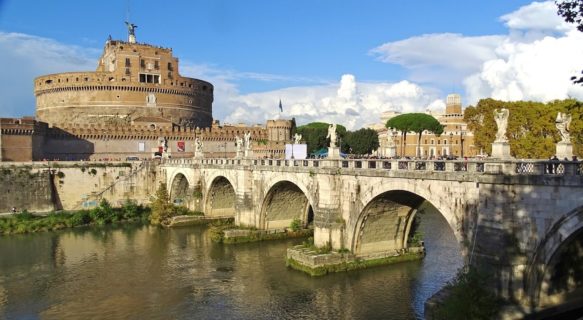
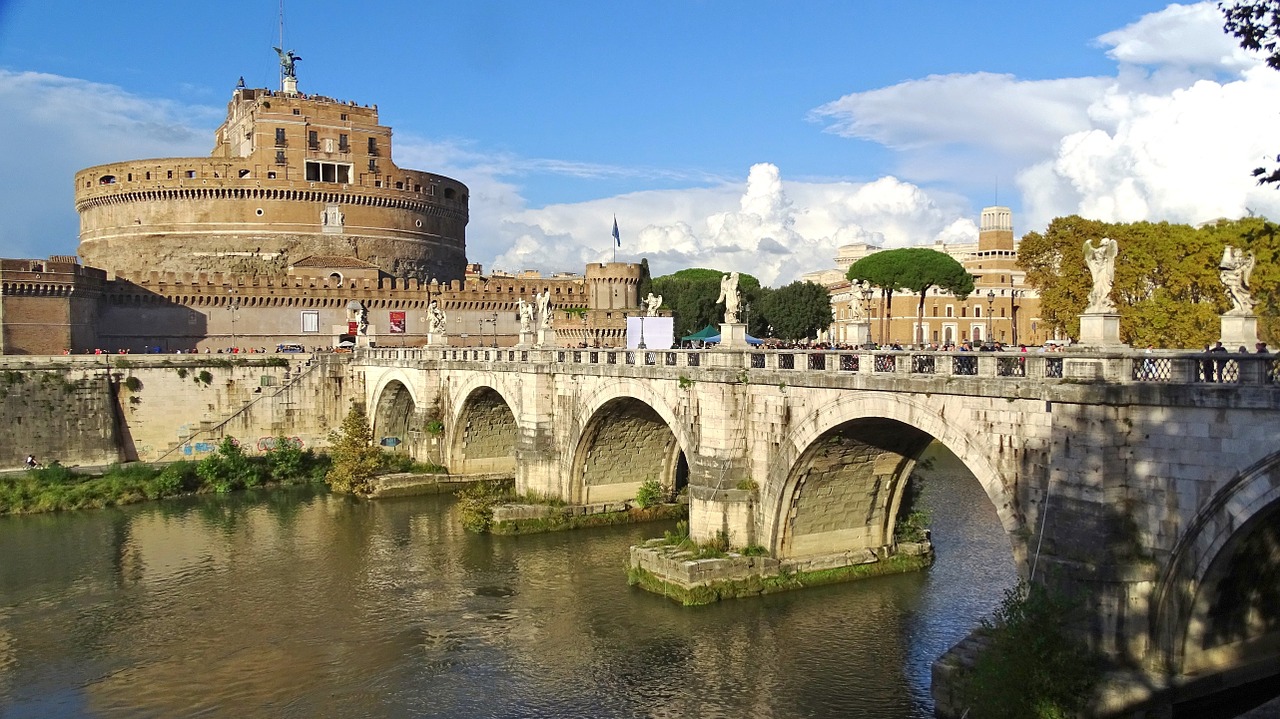
In Old Rome you must see the Pantheon, which is amazingly well preserved considering it dates back to 125 AD. There is a hole constructed in the ceiling so it is an interesting experience to be there when it is raining. If you are heading to the Pantheon from Piazza Venezia you first reach Largo di Torre Argentina on your left. Until 1926 this was covered in narrow streets and small houses, which were razed to the ground when ruins of Roman temples were discovered. Moving along Corso Vittorio Emmanuelle and crossing the Tiber river into the Vatican area you see the imposing Castel Sant’ Angelo, built as a Mausoleum for the Emperor Hadrian. This is connected by a covered fortified corridor to the Vatican and served as a refuge for Popes in times of trouble.
South of the Colosseum are the Baths of Caracalla (Aventino-Testaccio). You can then head South-East on the old Appian Way, passing through a stretch of very well-preserved city wall. For the adventurous, continuing along the Appian Way (Rome/South) will bring you to a whole host of Roman ruins, including the Circus of Maxentius, the tomb of Cecilia Metella, the Villa dei Quintili and, nearby, several long stretches of Roman aqueduct.
Returning to the Modern Center, the Baths of Diocletian are opposite the entrance to the main railway station, Termini. The National Museum of Rome stands in the South-West corner of the Baths complex and has an enormous collection of Roman sculptures and other artifacts. But this is just one of numerous museums devoted to ancient Rome, including those of the Capitoline Hill. It is really amazing how much there is.
Catholic Rome

There are more than 900 churches in Rome. Probably one third would be well worth a visit!
In Catholic tradition, St. Peter is said to have founded the church in Rome together with St. Paul. The first churches of Rome originated in places where early Christians met, usually in the homes of private citizens. By the IVth Century, however, there were already four major churches, or basilicas. Rome had 28 cardinals who took it in turns to give mass once a week in one of the basilicas. In one form or another the four basilicas are with us today and constitute the major churches of Rome. They are St Peter’s, St Paul’s Outside the Walls, Santa Maria Maggiore and San Giovanni. All pilgrims to Rome are expected to visit these four basilicas, together with San Lorenzo fuori le mura, Santa Croce in Gerusalemme, and the Sanctuary of Divino Amore. The latter was inserted as one of the seven at the time of the Great Jubilee in 2000, replacing San Sebastiano outside the walls.
Take a look inside a few churches. You’ll find the richness and range of decor astonishing, from fine classical art to tacky electric candles. Starting with several good examples of early Christian churches, including San Clemente and Santa Costanza, there are churches built over a period of 1700 years or so, including modern churches constructed to serve Rome’s new suburbs.
Some churches in Rome deny admission to people who are dressed inappropriately. You will find “fashion police” at the most visited churches. (“Knees and shoulders” are the main problem – especially female ones.) Bare shoulders, short skirts, and shorts are officially not allowed, but long shorts and skirts reaching just above the knee should generally be no problem. However, it’s always safer to wear longer pants or skirts that go below the knee; St. Peter’s in particular is known for rejecting tourists for uncovered knees, shoulders, midriffs, etc. (You also generally won’t be told until right before you enter the church, so you will have made the trek to the Vatican and stood in a long security line for nothing.) The stricter churches usually have vendors just outside selling inexpensive scarves and sometimes plastic pants. But relatively few churches enforce dress codes and you can wander into most wearing shorts, sleeveless shirts, or pretty much anything without problems. It is, however, good to keep one’s dress tasteful, as these are still churches and houses of prayer for many people. (Older Romans might comment on your attire and perhaps harass you if it is particularly revealing.)
The Seven Hills of Rome

To the modern visitor, the Seven Hills of Rome can be rather difficult to identify. In the first place generations of buildings constructed on top of each other and the construction of tall buildings in the valleys have tended to make the hills less pronounced than they originally were. Secondly, there are clearly more than seven hills. In Roman days many of these were outside the city boundaries.
The seven hills were first occupied by small settlements and not recognized as a city for some time. Rome came into being as these settlements acted together to drain the marshy valleys between them and turn them into markets and fora. The Roman Forum used to be a swamp.
The Palatine Hill looms over Circus Maximus and is accessed near the Colosseum . Legend has it that this was occupied by Romulus when he fell out with his brother, Remus, who occupied the Aventine Hill on the other side of the Circus. Also clearly recognisable as hills are the Caelian, to the southeast of Circus Maximus and the Capitoline, which overlooks the Forum and now hosts the Municipality of Rome. East and northeast of the Roman Forum are the Esquiline, Viminal, and Quirinal hills. These are less easy to distinguish as separate hills these days and from a distance look like one.

The red line on the map indicates the Servian Wall, its construction is credited to the Roman King Servius Tullius in the Sixth Century BC, but archaeological evidence places its construction during the Fourth Century BC. Small bits of this wall can still be seen, particularly close to Termini railway station and on the Aventine hill. As Rome expanded new walls were required to protect the larger area. These were built in the Third Century AD by the Emperor Aurelian. Lengthy sections of this wall remain all around the outskirts of Rome’s center. Much is in very good condition.
Among other hills of Rome, not included in the seven, are that overlooking the Vatican; the Janiculum overlooking Trastevere, which provides excellent views of Rome; the Pincio on the edge of the Borghese Gardens, which gives good views of the Vatican, and the Monte Mario to the north.
Museums
If you are in Rome for the Arts there are several world-class museums in the city. The natural starting point is a visit to the area of Villa Borghese in Rome/North Center, where there is a cluster of art museums in and around the Borghese Gardens. Galleria Borghese houses a previously private art collection of the Borghese family, Museo Nazionale di Villa Giulia is home of the world’s largest Etruscan art collection, and Galleria Nazionale d’Arte Moderna houses many Italian masterpieces as well as a few pieces by artists such as Cézanne, Degas, Monet and Van Gogh.
The Capitoline Museums in the Colosseo district opens their doors to the city’s most important collection of antique Roman and Greek art and sculptures. Visit the Galleria d’Arte Antica, housed in the Barberini palace in the Modern center, for Italian Renaissance and Baroque art.
A visit to Rome is not complete without a trip to the Vatican Museum. You need to go to the museum if you want to see the Sistine Chapel, but there is an enormous collection. You cannot miss part of this, such as tapestries, maps and the rooms painted by Rafael, as they are en route to the Sistine Chapel, but there is much, much more to explore, including a stunning Egyptian collection, and the Pinacoteca, which includes a Portrait of St. Jerome by Leonardo da Vinci and paintings by Giotto, Perugino, Raphael, Veronese and Caravaggio, to name just a few.
Rome’s National Museum at the Baths of Diocletian in the Modern Center has a vast archaeological collection as does the national museum at Palazzo Altemps, close to Piazza Navona. Further afield, the Museo di Civilta Romana (Museum of Rome’s Civilization), in EUR is most famous for an enormous model of Imperial Rome, but also has an extensive display of plaster casts, models and reconstructions of statues and Roman stonework.
If you have plenty of time there is absolutely no shortage of other museums covering a wide variety of interests. Examples include the Museum of the Walls (see Rome/South), the Musical Instrument Museum and a museum devoted to the liberation of Rome from German occupation in the Second World War (Rome/Esquilino-San Giovanni).
Check museum opening hours before heading there. Government museums are invariably closed on Mondays, so that is a good day for other activities. The Rome municipality itself operates some 17 museums and attractions. Info at [6]. These are free to European Union citizens under 18 and over 65. Web sites for other museums are listed on the relevant District pages.
Just walking around
.jpg)
Much of the attraction of Rome is in just wandering around the old city. You can quickly escape from the major tourist routes and feel as if you are in a small medieval village, not a capital city. If you can do so while watching for uneven cobblestones, keep looking upwards. There are some amazing roof gardens and all sorts of sculptures, paintings and religious icons attached to exterior walls. Look through 2nd and 3rd floor windows to see some oak-beamed ceilings in the old houses. Look through the archway entrances of larger Palazzos to see incredible courtyards, complete with sculptures, fountains and gardens. Take a stroll in the area between Piazza Navona and the Tiber river in Old Rome where artisans continue to ply their trade from small shops. Also in Old Rome, take a 1 km stroll down Via Giulia, which is lined with many old palaces. Film enthusiasts will want to visit Via Veneto (Via Vittorio Veneto) in the Modern Center, scene for much of Fellini’s La Dolce Vita.
The Piazzas
The narrow streets frequently broaden out into small or large squares (piazzas), which usually have one or more churches and a fountain or two. Apart from Piazza Navona and Piazza della Rotonda (in front of the Pantheon), take in the nearby Piazza della Minerva, with its unique elephant statue by Bernini and Piazza Colonna with the column of Marcus Aurelius and Palazzo Chigi, meeting place of the Italian Government. On the other side of Corso Vittorio Emanuele are Piazza Farnese with the Palazzo of the same name (now the French Embassy) and two interesting fountains and the flower sellers at Campo dei Fiori, scene of Rome’s executions in the old days. All of these squares are a short distance from each other in Old Rome. The enormous Piazza del Popolo in the North Center, which provided an imposing entrance to the city when it represented the northern boundary of Rome, is well worth a visit. A short walk back towards the center brings you to Piazza di Spagna at the foot of the Spanish Steps. Yet another fascinating fountain here. The area was much used as backdrop for the 1953 film Roman Holiday with Audrey Hepburn and Gregory Peck.

On the other side of the river is, of course, the magnificent square of St Peter’s at the Vatican. Further south, in Trastevere is Piazza Santa Maria in Trastevere, a great place to watch the world go by, either from one of the restaurants or bars that line two sides of the square or, if that is too expensive, from the steps of the central fountain. The square attracts many street entertainers.
Moving back to the Modern Center you have to see the Trevi Fountain, surely a part of everyone’s Roman holiday. Visitors are always amazed that such a big and famous fountain is tucked away in a small piazza in the middle of side streets. Take extra-special care of your possessions here. Further up the Via del Tritone you will come to Piazza Barberini, now full of traffic but the lovely Bernini fountain is not to be missed.
Overlooked Places
EUR provides a selection of Fascist Architecture, including the Palazzo della Civiltà Italiana, often referred to “the Square Colosseum.” It was designed to honour the historic Colosseum. This would be an interesting place to visit after seeing the Colosseum to compare their differences and similarities.
Viewpoints

With no tall buildings in Rome, views of the city come from climbing the many hills, either the original seven hills of Rome or others that surround them. The two most popular views of Rome are from the Janiculum hill overlooking Trastevere and the Pincio at the edge of the Borghese Gardens. The former, best reached by car, has sweeping views of the center of Rome, as long as the authorities remember to prune the trees on the hillside in front of the viewpoint. Cross over the piazza for an excellent view of the dome of St Peter’s. The Vatican is the main sight from the Pincio (metro Line A, Piazza del Popolo, and then a good climb). Less popular, but just as nice, is the orange grove at Parco Savello on the Aventine Hill. Even less popular among tourists, as it is better accessed by car or moped, it the small square in front of the Zodiaco Restaurant in Monte Mario, a very popular spot for young Roman couples.
Rome for kids
If you are planning some serious sightseeing then leave the kids with their grandparents! They don’t take kindly to being dragged from ruin to ruin and church to church. A common sight in Rome is miserable looking kids traipsing after their parents. Also, push chairs/buggies are difficult to use because of the cobbled streets. If you are a family, do not try to do too much. It will be a big strain on kids and in the end everyone will be tired.
Apart from the major attractions Rome has relatively little to entertain kids. If you noticed a big Ferris wheel on your way in from Fiumicino Airport, think again. Lunapark at EUR was closed down in 2008. A few of the other ways to bribe your kids, however, are:
- Children’s Museum. Via Flaminia 82. Just north of Piazza del Popolo. Controlled entrance at 10.00, 12,00, 15.00 and 17.00 for visits lasting 1 hour 45 minutes. Closed Mondays and for much of August. Best to check the web site for up-to-date info and to book in advance. Hands-on science, mainly for pre-teens, housed in a former tram-car depot.
- Bioparco. The renamed Rome Zoo. On the edge of the Borghese Gardens (North Centre).
- The Time Elevator. Via dei Santi Apostoli, 20 on a side street between Piazza Venezia and the Trevi Fountain. Daily 10.30 to 19.30. “Five-dimensional” shows on the Origins of Life and on the History of Rome, plus “The House of Horrors”. Not for the faint-hearted: your seats move all over the place. Kids love it.
- Rome’s Wax Museum. 67 Piazza di Santi Apostoli, next to Piazza Venezia. Few good reports about this museum. Comments invited.
- Planetarium. This also has an excellent astronomy museum and is conveniently next to the Museum of Rome’s Civilization (EUR).
- The Vatican is, by and large, not a great idea for kids although they often enjoy the Sistine Chapel and are impressed by the beauty and the fact that it was all done in just four years. However, the Sistine Chapel is very crowded and getting there through the corridors of the Vatican Museum is even worse. It is easy for families to get separated so determine a meeting point. The best part of St. Peter’s Basilica is that kids can go to the top of the dome. It is 500 steps but you can take the elevator up to the third floor. From there there are another 323 exhausting steps. So it is fun for older kids who can both climb up all the stairs and walk down as there is a huge line for the elevator (Vatican).
- Zoomarine. Dolphins, sea lions, exotic birds, splashy rides and swimming pools, some 20 km south of Rome near Pomezia. A good day out, but is this really why you came to Rome? Free transport from EUR and Pomezia railway station. Check web site for details.
Do
- Take in a show. There are lots of theatres, but you will need to know Italian to enjoy them. The main concert venue is the Auditorium in Viale Pietro de Coubertin to the north of Rome. The Auditorium at Parco della Musica is a large complex composed of three separate halls whose shapes are inspired by musical instruments. These are positioned around an open air amphitheatre, that is used nearly every night in the summer for concerts. The Parco della Musica hosts a constant stream of classical, popular, and jazz music, featuring national as well as international musicians and groups. Really big names perform outdoors in the summer; usually in either the Olympic Stadium or in Stadio Flaminio, which is next door to the Parco della Musica. In winter the Palalotto in EUR is an important pop concert venue.
- Walk and feel the energy of Rome; sights are everywhere waiting to be discovered.
- Walk or cycle along the banks of the Tiber. There are steps down to the river from close to most of the bridges. A few have special runners for cycle wheels. This gets you away from the traffic fumes and gives a different perspective of Rome. Not usually possible in winter when water levels can be very high.
- Explore the Trastevere neighbourhood for some great cafes and trattorie, and a glimpse at a hip Roman neighbourhood.
- Take in a game of soccer at the Olympic Stadium. Rome has two teams, A.S. Roma and S.S. Lazio and they both play at this stadium.
Events
- White Night (Notte Bianca). In early to mid-September, various events until dawn, plus shops and restaurants, museums stay open while the Roman Notte Bianca stages music, dance and theater events. Expect enormous crowds; buses and trams will be packed to the brim.
- Opera at Caracalla, Baths of Caracalla (see Rome/Aventino-Testaccio). If you are in Rome during summertime don’t miss the chance to experience a lyric opera in the truly unique setting of the Caracalla Baths. The 2009 program included Tosca, Carmen and Midsummer Night’s Dream. Performances start at 21.00.
- Festa dell’Unità (Unity Party). This is a traditional popular festival, once organized by the Italian Communist Party to promote its official newspaper l’Unità (“Unity”), and nowadays kept by the Democratic Party. Held annually in mid-June in Rome’s archaeological area, the festival has built a reputation for the great quality food stalls where people can taste for free or at low-price, a good variety of Italian food and wine. The event includes live music, cultural and literary meetings.
Learn
Rome is replete with foreign language and cultural institutions. Of course, learning Italian is a worthwhile activity if you plan to stay for any length of time. If you plan to combine a stay in Rome with academic study, there are several English-language universities.
- The regional government and two historical societies are offering free Latin classes to tourists. [7].
- The Historical Group of Rome runs a gladiator school. 18 Via Appia Antica. ph 00396 51607951. [8].
Work
If you want to work ask around at the hostels, hotels and restaurants. There are differing views on how easy it is to get a job in Rome, however. There is high unemployment and most jobs seem to go on a family – friends – other Romans – other Italians – white EU – other foreigners pecking order. Knowing Italian helps. And be wary about making any financial commitments before you’ve actually been paid — late and non-payment is common here, and you may find as a non-Roman you are more likely to be seen as an easy target for this. You will also need a permesso di soggiorno, whether or not you are an EU resident. Legally, you are required to have a working visa, although it is very easy to work and live without one.
There are numerous schools to teach the English language in Rome and if you are a mother-tongue this may be the best opportunity of picking up part-time work.
Talk
In Rome, obviously, the population speaks Italian. The road signs are mostly in Italian (except for “STOP”). If you are staying in the city there are plenty of English alternatives to be found. Seeing as Rome is a popular place to visit there are maps and information in many languages available. Police officers and transit drivers are more than willing to help you get around and usually provide easier ways to get around.
Some residents still speak the ancient local dialect, Romanesco; nowadays, however, Italian is the more common mother tongue.
English is widely spoken in Rome by the younger generations and by people working in the tourist industry. Since many people have a limited knowledge of English, it is wise to speak slowly and simply. Among 40+s the chance is a lot less, and with 60+s as good as zero.
Romance languages other than Italian, especially Spanish, Portuguese and French, are also fairly widely understood due to their similarity to Italian, although not necessarily spoken.
Buy

Rome has excellent shopping opportunities of all kinds – from clothing and jewellery to art and antiques. You also get some big department stores, outlets and shopping centres, notably in the suburbs and outskirts.
Main shopping areas include Via del Corso, Via Condotti, and the surrounding streets. The finest designer stores are around Via Condotti, whilst Via del Corso has more affordable clothing, and Via Cola di Rienzo, and the surroundings of Via del Tritone, Campo de’Fiori, and Pantheon are the places to go for cheaper items. Upim is a good shop for cheap clothing of workable quality. Some brands (like Miss Sixty and Furla) are excellent, some are not as good – be sure to feel garments and try them on. There are also great quality shoes and leather bags at prices that compare well with the UK and US. But when shopping for clothes note that bigger sizes than a UK size 16/US 12 aren’t always easy to find. Children’s clothing can be expensive with basic vests (tank tops) costing as much as €21 in non-designer shops. If you really need to buy clothiers for kids try the Oviesse chain. Summer sales in many stores begin around July 15 and Rome also has New Year sales.
As mentioned above, Via Condotti is Rome’s top haute couture fashion street (equivalent of Fifth Avenue in New York City, Via Montenapoleone in Milan, or Bond Street in London). Here, you can find big brand names such as Gucci, Armani, Dior, Valentino and Hermès, and several other high-class shops. However, the streets around the Via Condotti, such as Via Frattina, Via del Babuino, Via Borgognona and the Piazza di Spagna also offer some excellent high fashion boutiques, including Roberto Cavalli, Dolce & Gabbana, Versace, Prada and Givenchy (and several others). So once in the city, the big boutique names aren’t absent. In these luxurious streets, however, you needn’t only do clothing shopping – there are some really good and funky jewellery (e.g. Bulgari, Cartier, Tiffany’s & Co.), pen and accessory (i.e. Mont Blanc) and artsy stores peppered here and there in these streets.
If you want to spend a day in a large shopping mall, there’s the Euroma2 with about 230 shops (mainly clothes and accessories) and restaurants, to be found near the EUR district. Take Metro B line from Termini to EUR Palasport station, cross the road and take the frequent free bus (ride takes 5–15 minutes) to the mall. In addition to many shops and food, the conditioned air and free toilets may be a welcome relief if you are in Rome during mid-summer.
There are lots of fake plastic ‘Louis Vuitton’ bags being sold at the side of the road. Be aware, that buying of fake products is illegal in Italy. Fines up to €1000 have been reported. If you are happy to take the risk, make sure you haggle; unsuspecting tourists pay up to €60 for them.
If you want to buy souvenirs or gifts, a museum would be the worst choice since there are many stalls along the streets of touristic areas that offer reasonable prices. It is likely that the same item in the gift shop of any museum will cost much more.
Factory outlets
- Valmontone. A little further away from Rome than Castel Romano, you can find Valmontone outlet on the motorway towards Napoli just 50 km far from Rome. Valmontone itself is a delightful little town – 30 mins by train.
Eat
Rome is full of good restaurants, many in attractive settings, particularly when you sit outside in the evening. No one location can be recommended to search for a good restaurant: some of the best places to eat are in the most unpromising locations while well-situated restaurants can often live on their reputation rather than the quality of their food. Restaurants in guidebooks can be good but prices can be inflated because it is more than likely a “tourist trap”. To find an authentic restaurant that won’t break the bank, try to find a place in a more residential area or somewhere that isn’t in the middle of the tourist locations.
|
Eat like a Roman In Rome you can ask for:
|
Many of the good restaurants in Rome are hard to find, but a good tip is to go where Italians live and eat. On the top of the green, old mountain (Monte Verde Vecchio) there are some trattorias with authentic Italian cuisine at an affordable price. Rome also has many beautiful spots to eat, so buying some delicacies to make up a picnic can be a great experience. In Via Marmorata you find Volpetti’s which is known for its amazing selection of cheese, prosciutto and delicious pastries (and also for its prices!). A more affordable choice is to go to a local supermarket which will also have good fresh foods for lunch.
Pizza
Most pizza restaurants serve it only in the evening. Try some of the fried things like baccala (battered salt cod) for a starter, followed by a pizza for a really Roman meal. Roman pizzas tend to be very thin crusted. Avoid the tourist areas where you’ll often pay double the going rate just to get a badly reheated frozen pizza. Your best bet is to cross the river and find a restaurant in Trastevere–the food is authentic and a lot cheaper than in the rest of downtown Rome. Make sure you eat it with a fork and knife; Romans don’t eat this kind of pizza with their hands.
Pizza al Taglio is pizza with a thicker crust, cooked in a large pan. This is served by the piece, usually to take away, and is a good cheap way to get something to fill you up. Point to the one you want, indicate if you want more or less than your server is indicating with the knife. It’s sold by weight (the listed price is usually per 100 g, known as an etto, short for ettogrammo, i.e. hectogramm). This kind of pizza is eaten with the slices stacked on top of each other like a sandwich.
Ice cream
Look for a gelateria. Remember that it usually costs extra to sit inside. You pay for your ice cream first…take your receipt and go fight your way through the throng to choose your flavors (Italians don’t believe in lines). You will be asked “Panna?” when it’s almost made – this is the offer of whipped cream on top. If you’ve already paid, this is free.
There are a few signs to keep in mind: “Produzione Propria” (homemade – our own production), “Nostra Produzione” (our production), “Produzione Artigianale” (production by craftsmen). If the colors seem dull and almost ugly it is probably natural, the bright colors being just a mix. Keep in mind, Italians usually won’t queue, but if they are in line for gelato, get in line yourself: you may have hit the jackpot. Producers to try include Gelato di San Crispino; Giolitti; and Fassi.
Vegetarians
Vegetarians should have an easy time. Buffets in many restaurants usually have a good range of delicious vegetarian stuff – e.g. gratinated roast peppers/aubergines, etc. Vegans should do all right too; pizzas don’t always have cheese – a Marinara for example, is just tomato, garlic and oregano.
Kosher dining
While there is not much choice, at least Rome’s Kosher cooking is truly excellent. Try La Taverna del Ghetto in the heart of the Jewish Quarter.
More places can be found near the synagogue in via Padova, close to the “La Sapienza” university and the Bologna underground station.
Pricing
You can get cheap food in Rome, the problem is that if you don’t know the city well or are forced to eat out in the centre, the prices go up.
- €3.50 – You buy the pizza and eat it walking around, since it’s a bread shop with no sitting area. You can choose how much you want to eat, but you’ll be spending about €2 per slice + about €1.50 for a can of soda or €1 for water.
- €15-20 – At lunchtime if you go to a restaurant you’ll be spending between €15 for a set menu (not always good, try to go where you see Italian office people having their lunch as your best bet) and €20. For this you should get a pasta dish and a second course (meat) ending with coffee. Obviously if you have special wine the price will increase.
- €20 – At night you can spend about €20 at a pizza restaurant or if you have only one main course. Again, if you have special wine it will cost more. The cheapest food you can get at a decent restaurant is a pizza marinara (that is, without cheese) for about €6. The price goes up from there depending on the toppings.
- €20+ – For a sit down lunch or dinner in a restaurant €20 is cheap and if you want you can go up to €200 a head.
Chinese restaurants are still quite cheap but other ethnic restaurants (Thai, Indian) are generally expensive (think €30 upwards per person). Sushi is very expensive (€40 minimum per person).
Waiters have been known to take advantage of patrons by bringing more expensive items than what was ordered or asking for a tip although it’s not mandatory and should be included in the price by law.
Drink
Coffee
Starbucks has so far avoided Rome. And no wonder: Italian coffee is great so our friends from Seattle would face a lot of competition. A latte in Italian is just a glass of milk. If you’re expecting coffee in that glass, you should ask for a caffe latte. A latte macchiato (meaning “marked”) is steamed milk stained with a smaller shot of espresso. “Espresso” or “normale” is just that, but more commonly just referred to as caffe. Espresso doppio means a double shot of espresso, while espresso macchiato is espresso ‘marked’ with a dab of steamed milk. Americano — the one to order if you like filter coffee — is espresso diluted with hot water and not drunk much by Italians. Cappuccino is well known outside of Italy, but be warned: it is considered very un-classy, and somewhat childish, to order one after 11AM (and certainly after a meal). Decaffeinato is self-explanatory, but often referred to by the common brand-name Caffe Hag.
Wine and water
House wines are almost always drinkable and inexpensive (unlike, say, in the UK). You are better off ordering a bottle rather than house wine in most establishments in Rome due to some places watering down their wines. You may often find a bottle of wine on the table for you. Believe it or not: this bottle will be less expensive than a glass would be in the US or UK, possibly only €4 or €5. This does not always apply to those places that look really tourist-trap-like! Slightly better quality wines are usually sold at a relatively small mark-up on shop prices. Most Romans drink water with their meals. In restaurants it normally comes in 1 litre bottles and can be had normale (still water) or gassata (carbonated water).
Water is free at designated water fountains, called “nasone” (big nose). Some of these date back to ancient times, and the water is still very good. It’s fresh spring water coming from the famous underground springs of Rome and is safe to drink. If you carry an empty bottle, fill it up for the rest of the day. Look for the drinking fountain with constant running water, plug the bottom hole, and cool water will shoot up from a smaller hole on top of the tap. Don’t put your lips round the hole at the bottom, as stray dogs tend to like to get a drink.
Before dinner
Pre-dinner drinks (aperitivi) accompanied with small hors d’oeuvres (antipasti) are very popular with Romans: 1) chic yuppies in their 20s-30s crowd the area around Piazza delle Coppelle (behind the Parliament) and Piazza di Pietra (near the Chamber of Commerce); 2) younger generations sprawl around the square and streets of Campo de’ Fiori; 3) everyone sits to drink in the narrow streets behind the Pantheon (Piazza Pasquino and Via del Governo Vecchio).
Clubbing & Night Life

Given a heart for exploration, Testaccio is the place to wander for after-dinner partying on the weekends. Head down there around 11PM (take metro Line B and get off at Piramide station) and listen for music. There are usually loads of people simply walking through the streets or looking for parking. Be brave, walk in, meet some wonderful Romans. This area is best in the winter. In the summer, the dancing moves to Ostia and Fregene, 45 minutes by car from Rome, at the seaside. Many clubs in Rome close in the summer months.
Many visitors like to go on Roman pub crawls. The Colosseum Pub Crawl for example, has been throwing parties since 1999.
To the east of Termini Station, and near the first University of Rome “La Sapienza”, is the San Lorenzo district, where you will find many pubs and clubs where university students and young Romans in their twenties spend their nights. On Saturday night the streets are crowded with people moving from one pub to another. On the city side of the railway, near Santa Maria Maggiore Cathedral, are some great Irish pubs, i.e. the Fiddler’s Elbow, the oldest in Rome, where many English-speaking residents and Italian customers like to sip their pints. It’s a good place to meet Romans who speak English. Also nearby are the Druid’s Den and the Druid’s Rock .
On Via Nazionale there’s a huge and beautiful pub called The Flann o’Brien, one of the biggest in Rome. On the same street near Piazza Venezia there is another cluster of pubs including The Nag’s Head Scottish Pub. After 22.00 it’s very expensive as it becomes more like like a disco. Entrance with first drink costs €13 and drinks cost €8. Before midnight they sometimes host live music concerts. In the same area, at the beginning of Via Vittorio Emanuele II you can find The Scholar’s Lounge Irish pub with nice music. This is definitely worth a look but there is no room to dance. During winter American colleges students residents in Rome end up their highly alcoholic nights here. Also nearby there’s the Trinity College Irish Pub. Drinks are quite expensive there.
Also on Via Vittorio Emanuele, near Piazza Navona, there’s the Bulldog’s Inn English pub. DJs play very good music there and there’s room to dance, although few do. Nearby in Campo dei fiori there are several crowded pubs. Beware, there have been huge and serious fights there. In the narrow streets behind Piazza Navona there are also many places to go. Try Jonathan’s Angels in Via del Fico. Also the Abbey Theatre Irish pub [9] is a good place in Via del Governo Vecchio.
On the other side of the River Tiber (Tevere) is Trastevere district where there are many places to eat and drink. This is also a good place where to enjoy a walk in crowded streets at night. In summer time on Isola Tiberina, the island in the Tiber, temporary bar are built and there are all sorts of things to do.
Far from the center there are some other good places. The Palacavicchi in a small suburban town called Ciampino is a multi-dance room area where they play different kinds of music, mostly Latin American. You definitely need to get a cab to get there and it won’t cost less than €20. South of Ciampino Airport there is The Ice Palace for ice skating, and the Kirby’s and the Geronimo pubs. All of them are nice places. At the Geronimo pub before midnight there usually are live music concerts with many bands covering different genres. On Friday and Saturday nights after the concert they play disco music. Entrance is free and you may drink and eat as you feel. Very cool place and for every budget. Unfortunately you need a cab to get there.
Those Romans who speak fluent English usually have a great deal of confidence with tourists, so just offer them a beer and they will be glad to share with you their tip & tricks about night life in Rome.
Discos: There are many beautiful discos. Unfortunately the city is huge and it’s not very easy to find them, unless you have a very good guide.
The best way to start is from the most established ones: Piper, Gilda, Alien, all of them run by the Midra Srl. Their website is nothing to write home about but can be used to discover telephone numbers and addresses. Gilda is near the Spanish Steps, and the others not too far from Termini station. During summer they close to move to the seaside of Fregene (north of Fiumicino and Ostia) where Gilda on the Beach can be found.
A pint of beer in pubs usually costs around €6, entrance in discos around €20 with first drink included. Drinks in discos cost around €10.
Sleep

Note: Rome’s city council levies an accommodation tax. This is €2 per night per person for campsites up to three-star hotels and €6 a night for four- and five-star hotels. This fee is supposed to be for the restoration of Rome’s crumbling ruins. Apparently it can only be paid in cash.
The area to the southwest of Termini railway station has numerous large hotels; these are used in particular by groups and coach parties. On the other side of the station are many smaller, fairly inexpensive, hotels that are popular with individual travellers. Perhaps the best choice for a first-time visitor is to stay right downtown, (such as near the Pantheon). Most attractions are walking distance from there, and you will save much transportation time and leave more for enjoying the city. Hotels in the downtown area are costly, but a good apartment is a decent alternative, especially for couples and if you don’t mind cooking yourself from time to time: it will save even more of your budget.
Offering of short term apartment rentals is enormous. Many apartments can be booked directly through the owner, but most owners make arrangements via rental agencies, both large and small. When looking for a hotel or an apartment in Rome, take note that the price of accommodations varies significantly from month to month, depending on typical amount of tourists—always check prices at your accommodation for your specific dates.
Being as it is one of the world’s most popular tourist destinations, there are tons of choices for where to stay, and you will have the choice of whatever type of accommodation you wish.
|
Warning! Rome hotel touts This Rome guide is heavily frequented by business owners keen on adding their own hotel or rental agency. While the worst of them are removed on a regular basis, you should always check other reviews before committing. Many unscrupulous hotel owners are also busy creating false reviews of their accommodation on sites like Tripadvisor and Hotels.com – so tread carefully! |
Camping
There are at least three campsites near Rome, they are:
- Camping Tiber, Via Tiberina Km. 14, Prima Porta (On Rome’s ringroad, take exit No 6 Via Flaminia, if arriving by public transport, take the ground-level Roma-Nord Subway leaving from Piazza Flaminia towards Prima Porta, from there there is a free shuttle service to the Camp Site), ☎ +39 06 33610733, fax: +39 06 33612314. On the bank of the river from which it draws its name. To the north of the city. There’s a minimarket, a pool, a restaurant and a bar.
- Happy Valley (In the hills north of the city at Via Prato della Corte 1915, Prima Porta-Cassia Bis, Roma. Take exit no 5 from Rome’s ring road and head towards Cassia-Veientana. If you take public transport, take the ground-level Roma-Nord Subway leaving from Piazza Flaminia towards Prima Porta and wait for the free shuttle bus service.), ☎ +39 06-33626401, fax: +39 06-33613800. It has a pool, a bar, a restaurant and a minimarket.
Connect
- Tourist information points (PIT), open daily 9AM to 6PM
– Via del Corso, Largo Goldoni, tel.: 68136061
– Castel Sant’Angelo, Piazza Pia, tel.: 68809707
– Fori Imperiali, Piazza Tempio della Pace, tel.: 69924307
– Piazza Navona, Piazza delle Cinque Lune, tel.: 68809240
– Via Nazionale, Piazza delle Esposizioni, tel.: 47824525
– Trastevere, Piazza San Sonnino, tel.: 58333457
– San Giovanni in Laterano, Piazza San Giovanni, tel.: 77203535
– Santa Maria Maggiore, Via dell_OLmata, tel.: 4740995
– Termini (arrivals), Piazza dei Cinquecenti, tel.: 47825194
– Termini, Galleria Gommata, Terminal 4, tel.: 48906300
– Fontana di Trevi, Via Marco Mingehtti, tel.: 3782988
Respect
Romans regularly interact with foreigners and tourists; it shouldn’t be hard to find friendly help provided you know some Italian. As for most every place in Italy, just be polite and you won’t have much trouble.
If you hit someone with your luggage or shoulder while walking on a street, say “sorry” (Mi scusi): despite being very busy, Rome is not London or New York and going ahead is considered bad behaviour, while a little apology will be satisfactory.
In buses or trains, let older people have your seat if there’s no space available. The gesture will be appreciated. Romans, and Italians as well, are very chaotic while in a queue, and often “clump” without any particular order: It’s considered unpolite, but they do it anyway. Be careful while driving, as Romans often drive frantically and bend the rules to cope with the heavy traffic.
If you are a young lady, you may get “shoutouts” or wolf whistles. Don’t take offense to it, don’t react to it either. Italian men are a nice bunch and when they see an attractive lady – they call it. So if this happens to you, just stick your nose up and walk by. They are not trying to harm you.
Stay safe

Rome is generally a safe place, even for women traveling alone. However there have been rape cases around the Roma Termini train station, so be careful especially at night time. There is very little violent crime, but plenty of scams and pickpocketing that target tourists. As in any other big city, it is better if you don’t look like a tourist: don’t exhibit your camera or camcorder to all and sundry, and keep your money in a safe place. Consciousness and vigilance are your best insurances for avoiding becoming a victim of a crime in Rome. Remember, if you are pickpocketed or victim of another scam, don’t be afraid to shout, “Aiuto, al ladro!” (Help, Thief!) Romans will not be nice to the thief.
Members of the Italian public are likely to be sympathetic if you are a crime victim. Police are also generally friendly if not always helpful. Carabinieri (black uniform, red striped trousers) are military police, and Polizia (blue and grey uniform) are civilians, but they both do essentially the same thing and are equally good, or bad. If you are robbed, try to find a police station and report it. This is essential to establishing a secure insurance claim and to replace documents: the chances of it resulting in the return of your possessions are, however, fairly remote.
Rome is home to two rival Serie A soccer clubs, A.S. Roma and S.S. Lazio, and there is a history of conflict, and even rioting, between the two. Never wear anything that shows that you support either of them, especially during the Rome Derby (when the two clubs play each other): avoid even wandering into groups of supporters of the other club, or you may be subject to heckling or even confrontation. Play it safe and refrain from openly supporting either club unless you are very familiar with the rivalry. If you are a fan of a foreign team that is playing in Rome, be very careful as a number of supporters have been stabbed over the past few years.
Pickpocketing
Since Rome is incredibly popular as a tourist destination, a great deal of pickpocketing and bag or purse snatching takes place, especially in crowded locations, and pickpocketers in Rome can get pretty crafty. A 2010 study found that Rome was second only to Barcelona for pickpocketing of tourists.
As a rule, you should pretty much never carry anything very valuable in any outside pocket, especially the front pocket of your pants is one of the easiest and most common targets. Keeping your wallet in your front pocket or in your bag is far from safe. You should consider using a money belt and carry only the cash for the day in your pocket.
Pickpocketing on the Metro is rife in the form of gangs of young girls (8 to 12 years old) who jump on the trains just they are about to leave. They buffet you and have bags to hide where their hands are. You have been warned!
Also, beware of thieves—one popular technique that they use is to ride by you on a moped, slice the strap of a handbag with a knife, and ride off. They might also try to cut the bottom of your bag open and pick your wallet from the ground. Others will use the old trick of one person trying to distract you (asking for a cigarette or doing a strange dance) while another thief picks your pockets from behind. Bands of gypsy kids will sometimes crowd you and reach for your pockets under the cover of newspapers or cardboard sheets. It is generally a good idea to be extremely wary of any strange person who gets too close to you, even in a crowd. If someone is in your personal space, shove the person away. As one frequent traveller put it, “Don’t be afraid to be a dick in Rome.” It is better to be rude than to be stolen from.
Termini (the main railway station), Esquilino, bus line 64 (Termini to San Pietro), and the Trevi fountain are well known for pickpockets, so take extra care in these areas. On the Metro especially, pickpockets are extremely skilled.
Remember that hotel rooms are not safe places for valuables; if your room has no safe, give your valuables to the hotel staff for safekeeping. Even if it does have a safe, hotels normally warn that they have no liability unless items are deposited in the main safe.
Be wary while boarding or getting off the metro/train, especially if doors are about to close/closing. Thieves pretend to be helpful by pressing the ‘door open’ button for you, and while you gratefully squeeze into the train and catch your breath, they’ll sidle up to you and pick your pocket or dip into your handbag or purse.
Be aware of the danger and take the usual precautions and you should be all right.
Tourist scams
Read up on the legends concerning tourist scams. Most of them occur regularly in Rome and you will want to see them coming.
A particular scam is when some plainclothes police will approach you, asking to look for “drug money,” or ask to see your passport. This is a scam to take your money. You can scare them by asking for their ID. Guardia di Finanza (the grey uniformed ones) do customs work.
A recent scam involves men working near the Spanish Steps, around Piazza Navona, and outside of the Colosseum. They approach you, asking where you are from, and begin to tie bracelets around your wrists. When they are done they will try to charge you upwards of €20 for each bracelet. If anyone makes any attempt to reach for your hand, retract quickly. If you get trapped, you can refuse to pay, but this may not be wise if there are not many people around. Carry small bills or just change, in your wallet, so if you find yourself in cornered to pay for the bracelet, you can convince them that €1 or €2 is all you have.
When taking a taxi, be sure to remember license number written on the card door. In seconds, people have had a taxi bill risen by €10 or even more. When giving money to taxi driver, be careful.
Be careful of con-men who may approach you at tourist sights such as the Colosseum or Circus Maximus. A car may pull up next to you, and the driver asks you for directions to the Vatican. He will strike up a conversation with you while he sits in his car and tell you he is a sales representative for a large French fashion house. He will then tell that you he likes you and he would like to give you a gift of a coat worth several thousand euros. As you reach inside his car to take the bag the coat is in, he will ask you for €200 for gas, as his car is nearly empty.
Around tourist sites like the Trevi Fountain, Colosseum and the Spanish Steps there are groups mostly of men trying to sell cheap souvenirs. They may also carry roses and say they are giving you a gift because they like you, but the minute you take their ‘gift’ they demand money. They are often very insistent and often the only way to get rid of them is to be plain rude. Do the best you can to not take their “gifts” as they will follow you around asking for money. Simply saying “no” or “go away” will get them off your back until the next vendor comes up to you.
Be wary of places to change currency. Read ALL signs before changing money. Oftentimes places set up just for currency exchange will add as much as a 20% service fee on all money being traded. The shops near the Vatican have especially high service fees, whereas places near the Trevi Fountain will be more reasonable. The best bet is to change enough money before you leave your home country. There are few places around the city that are under the table and are just interested in American money. These places charge no service fee.
The best advice to avoid scams is to get way from anyone that you have never seen before who starts talking to you.
Emergencies
In an emergency, call 112 (Carabinieri), 113 (Police), 118 (medical first aid) or 115 (firemen). Carry the address of your embassy or consulate.
On anything else you may need for your rome holiday, you can contact the official help line of the Minister of Tourism 039.039.039. From Monday to Sunday, from 9.00 to 22.00, in seven languages seven days a week.
Cope
- Police. To report theft you should generally go to the Carabinieri station nearest where the theft occurred. Ask people at the scene of the crime where to go.
- Left Luggage Termini. You can leave luggage at Termini but they have a lot of security and only one X-ray machine so there can be a +100 people queue. It costs about €4 per bag (of any size) for the first 5 hours, €0.80 per bag for each hour thereafter. There’s a sign limiting bags to 20 kg each, but no facility for weighing them (that I saw) so it’s probably not enforced.
- Splashnet laundry, internet, left luggage, Via Varesi 33, 100 m west of Termini. €2 per luggage left (and 15 min of internet included).
Embassies
 Afghanistan, Via Nomentana 120 phone=, fax: +39 06 86322939.
 Australia, Via Antonio Bosio 5, ☎ +39 06 85 2721, fax: +39 06 85 272 300. M-F 8:30AM-4PM.
 Austria, Via Pergolesi 3, ☎ +39 068440141, fax: +39 06 85 43286. M-F 9AM-noon.
 Azerbaijan, Viale Regina Margherita 1, 2 piano, 00198, ☎ +39 06 85 30 55 57, fax: +39 06 85 83 14 48, e-mail: rome@mission.mfa.gov.az.
 Brazil, Piazza Navona, 14, ☎ +39 06 683-981, fax: +39 06 6880 2883, e-mail: consulado@brasilroma.it.com. M-F 9AM-17PM.
 Bulgaria, Via Pietro Polo Rubens 21, ☎ +39 06 322 46 40, +39 06 322 46 43, fax: +39 06 322 61 22, e-mail: embassy@bulemb.it. M-F 9AM-5PM.
 Canada, Via Zara 30, ☎ +39 06 44598 1, fax: +39 06 44598 2905.
 China, Via Bruxelles 56, ☎ +39 06 8413458, fax: +39 06 85352891.
 Croatia, Via Luigi Bodio 74/76, ☎ +39 06 363 07650, fax: +39 06 3630 3405, e-mail: vrhrim@mvpei.hr. M-F 09.30-12.30.
 Denmark, Via dei Monti Parioli 50, ☎ +39 06 9774 831, fax: +39 06 9774 8399, e-mail: romamb@um.dk. M-F 8AM-5:30PM.
 Egypt, Via Salaria 267, ☎ +39 06 8440-1976, fax: +39 06 855-4424, e-mail: ambegitto@yahoo.com. M-F 9AM – 17:00 PM.
 Estonia, Ambasciata di Estonia, Viale Liegi 28 int. 5, ☎ +39 06 844 075 10, fax: +39 06 844 075 19, e-mail: embassy.rome@mfa.ee. M-F 9AM-12PM.
 Finland, Ambasciata di Finlandia, Via Lisbona 3, ☎ +39 06 852 231, fax: +39 06 854 0362, e-mail: sanomat.roo@formin.fi. M-F 8AM-5:30PM.
 France, Piazza Farnese 67, ☎ +39 066 86011.
 Germany, Ambasciata di Germania, Via San Martino della Battaglia 4, ☎ +39 06 49 213-1, fax: +39 06 445 26 72, e-mail: info@rom.diplo.de.
 Greece, Ambasciata di Grecia, Via S. Mercadante 36, ☎ +39 06 853 7551, fax: +39 06 841 5927, e-mail: gremroma@tin.it.
 Hungary, Via Messina, 15 00198 Roma, ☎ +39 06 442 49938, +39 06 442 49939, fax: +39 06 442 49908, e-mail: konzulatus@tin.it.
 India, Via XX Settembre, 5, 00187 Rome (Italy), ☎ +39 06 4884642 (/3/4/5), fax: +39 06 4819539.
 Ireland, Piazza di Campitelli 3, ☎ +39 06 6979 121, fax: +39 06 6979 1231. M-F 10AM-12:30PM / 3PM-4:30PM.
 Lithuania, Viale di Villa Grazioli 9, ☎ +39 06 855 90 52, +39 06 854 04 82, fax: +39 06 855 90 53. M-F 07:00AM-05:00PM.
 Macedonia, Via Bruxelles 73/75, ☎ +39 06 8419868, +39 06 84241109, fax: +39 06 84241131, e-mail: rome@mfa.gov.mk. M-F 9AM-5PM.
 Malaysia, Via Nomentana, 297, ☎ +39 06 8415764, fax: +39 06 8555040. 09.00AM-16.00PM (no lunch break).
 Malta, Lungotevere Marzio 12, ☎ +39 06 6879990.
 Netherlands, Via Michele Mercati 8, ☎ +39 06 3228 6001, fax: +39 06 3228 6256, e-mail: nlgovrom@ambreale.tuttopmi.it. M-F 8AM-5:30PM.
 New Zealand, Via Zara 28, ☎ +39 06 441 7171, fax: +39 06 440 2984, e-mail: nzemb.rom@flashnet.it.
 Norway, Via delle Terme Deciane 7, ☎ +39 06 571 7031, fax: +39 06 571 70326, e-mail: emb.rome@mfa.no.
 Pakistan, Via Della Camilluccia 682, 00135, ☎ +39 06 36 1775, fax: +39 06 36 301 936, e-mail: pareprome1@tiscali.it. M-F 9:30AM-4:20PM.
 Poland, Via P.P.Rubens, 20, ☎ +39 06 36 20 42 00, +39 06 36 20 42 04, +39 06 36 20 42 17, fax: +39 06 32 17 89 5, e-mail: ufficio.stampa@ambasciatapolonia.it.
 Romania, Via Nicolo Tartaglia, 36, ☎ +39 06 808 45 29, +39 06 807 88 07, +39 06 808 35 37, fax: +39 06 808 49 95, e-mail: amdiroma@roembit.org. M-F 8.30 – 13.00; 14.00 – 17.30.
 Russia (Via Gaeta 5), ☎ +39 06 4941680, +39 06 4941681, fax: +39 06 491031.
 Serbia, Via dei Monti Parioli 20, ☎ +39 06 320 07 96, +39 06 320 08 90, +39 06 320 09 59, +39 06 320 08 05 (all night), fax: +39 06 320-08-68, e-mail: info@ambroma.com. telex 616-303
 Slovenia, Via Leonardo Pisano 10, ☎ +39 06 80 914 310, +39 335 80 64 552 (all night), fax: +39 06 80 81 471, e-mail: vri@gov.si.
 South Africa, Via Tanaro 14, ☎ +39 06 85 25 41. M-F 8AM-4:30PM.
 Spain, Palazzo Borghese, Largo Fontanella di Borghese 19, ☎ +39 06 684 04 011.
 Turkey, 28, Via Palestro 00185, ☎ +39 06 445 941.
 Ukraine, Via Guido d’Arezzo, 9, ☎ +39 06 841 26 30.
 United Kingdom, Via XX Settembre 80/a, ☎ +39 06 4220 0001, +39 06 4220 0001 (emergency consular help), fax: +39 06 4220 2333. Appointments only.
 United States of America, Via Vittorio Veneto 119/A, ☎ +39 06 4674 1, fax: +39 06 4882 672, +39 06 4674 2356. 8:30AM-5:30PM.
 Venezuela, Via Nicolò Tartaglia, 11, ☎ +39 06 807 97 97, fax: +39 06 808 44 10, e-mail: embve.itrom@mppre.gob.ve. M-F 9:30AM – 1:00PM; 2:00PM – 5:00PM.
Consulates
 Singapore, Via Frattina, 89, ☎ +39-06 69940398, fax: +39-06 6780586, e-mail: hcgoffice.rome@yahoo.com. M-F: 9:30AM-1PM.
Go next
- Especially if you have a rail pass, making Pompeii a day trip, while it is a very full day, is very doable. To reach Pompeii from Rome will take about 3 hours.
- Explore the Etruscan sites of Cerveteri, Tarquinia and Vulci.
- Head to Frascati, one of the historic hill towns to the South East of Rome known as the Castelli Romani. This town has been a popular destination for centuries away from the hustle and bustle of the capital, and this is still true today. Famous worldwide for its white wine, Frascati is a relaxed hill town with a slower pace of life. Just 21 km from Rome, Frascati is accessible by bus or train. Trains run from Roma Termini approximately every hour, take about 30 minutes, and cost around €2. Also in the Castelli is Castel Gandolfo, the summer residence of the Pope. The town overlooks Lake Albano, a popular weekend trip for Romans in the summer. Also accessible by bus and train but there are several interesting towns and villages in the Castelli so hiring a car for the day would be well-rewarded.
- Head to Ostia Antica, the ancient harbor and military colony of Rome. It is accessible by Metro every 30 minutes from Stazione Piramide (near the Pyramid). It is a monumental area a bit like the Colosseum district, but in Ostia Antica you can get an impression how a Roman city really looked.
- Consider a day trip to Tivoli to see the Villa d’Este with its famous and glorious fountains. Check out the Emperor Hadrian’s Villa while you are out there. Hourly trains from Tiburtina; fewer on Sundays.
- Understand the Second World War in Italy by visiting the Anzio beachhead area, the landing museum at Anzio and Monte Cassino.
- Visit Naples and the famed islands in its gulf, Capri, Ischia and Procida. Naples is 1 hour away by high speed train.
- Discover the papal city of Viterbo, well-known medieval and thermal destination (about 1 and half hours from Rome)
- Civitavecchia, the port of Rome, is the point of arrival and departure of hundreds of ships, cruises, and ferries travelling all around the Mediterranean. From here it is possible to reach Sardinia, Corsica, Sicily, Spain, France, some other small islands, and even north Africa. A good transportation system links the port to the Eternal City, e.g., see “Get in” “By train” above.
- Palestrina is a center 40 km from Rome, rich in archaeological remains from the Roman time. Among the things to see: the Pagan Temple of the Goddess ” Fortuna “, the National Archaeological Museum ( housed in the Renaissance Palazzo Barberini ), the Roman Forum and the Nilotic Mosaic.
- Canterano, a picturesque village with strange legends just a few km away.
Not so Shocking, but some superb tips for visiting Rome Video