
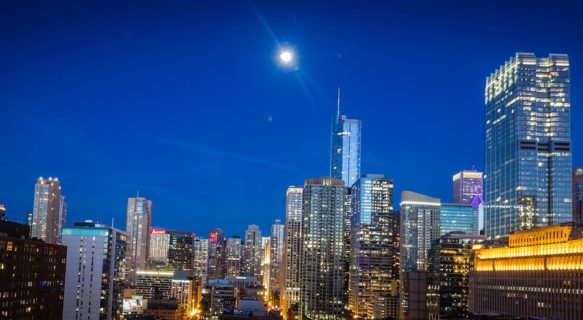
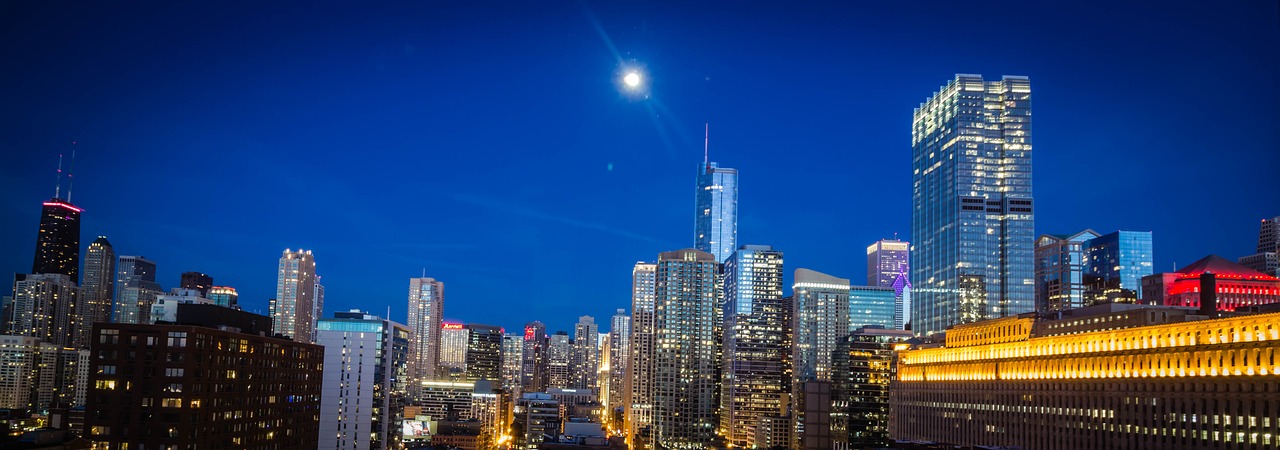
Chicago is the home of the blues and the truth of jazz, the heart of comedy and the idea of the skyscraper. Here, the age of railroads found its center, and airplanes followed suit. Butcher of hogs and believer in progress, it is one of the world’s great cities, and yet the metropolitan luxuries of theater, shopping, and fine dining have barely put a dent in real Midwestern friendliness. It’s a city with a swagger, but without the surliness or even the fake smiles found in other cities of its size.
As the hub of the Midwest, Chicago is easy to find — its picturesque skyline calls across the waters of Lake Michigan, a first impression that soon reveals world-class museums of art and science, miles of sandy beaches, huge parks and public art, and perhaps the finest downtown collection of modern architecture in the world.
With a wealth of iconic sights and neighborhoods to explore, there’s enough to fill a visit of days, weeks, or even months without ever seeing the end. Dress warm in the winter, and prepare to cover a lot of ground; the meaning of Chicago is only found in movement, through subways and archaic elevated tracks, in the pride of tired feet and eyes raised once more to the sky.
Districts
Many visitors never make it past the attractions downtown, but you haven’t truly seen Chicago until you have ventured out into the neighborhoods. Chicagoans split their city into large “sides” to the north, west, and south of the central business district (the Loop). Chicagoans also tend to identify strongly with their neighborhood, reflecting real differences in culture and place throughout the city. Rivalries between the North and South Sides run particularly deep, while people from the West Side are free agents in critical issues like baseball loyalty.

| Downtown (The Loop, Near North, Near South) The center of Chicago for work and play, with shopping, skyscrapers, big theaters, and the city’s most famous travel sights |
| North Side (Lakeview, Boystown, Lincoln Park, Old Town) Upscale neighborhoods with entertainment aplenty in storefront theaters and the Friendly Confines of Wrigley Field, along with a ton of bars and clubs, and one of the largest LGBT communities in the nation |
| South Side (Hyde Park, Bronzeville, Bridgeport-Chinatown, Chatham-South Shore) The historic Black Metropolis, brainy Hyde Park and the University of Chicago, Chinatown, the White Sox, soul food, and the real Chicago blues |
| West Side (Wicker Park, Logan Square, Near West Side, Pilsen) Ethnic enclaves, dive bars, and hipsters abound on the fashionably rough side of town |
| Far North Side (Uptown, Lincoln Square, Rogers Park) Ultra-hip and laid-back, with miles of beaches and some of the most vibrant immigrant communities in the country |
| Far West Side (Little Village, Garfield Park, Humboldt Park, Austin) So far off the beaten tourist track you might not find your way back, but that’s OK given all the great food, a couple of top blues clubs, and enormous parks. |
| Southwest Side (Back of the Yards, Marquette Park, Midway) Former home to the massive meatpacking district of the Union Stockyards, huge Polish and Mexican neighborhoods, and Midway Airport |
| Far Northwest Side (Avondale, Irving Park, Portage Park, Jefferson Park) Polish Village, historic homes and theaters, and some undiscovered gems in the neighborhoods near O’Hare International Airport |
| Far Southeast Side (Historic Pullman, East Side, South Chicago, Hegewisch) The giant, industrial underbelly of Chicago, home to one large tourist draw: the historic Pullman District |
| Far Southwest Side (Beverly, Mount Greenwood) Ireland in Chicago: authentic Irish pubs, brogues, galleries, and the odd haunted castle, all extremely far from the city center |
Understand

Chicago was known as a fine place to find a wild onion if you were a member of the Potawatomi tribe, who lived in this area of Illinois before European settlers arrived. It was mostly swamps, prairie and mud long past the establishment of Fort Dearborn in 1803 and incorporation as a town in 1833. It could be argued that nature never intended for there to be a city here; brutal winters aside, it took civil engineering projects of unprecedented scale to establish working sewers, reverse the flow of the river to keep it out of the city’s drinking supply, and stop buildings from sinking back into the swamps — and that was just the first few decades.
Chicago became a waypoint between the Great Lakes and the Wild West, where boats came to drop off settlers, and load crops and other goods from the Great Plains and the Rocky Mountains.
By 1871, the reckless growth of the city was a sight to behold, full of noise, Gothic lunacy, and bustling commerce. But on October 8, Mrs. O’Leary’s cow supposedly knocked over a lantern in the crowded immigrant quarters in the West Side, starting a roaring fire. Most likely the cow story is fiction, but whatever the real reason, the Great Chicago Fire quickly spread through the dry prairie, killing 300 and destroying virtually the entire city. The stone Water Tower in the Near North is the most famous surviving structure. But the city seized this destruction as an opportunity to rebuild bigger than before, giving canvas for several architects and urban planners who would go on to become legends of modern architecture.
At the pinnacle of its rebirth and the height of its newfound powers, Chicago was known as The White City. Cultures from around the world were summoned to the 1893 World’s Colombian Exposition, to bear witness to the work of Louis Sullivan, Daniel Burnham, and the future itself. Cream of Wheat, soft drinks, street lights and safe electricity, the fax machine, and the Ferris Wheel bespoke the colossus now resident on the shores of Lake Michigan.
As every road had once led to Rome, every train led to Chicago. Carl Sandburg called Chicago the Hog Butcher for the World for its cattle stockyards and place on the nation’s dinner plate. Sandburg also called it the City of the Big Shoulders, noting the tall buildings in the birthplace of the skyscraper — and the city’s “lifted head singing so proud to be alive and coarse and strong and cunning.” But Chicago is a city in no short supply of nicknames. Fred Fisher’s 1922 song (best known in Frank Sinatra’s rendition) calls it That Toddlin’ Town, where “on State Street, that great street, they do things they don’t do on Broadway.” It’s also referenced by countless blues standards like Sweet Home Chicago.
Chicago is also known as The Second City, which refers to its rebuilding after the fire — the current city is literally the second Chicago, after the one that disappeared in 1871. The moniker has stuck, in no small part due to its popular association with the city’s long-held former position as the United States’ second largest city. And many know the nickname from Chicago’s great comedy theater in Old Town.
Chicago’s history of corruption is legendary. During the Prohibition era, Chicago’s criminal world, emblemized by names like Al Capone, Baby Face Nelson, and later Sam Giancana, practically ran the city. The local political world had scarcely more legitimacy in a town where voter turnout was highest among the dead and their pets, and precinct captains spread the word to “vote early, vote often.” Even Sandburg acknowledged the relentless current of vice that ran under the surface of the optimistic city.
Today, Chicago is known as The Windy City. Walking around town, you might suspect that Chicago got this nickname from the winds off Lake Michigan, which shove through the downtown corridors with intense force. But the true origin of the saying comes from politics. Some say it may have been coined by rivals like Cincinnati and New York as a derogatory reference to the Chicagoan habit of rabid boosterism and endless political conventions. Others say that the term originated from the fact that Chicago politicians change their minds “as often as the wind.” Yet another saying is that the name came about because of Chicago’s long-winded politicians.
Finally, the city is known as The City That Works, as promoted by longtime Mayor Richard M. Daley, which refers to Chicago’s labor tradition, the long hours worked by its residents, and its willingness to tackle grand civic projects. Daley and his father, former Mayor Richard J. Daley, ruled the city for decades in what can only be described as a benevolent dictatorship; as other Midwestern manufacturing cities like Cleveland and Detroit went into decline, Chicago thrived, transforming from a city of stockyards and factories to a financial giant at the forefront of modern urban design. Former White House Chief of Staff Rahm Emanuel became mayor of Chicago in 2011.
While the city has many great attractions downtown, most Chicagoans live and play outside of the central business district. To understand Chicago, travelers must venture away from the Loop and Michigan Avenue and out into the vibrant neighborhoods, to soak up the local nightlife, sample the wide range of fantastic dining, and see the sights Chicagoans alone know and love — thanks to the city’s massive public transit system, every part of Chicago is only slightly off the most beaten path. The good public transport, as well as its historical (and current) role as a major rail hub make Chicago one of the places best suited for visiting the United States without a car.
Talk
As with most other American cities, English is the main language spoken in Chicago. However, Chicago is also home to large migrant populations from Latin America, and Spanish is also commonly heard. Municipal government services are generally available in both English and Spanish. Various Asian languages may be spoken at businesses in neighborhoods dominated by Asian migrants. Although there are also large ethnic Italian and Polish communities in Chicago, most of these people have already lived in the US for several generations, and as such generally do not speak their ancestral languages.
Climate
| Climate | Jan | Feb | Mar | Apr | May | Jun | Jul | Aug | Sep | Oct | Nov | Dec |
|---|---|---|---|---|---|---|---|---|---|---|---|---|
| Daily highs (°F) | 29 | 34 | 45 | 58 | 70 | 80 | 84 | 82 | 75 | 63 | 48 | 35 |
| Nightly lows (°F) | 13 | 18 | 28 | 39 | 48 | 57 | 63 | 62 | 54 | 42 | 31 | 20 |
| Precipitation (in) | 1.7 | 1.4 | 2.7 | 3.6 | 3.2 | 3.8 | 3.6 | 4.1 | 3.5 | 2.6 | 2.9 | 2.2 |

Weather is definitely not one of the attractions in Chicago. There’s a good time to be had in any season, but it is a place where the climate has to be taken into consideration.
A little-known fact: despite Chicago’s winters, there are more days with a maximum temperature of between 80-84°F (27-29°C) than any other five-degree range. Obscured by Chicago’s ferocious winters are the heat waves of summer. The days in July and August that go above the “normal” are oftentimes disgustingly hot and humid, and dewpoints can be similar to those found closer to the Gulf of Mexico. The city’s surprisingly attractive lakefront beaches can relieve some of the swelter. Summer nights are usually reasonable, though, and you’ll get a few degrees’ respite along the lakefront — in the local parlance, that’s “cooler by the lake.”
But then there are those winters. The months from December to March will see very cold temperatures, with even more bitter wind chill factors. Snow is usually limited to a handful of heavy storms per season, with a few light dustings in-between. (And a little more along the lakefront — again in the local parlance, that’s “lake effect snow”.) Ice storms are also a risk. It’s a city that’s well-accustomed to these winters, though, so city services and public transportation are highly unlikely to shut down.
That said, Chicago does have a few nice months of weather. May and September are pleasant and mild; April and June are mostly fine, although thunderstorms with heavy winds can also occur suddenly. Although there may be a slight chill in the air in October, it rarely calls for more than a light coat and some days that’s not even necessary. In some years, the warmth stored by the lake may prolong a pleasant autumn into November.
Smoking
Smoking is prohibited by state law at all restaurants, bars, nightclubs, workplaces, and public buildings. It’s also banned within fifteen feet of any entrance, window, or exit to a public place, and at CTA train stations. The fine for violating the ban can range from $100 to $250.
Tourist information
Chicago’s visitor information centers offer maps, brochures and other information.
- Chicago Water Works Visitor Information Center, 163 E Pearson Ave, toll-free: +1-877-244-2246. Jan 2-Mar 15: Sa-Su 10AM-5PM; Mar 16-May 26: Su 10AM-5PM, M-Sa 9:30AM-6PM; May 27-Sep 2: Su 10AM-6PM, M-Th 9AM-7PM, F-Sa 9AM-6PM; Sep 3-Dec 31: Su 10AM-5PM, M-Sa 9:30AM-6PM; closed Thanksgiving, Dec 25, Jan 1. The city’s main visitor information center is located on the Magnificent Mile in the historic Pumping Station, across the street from the Water Tower. In addition to extensive free visitor materials, there is a small cafe and a Hot Tix window for discount theater tickets.
- Chicago Cultural Center Visitor Information Center, 77 E Randolph St, ☎ +1-312-744-8000. Jan 2-Mar 15: Sa-Su 10AM-5PM; Mar 16-May 26: Su 10AM-5PM, M-Sa 9:30AM-6PM; May 27-Sep 2: Su 10AM-6PM, M-Th 9AM-7PM, F-Sa 9AM-6PM; Sep 3-Dec 31: Su 10AM-5PM, M-Sa 9:30AM-6PM; closed Thanksgiving, Dec 25, Jan 1. A centrally located place to pick up a host of useful, free materials. The Cultural Center itself makes a good first stop on your tour, with free, worthwhile art and historical exhibits throughout the year.
Get in

By plane
- See also: air travel in the United States
Chicago (CHI IATA for all airports) is served by two major airports: O’Hare International Airport and Midway Airport. There are plenty of taxis both to and from the city center, but they are quite expensive, especially during rush hours. Expect upwards of $40 for O’Hare and $30 for Midway. CTA trains provide direct service to both larger airports for $2.25 from anywhere in the city — faster than a taxi during rush hour and a lot less expensive. (Train rides originating at O’Hare are $5.)
Many large hotels offer complimentary shuttle vans to one or both airports, or can arrange one for a charge ($15–25) with advance notice.
O’Hare
O’Hare International Airport (ORD IATA) is 17 miles (27 km) northwest of downtown and serves many international and domestic carriers. United Airlines has the largest presence here (about 50%) followed by American Airlines with about 40%. Most connecting flights for smaller cities in the Midwest run through O’Hare. It’s one of the biggest airports in the world, and it has always been notorious for delays and cancellations. Unfortunately, it’s too far northwest for most travelers who get stuck overnight to head into the city. As a result, there are plenty of hotels in the O’Hare area. See the O’Hare article for listings.
The CTA Blue Line runs between the Loop and O’Hare at least every 15 minutes, 24 hours a day and 7 days a week. Many upgrades have recently been completed on the Blue line, and the trip from O’Hare to the Loop now takes 35–50 minutes. The O’Hare station is the end of the line and is essentially in the basement of O’Hare airport. Walking from the platform to the ticket counters should take 5–10 minutes for Terminals 2 or 3, slightly more for Terminal 1, and a great deal longer for the International Terminal 5 (It is necessary to take the free people mover for transfer).
Midway
Midway International Airport (MDW IATA) is 10 miles (16 km) southwest of downtown. Southwest Airlines is the largest carrier here. If it’s an option for your trip, Midway is more compact, less crowded, has fewer delays, and usually cheaper. And, of course, it’s significantly closer to downtown.
The CTA Orange Line train runs between the Loop and Midway in around 25 minutes. Keep in mind that the CTA Midway Station is at the end of the Orange Line. There is an enclosed tunnel that links the station and airport but it takes approximately 10–15 minutes to walk from one to the other. There are a number of hotels clustered around Midway, too — see the Southwest Side article for listings.
Others
Chicago Executive Airport (PWK IATA) is nine miles north of O’Hare, serves the general and business aviation sector, and is the third busiest airport in Illinois. Approximately three hundred aircraft are based on the field and approximately 200,000 take-offs and landings occur annually. Air taxi and air charter companies such as Jetset Charter fly a variety of private charter aircraft and jets, from charter luxury Gulfstream’s down to economical piston twins for small groups and individuals.
Milwaukee‘s General Mitchell International Airport (MKE IATA) is served by 7 Amtrak trains per day (6 on Sunday), and the Hiawatha Service has a 95% on-time rating. The trip from Chicago Union Station to Mitchell Airport Station is about one hour and 15 minutes. There are also buses from Mitchell Airport to Chicago O’Hare Airport.
By bus
- Burlington Trailways, 630 W Harrison St. 24 hours. Several daily buses headed to Davenport, Iowa City, Des Monies and Omaha at competitive prices. Onward connections to Denver.
- Greyhound, 630 W Harrison St, ☎ +1-312-408-5800. 24 hours. Very frequent service to destinations throughout the Midwest with connections to most of the US, Canada and Mexico. The main terminal is near the southwestern corner of the Loop. There are secondary terminals at the 95th/Dan Ryan red line station and the Cumberland blue line station.
- Indian Trails (at the Greyhound Station). Frequent service to East Lansing, Grand Rapids with onward destinations available. Daily service to Michigan’s Upper Peninsula connecting via Greyhound in Milwaukee. Wi-Fi and power outlets on-board.
- Megabus (bus stop located along Polk St between Clinton St and Canal St), toll-free: +1-877-462-6342. Daily service across the Midwest and also from far-flung places like Atlanta and Dallas. Buses have Wi-Fi and 110V outlets. Reservations must be made online. No tickets are available on the bus or at the bus stop.
- CoachUSA/Wisconsin Coach, O’Hare Airport, toll-free: +1-877-324-7767. Offers 14 buses daily, departing every hour, from O’Hare to Southeastern Wisconsin and Milwaukee (including Milwaukee Airport and Amtrak station), and Waukesha. ORD to Milwaukee $28.
- CoachUSA/Van Galder (Service from O’Hare Airport, Midway Airport, and Union Station), toll-free: +1-800-747-0994. Frequent bus service to Madison and Janesville Wisconsin and to Rockford and South Beloit Illinois.
By train
- See also: Rail travel in the United States

Chicago is historically the rail hub of the entire United States. Today, Amtrak, ☎ +1-800 872-7245, uses the magisterial Union Station (Canal St and Jackson Blvd) as the hub of its Midwestern routes, making Chicago one of the most convenient U.S. cities to visit by train, serving the majority of the passenger rail company’s long-distance routes, with options from virtually every major U.S. city. To this day, most coast to coast rail journeys in the U.S. require a train change in Chicago. With its massive main hall, venerable history, and cinematic steps, Union Station is worth a visit even if you’re not coming in by train.
Most (but not all) Metra suburban trains run from Union Station and nearby Ogilvie/Northwestern Station (Canal St and Madison St), which are west of the Loop. Some southern lines run from stations on the east side of the Loop. The suburban trains run as far as Kenosha, Aurora, and Joliet, while the South Shore line runs through Indiana as far as South Bend. Several CTA buses converge upon the two stations, and the Loop CTA trains are within walking distance.
By car
Chicagoans have a maddening habit of referring to some expressways by their names, not the numbers used to identify them on the signs you’ll see posted on the U.S. interstate highway system, so you’ll have to commit both name and number to memory. I-55 (the Stevenson Expressway) will take you directly from St. Louis into downtown Chicago. I-90/94 (the Dan Ryan on the South Side) comes in from Indiana to the east (via the Chicago Skyway – I-90 and Bishop Ford Freeway – I-94) and from central Illinois (via I-57). I-90 (the Kennedy on the North Side) comes in from Madison to the northwest. I-94 (the Edens Expressway) comes in from Milwaukee to the north, but recent roadwork has slowed traffic considerably compared to I-90. I-80 will get you to the city from Iowa which neighbors Illinois to the west.
The Illinois tollway (which in addition to I-90 – The Jane Addams west of O’hare airport) consists of I-88 – The Reagan which serves the west suburbs, I-355 – The Veterans Memorial which connects Joliet with Schaumburg, and I-294 – The Tri-State which bypasses downtown from the south side to the far northwest side and passes next to O’hare airport. Be prepared for toll booths off to the right hand side of the tollway which will cost about $1.50 per booth. When travelling the tollways, always have a few dollars in cash to pay at the booths, which are staffed on mainline toll plazas, but not always at exits, so always have some coins as well. If you happen to be in the I-Pass lanes as you approach a tollbooth, do not cut across the expressway to get to the cash lanes, just go through. You have up to seven days to pay tolls online. Also, if you have an E-ZPass, it is fully compatible with the I-Pass system.
If arriving downtown from Indiana, from the south on I-94 or I-90, or from the north, Lake Shore Drive (U.S. Highway 41) provides a scenic introduction in both directions, day or night. If arriving on I-55 from the southwest, or on I-290 (the Eisenhower Expressway, formerly and sometimes still called The Congress Expressway) from the west, the skyline may also be visible from certain clear spots, but without the shore view. It should also be noted that I-55 from the southwest and I-90 through much of northwest Indiana are chock full of heavy industries with odors that’ll knock your socks off, so plan your route downtown wisely.
Get around

Navigating Chicago is easy. Block numbers are consistent across the whole city. Standard blocks, of 100 addresses each, are roughly 1/8th of a mile (200 meters) long. (Hence, a mile is equivalent to a street number difference of 800.) Each street is assigned a number based on its distance from the zero point of the address system, the intersection of State Street and Madison Street. A street with a W (west) or E (east) number runs east-west, while a street with a N (north) or S (south) number runs north-south. A street’s number is usually written on street signs at intersections, below the street name. Major thoroughfares are at each mile (multiples of 800) and secondary arteries at the half-mile marks. Thus, Western Ave at 2400 W (3 miles west of State Street) is a north-south major thoroughfare, while Montrose Ave at 4400 N is an east-west secondary artery.
In general, “avenues” run north-south and “streets” run east-west, but there are numerous exceptions. (e.g., 48th Street may then be followed by 48th Place). In conversation, however, Chicagoans rarely distinguish between streets, avenues, boulevards, etc.
Several streets follow diagonal or meandering paths through the city such as Clark St, Lincoln Ave, Broadway, Milwaukee Ave, Ogden Ave, Archer Ave, Vincennes Ave, and South Chicago Ave.
By public transit
The best way to see Chicago is by public transit. It is cheap (basically), efficient (at times), and safe (for the most part). The Regional Transportation Authority (RTA) oversees the various public transit agencies in the Chicagoland area. You can plan trips online with the RTA trip planner or get assistance by calling 836-7000 in any local area code between 5AM-1AM. The RTA also has an official partnership with Google Maps, which can provide routes with public transit.
CTA
The Chicago Transit Authority (CTA) operates trains and buses in the city of Chicago and some of the suburbs. Put simply, the CTA is Chicago. It is a marvel and a beast, convenient, frustrating, and irreplaceable. Even if you have the option of driving while you’re in town, no experience of Chicago is complete without a trip on the CTA.
The CTA officially refers to its entire train system as The ‘L’. The CTA inherited the name from its predecessor agencies that ran elevated trains, but now refers to all trains, including subways, as The ‘L’. All train lines radiate from the Loop to every corner of the city. The “Loop” name originally referred to a surface-level streetcar loop, which pre-dated the elevated tracks. That any form of transportation preceded the present one may come as a surprise, given how old some of the stations look, but they work.

CTA train lines are divided by colors: Red, Green, Brown, Blue, Purple, Yellow, Orange and Pink. All lines lead to the Loop except the Yellow Line, which provides service between the suburb of Skokie and the northern border of Chicago. The Red and Blue lines run 24/7, every day of the year, making Chicago and New York City the two American cities, and one of a handful worldwide, to offer 24-hour rail service within the city. Hours for the other lines vary somewhat by the day, but as a general rule run from about 4:30AM–1AM. A few major stations have trackers noting the times when the next trains will arrive, but most do not.
Before you travel, find out the name of the train stop closest to your destination, and the color of the train line on which it is located; beware that the blue line has two stations named Western, and the green line has two stations with similar names, Ashland and Ashland/63rd. Once you’re on board, you’ll usually find route maps in each train car, above the door (although they are often stolen). The same map is also available online. The name signs on platforms often have the station’s location in the street grid, e.g. “5900 N, 1200 W” for Thorndale.
There should be an attendant on duty at every train station. They cannot provide change or deal with money, but they can help you figure out where you need to go and guide you through using the machines.

Buses run on nearly every major street in the city, and in many cases, every four blocks apart. Look for the blue and white sign, which should give a map of the route taken by the bus and major streets/stops along the way. Once inside, watch the front of the bus, a red LED display will list the names of upcoming streets where stops are located, making it easy to stop exactly where you want, even a small side street. To request a stop, pull the cord hanging above the window and make sure you hear an audible ‘ding’. Hollering at the bus driver will raise tempers but works in a pinch.
If you plan to ride only a few times during your stay, you can buy $3 CTA Single-Ride Ventra Tickets, valid for a single ride on the L or on the bus (includes two transfers). Note trips from (but not to) O’Hare airport are charged $5. If you have a NFC-enabled payment card, or a device with Android Pay, Apple Pay, or Samsung Pay, you can touch it on the reader at the turnstiles or when boarding the bus: the fare will be $2.25, or $5 from O’Hare. If you want to ride the bus, you can also pay with cash when boarding the bus, it costs $2 and you cannot buy a transfer (so you will have to pay again $2 if you board another bus).
If you plan to ride more than 4 times on a 24-hour timespan, you should buy a $10 1-day Ventra Ticket at any ‘L’ station (but not on the bus), it allows unlimited rides during the next 24 hours on the ‘L’ or the CTA buses, but not on the PACE buses (remote suburbs of Chicago) or on the Metra (suburban trains).
If you plan to ride more than 8 times on a 72-hour timespan, or more than 12 times on a 168-hour (one-week) timespan, you should buy a $20 3-day pass, or a $28 7-day pass. They can only be loaded on your personal NFC payment card (but you’ll need to have used your card at least once at a turnstile or on a bus for a single trip), or on a Ventra card which costs $5: those $5 are returned as transit value on your card if your register it within 90 days on Ventra website (it’s easy and takes about a minute), the transit value can then be used for future trips or passes. Ventra cards and passes are sold at ‘L’ stations (but not on the bus), or at one of the 1,300 retail locations. Again, the passes are not valid on PACE buses (remote suburbs of Chicago) or on the Metra (suburban trains). If you need to ride PACE buses, you can buy a $33 7-day pass that includes PACE.
In compliance with the Americans With Disabilities Act, all CTA buses and some train stations are accessible to wheelchairs. Wheelchair-accessible ‘L’ stations are indicated by the international wheelchair symbol and have elevators or are at ground level. If you are trying to get to a place with a non-accessible station, there will be alternate routes by bus so contact the CTA for more information.
Crime on the CTA is low, but as with any major urban area, travelers should be aware of their surroundings, especially when traveling in the wee hours of the night, and sit close to the driver if you feel uncomfortable for any reason. Buses are being equipped with video cameras as the fleet is upgraded. Some train cars have a button and speaker for emergency communication with the driver, located in the center aisle of the car on the wall next to the door. This is for emergencies only: do not press this just to chat, as the driver is required to halt the train until the situation has been confirmed as resolved, and your fellow passengers will not be amused.
Metra and South Shore


Metra, ☎ +1-312-322-6777, runs commuter trains for the suburbs, providing service within Illinois, to Kenosha, Wisconsin, out west, and to the far south and southwest suburbs. Metra trains are fast, clean, and punctual, but unpleasantly crowded during rush hour. Generally, every car or every other car on the train has a bathroom.
Metra’s Electric Line provides service to the convention center (McCormick Place), Hyde Park (Museum of Science and Industry, University of Chicago), and the Far Southeast Side‘s Pullman Historic District and Rainbow Beach. The Electric Line is fast, taking at most 15 minutes to reach Hyde Park from the Loop. Unfortunately, service outside of rush hours is infrequent (about once/hour), so be sure to check the schedules while planning your trip.
The Northern Indiana Commuter Transit District (NICTD), ☎ +1-219-926-5744 operates the South Shore Line railroad. The South Shore Line railroad runs commuter trains between the Millennium Park Metra station in downtown Chicago and the South Bend, Indiana airport. South Shore trains cannot carry passengers whose journey is entirely within the State of Illinois, except to and from the Hegewisch station on Chicago’s far southeast side. Although the South Shore Line receives some subsidies from Metra, it is not part of the Metra system and does not accept Metra or CTA tickets.
Although there are plans to change this in the future, none of the commuter trains currently accept CTA fare cards as payment. From downtown Chicago, the Metra fare to McCormick Place is $3.50 and the fare to Hyde Park is $3.75. Buy your tickets before boarding the train at a window or one of the automated vending machines. You can buy a ticket on the train, but that comes with an extra $5/ticket surcharge if the station you’re leaving from had an open ticket window or an operational ticket machine. If you have a smartphone, you can download and use the Ventra app to purchase a ticket on the train and avoid a surcharge.
Ten-ride, weekly, and monthly passes are available. If you have a group of four or more people, it may be cheaper to purchase a ten-ride card and have all of your fares punched from that one card. If using Metra on Saturday and/or Sunday, you can purchase an unlimited ride weekend pass for just $8. If you buy your ticket at a station, you can use cash or credit. If you buy your ticket on the train, you can use cash or the Ventra app if you have a smartphone. Credit cards are not accepted on the train.
Pace
Pace runs buses in the suburbs, although some routes do cross into the city, particularly in Rogers Park at the Howard (Red/Purple/Yellow Line) CTA station and the Far Northwest Side at the Jefferson Park (Blue Line) CTA station. In addition to its regular fixed-route service, Pace provides two types of paratransit services within the areas served by Pace and the CTA. ADA Paratransit Service is provided to passengers who have been previously certified as disabled. Call-n-Ride service is provided in some suburban areas where there is insufficient demand to justify regularly scheduled service. Call-n-Ride passengers must call in advance to arrange pickup and drop-off.
The standard Pace bus fare is $1.75. This may be paid in cash (no change provided) or by using a Ventra Card. Ventra Cards may be loaded with cash (“transit value”), 7-day and 30-day CTA/Pace passes, and 30-day Pace passes. Pace accepts transfers from the CTA by passengers using a Ventra Card for the same fee as the CTA charges (25 cents for the second ride and free for the third ride within two hours). Conversely, passengers paying with a Ventra Card receive transfer privileges onto CTA buses and trains under the same terms.
By car
Avoid driving in downtown Chicago if at all possible. Traffic is awful, pedestrians are constantly wandering into the street out of turn, and garages in the Loop can cost as much as $40 per day. And although downtown streets are laid out on the grid, many have multiple levels which confuse even the most hardened city driver. Even outside of the city center, street parking may not be readily available. If you do find a spot, check street signs to make sure that a) no residential permit is required to park here and b) parking is not disallowed during certain hours for “street cleaning”, rush hour or something along those lines. Parking restrictions are swiftly and mercilessly enforced in the form of tickets and towing — be especially wary during snowy weather.
Parking is handled by one-per-block kiosks, which will issue a slip for you to put in your front window. The kiosks will accept cash or credit cards. If the kiosk fails for any reason (such as the printer running out of paper), there should be a phone number to call to report it and ensure you don’t receive an undeserved ticket. As you do, any passing Chicagoan will be happy to commiserate about how badly the city bungled privatizing the parking meters.
Be advised: talking on a handheld cell phone while driving is illegal in Chicago, and the police are eager to write tickets for it. If you need to take a call, use a hands-free headset — or better yet, pull over.
The perpetual construction is bad enough, but drivers on the city expressways can be very aggressive. For those used to driving on expressways in the Northeast, this may be a welcome reminder of home. For everyone else, though, it can be intimidating.
By taxi
|
Your Name Here As if determined to shake off the burden of a world-class cultural heritage, Chicago has always found ways to undercut its own treasures in exchange for a quick buck. Of late, “naming rights” are all the rage; while official city tourism guides rush to comply, using the new names will earn an eye roll or an oblivious look from most Chicagoans (and cab drivers). A few of the worst offenders:
|
Chicago has some of the cheapest taxi fares in the U.S. Taxis can be hailed from the street throughout the major tourist areas, and are strictly regulated by the city. Fares are standard and the initial charge (“flag pull”) is $2.25 for the first 1/9 mile, then $0.20 for each additional 1/9 mile or $0.20 for each elapsed 36 seconds. There is a $1.00 fuel surcharge added to the initial charge. There is also a flat $1.00 charge for the second passenger, and then a $0.50 charge for each additional passenger after that (for example, if four people take a taxi together, there will be $2.00 in additional flat fees). There is no additional charge for baggage or credit card use. Rides from O’Hare and Midway to outer suburbs cost an additional one half the metered fee. Give the driver the nearest major intersection to which you are heading (if you know it) and then the specific address.
Outside of the downtown, North Side, Near West and Near South neighborhoods, you will likely have greater difficulty hailing a taxi directly from the street. In these situations, you can call for a taxi to come pick you up. Taxis typically take 10–15 minutes from the time you call to arrive. The principal companies are:
- American-United Taxi, ☎ +1-773-248-7600.
- Checker Cab, ☎ +1-312-243-2537.
- Universal Taxi, ☎ +1-888-344-8294.
- Flash Cab, ☎ +1-773-561-1444.
The above applies only to Chicago taxis. Suburban taxi cabs have their own fares and rates, depending on the laws and regulations of the town in which they are based.
By bicycle
Chicago has a bike path along the shores of Lake Michigan, making north-south travel very convenient as long as the weather is favorable by the lake. Most major city streets have bike lanes, and the biking culture is established enough that cars tend to accommodate and (grudgingly) yield to bicycles. Bike trips can also be combined with rides on the CTA, and Chicago’s new bike-sharing program DIVVY has docks located near many major stations. See the bicycling section below for more details.
By water taxi
In the summer, water taxis are sometimes more convenient than the CTA, if you are traveling around the fringes of downtown. They are also a relatively cheap way to take in some offshore views. Two private companies operate water taxi services around the Loop.
Chicago Water Taxi (Wendella Boats) ☎ +1-312-337-1446, uses yellow boats and has seven stops connecting Ogilvie/Union Metra station to Michigan Ave, Chinatown, and Goose Island ($5 single ride, $9 all day pass, $20 ten-ride pass). Taxis run roughly M-F 6:30AM–8:30PM, Sat-Sun 10AM–9:30PM.
Shoreline Sightseeing ☎ +1-312-222-9328, has blue and white boats. It is more expensive ($5–7), but it serves seven destinations including some on Lake Michigan (Union Station/Sears Tower, Wells & Wacker, Michigan Ave Bridge, Navy Pier-Ogden Slip, Navy Pier-Dock St, Buckingham Fountain, and Museum Campus). Shoreline taxis run 10AM-6PM every twenty minutes and 6PM-9PM every half hour Memorial Day–Labor Day, with occasional and less frequent service in the spring and fall.
See
Itineraries
- Along the Magnificent Mile — one day and night in Chicago, with skyscrapers, shopping, food, parks, and amazing views of the city from high and low.
- Loop Art Tour — a 2 to 4 hour walking tour of downtown Chicago’s magnificent collection of modern sculptures.
Museums

Chicago’s set of museums and cultural institutions are among the best in the world. Three of them are located within a short walk of each other in the Near South, on what is known as the Museum Campus, in a beautiful spot along the lake: the Adler Planetarium, with all sorts of cool hands-on space exhibits and astronomy shows; the Field Museum of Natural History, which features SUE, the giant Tyrannosaurus Rex skeleton, and a plethora of Egyptian treasures; and the Shedd Aquarium, with dolphins, whales, sharks, and the best collection of marine life east of California. A short distance away, in Hyde Park, is the most fun of them all, the Museum of Science and Industry — or, as generations of Chicago-area grammar school students know it, the best field trip ever. The Museum of Science and Industry has a transportation exhibit and a weather exhibit. Visitors can even control a tornado with the joystick controller desk. In Loop, the Art Institute of Chicago has a handful of iconic household names among an unrivaled collection of Impressionism, modern and classical art, and tons of historical artifacts. Just one block east of the historic Water Tower in the Near North is the Museum of Contemporary Art which features paintings, sculpture, film and photography produced since 1945.
Also, Chicago has some knockout less well-known museums scattered throughout the city like the International Museum of Surgical Science in Gold Coast, Chicago History Museum in Lincoln Park, DuSable Museum of African American History in Washington Park, National Museum of Mexican Art in Pilsen, the Polish Museum of America in Wicker Park, the Museum of Photography in the Loop, and the Driehaus Museum in Near North. The University of Chicago, in Hyde Park, has several cool (and free) museums that are open to all visitors, showcasing a spectacular collection of antiquities and modern/contemporary art.
Discount packages like the Chicago CityPASS can be purchased before you arrive in town. They cover admission to some museums and other tourist attractions, allowing you to cut to the front of lines, and may include discounts for restaurants and shopping. Also, programs such as Bank of America’s Museums to Go offer free admission at multiple Chicago museums for designated times which can save you a small fortune on admission fees.
Architecture
See the Chicago skyline guide to find out more about the city’s skyscrapers.

From the sternly classical to the space-age, from the Gothic to the coolly modern, Chicago is a place with an embarrassment of architectural riches. Frank Lloyd Wright fans will swoon to see his earliest buildings in Chicago, where he began his professional career and established the Prairie School architectural style, with numerous homes in Hyde Park/Kenwood, Oak Park, and Rogers Park — over 100 buildings in the Chicago metropolitan area! Frank Lloyd Wright learned his craft at the foot of the lieber meister, Louis Sullivan, whose ornate, awe-inspiring designs were once the jewels of the Loop, and whose few surviving buildings (Auditorium Theater, Carson Pirie Scott Building, one in the Ukrainian Village) still stand apart.
The 1871 Chicago Fire forced the city to rebuild. The ingenuity and ambition of Sullivan, his teacher William Le Baron Jenney (Manhattan Building), and contemporaries like Burnham & Root (Monadnock, Rookery) and Holabird & Roche/Root (Chicago Board of Trade) made Chicago the definitive city of their era. The world’s first skyscrapers were built in the Loop as those architects received ever more demanding commissions. It was here that steel-frame construction was invented, allowing buildings to rise above the limits of load-bearing walls. Later, Mies van der Rohe would adapt Sullivan’s ethos with landmark buildings in Bronzeville (Illinois Institute of Technology) and the Loop (Chicago Federal Center). Unfortunately, Chicago’s world-class architectural heritage is almost evenly matched by the world-class recklessness with which the city has treated it, and the list is long of masterpieces that have been needlessly demolished for bland new structures.

Today, Chicago boasts four out of America’s ten tallest buildings: the Sears Tower (2nd), the Trump Tower (3rd), the Aon Center (6th), and the local favorite, the John Hancock Center (7th). For years, the Sears Tower was the tallest building in the world, but it has since lost the title. Various developers insist they’re bringing the title back with proposed skyscrapers. Until they do, Chicago will have to settle for having the second-tallest building in the Western Hemisphere with the Sears Tower, although the Hancock has a better view and is quite frankly better-looking.
Chicago is particularly noted for its vast array of sacred architecture, as diverse theologically as it is artistically. There were more than two thousand churches in Chicago at the opening of the twenty-first century. Of particular note are the so-called Polish Cathedrals like St. Mary of the Angels in Bucktown and St. Hyacinth Basilica in Avondale, as well as several treasures in Ukrainian Village — beautifully crafted buildings with old world flourishes recognized for their unusually large size and impressive scope.
Architectural tours cover the landmarks on foot and by popular river boat tours, or by just standing awestruck on a downtown bridge over the Chicago River; see individual district articles for details. For a tour on the cheap, the short trip around the elevated Loop train circuit (Brown/Purple Lines) may be worth every penny of the $2 fare.
African-American history
Chicago’s African-American history begins with the city’s African-American founder, Jean Baptiste Pointe du Sable. Born to a Haitian slave and a French pirate, he married a woman from the Potawatomi tribe, and built a house and trading post on the Chicago River on the spot of today’s Pioneer Court (the square just south of the Tribune Tower in the Near North). Du Sable lived on the Chicago River with his family from the 1770s to 1800, when he sold his house to John Kinzie, whose family and friends would later claim to have founded the city.
Relative to other northern cities, African-Americans constituted a fairly large part of Chicago’s early population because of Illinois’ more tolerant culture, which was inherited from fervent anti-slavery Mormon settlers. As a non-slave state generally lacking official segregation laws, Illinois was an attractive place to live for black freedmen and fugitive slaves.
By the 1920s, Chicago had a thriving middle class African-American community based in the Bronzeville neighborhood, which at the time became known as “The Black Metropolis,” home to a cultural renaissance comparable to the better-known Harlem Renaissance of New York. African-American literature of the time was represented by local poetess Gwendolyn Brooks and novelist Richard Wright, most famous for his Native Son, nearly all of which takes place in Chicago’s Bronzeville and Hyde Park/Kenwood. The Chicago school of African-American literature distinguished itself from the East Coast by its focus on the new realities of urban African-American life. Chicago became a major center of African-American jazz, and the center for the blues. Jazz great Louis Armstrong got his start there; other famous black Chicagoans of the day included Bessie Coleman — the world’s first licensed black pilot, the hugely influential African-American and women’s civil rights activist Ida B. Wells, the great pitcher/manager/executive of Negro League Baseball Andrew “Rube” Foster, and many more.
Both fueling and threatening Chicago’s black renaissance was the single most influential part of Chicago’s African-American history: the Great Migration. African-Americans from the rural South moved to the industrial cities of the North due to the post-WWI shortage of immigrant industrial labor, and to escape the Jim Crow Laws and racial violence of the South. The massive wave of migrants, most from Mississippi, increased Chicago’s black population by more than 500,000. With it came southern food, Mississippi blues, and the challenges of establishing adequate housing for so many recent arrivals — a challenge that they would have to meet themselves, without help from a racist and neglectful city government.
Black Chicago’s renaissance was brought to its knees by the Great Depression; its fate was sealed ironically by the 1937 creation of the Chicago Housing Authority, which sought to build affordable public housing for the city. However well-intentioned the project may have sounded, the results were disastrous. The largest housing projects by far were the 1940 Ida B. Wells projects, which were designed to “warehouse” Chicago’s population of poor African-Americans in a district far away from white population centers, the Cabrini Green projects, which developed a reputation as the most violent housing projects in the nation, and the massive 1962 Robert Taylor Homes in Bronzeville, which were forced to house an additional 16,000 people beyond their intended 11,000 capacity. The Black Metropolis proved unable to cope with this massive influx of new, impoverished residents, and the urban blight that came from concentrating such a great number of them in one place.
Further damaging to Chicago’s black population was the phenomenon of “white flight” that accompanied the introduction of African-Americans to Chicago neighborhoods. Unwilling to live beside black neighbors, many Chicagoans fled desegregation to the suburbs. This trend was accelerated by the practice of “blockbusting,” where unsavory real estate agents would fan racist fears in order to buy homes on the cheap. As a result, Chicago neighborhoods (with the notable exceptions of Hyde Park/Kenwood, and Rogers Park) never truly integrated, and the social, educational, and economic networks that incoming African-Americans hoped to join disintegrated in the wake of fleeing white communities. During this period, Chicago experienced a huge population loss and large sections of the city became covered with vacant lots, which in turn created the conditions for crime to flourish. A number of Chicago’s major roads, most notably the Dan Ryan Expressway, were built in part to segregate these areas from more prosperous ones like the Loop.
In 1966, Dr. Martin Luther King, Jr. decided to come north and chose Chicago as his first destination. However, from the moment of his arrival on the Southwest Side, King was utterly confounded. The death threats that followed his march through Marquette Park were challenge enough, but nowhere in the South was there a more expert player of politics than Chicago’s Mayor Richard J. Daley. King left town frustrated and exhausted, but Rev. Jesse Jackson continued civil rights efforts in Chicago through his Operation PUSH. The 1983 election of Mayor Harold Washington, the first black mayor of Chicago, was a watershed event for Chicago’s African-American population, and although long battles with obstructionist white politicians lay ahead, it marked the moment when African-American elected officials became major, independent forces in Chicago.
Today, comprising well over a third of the city, Chicago’s black population is the country’s second largest, after New York. The broader South Side is the cultural center of Chicago’s black community; it constitutes the largest single African-American neighborhood in the country and boasts the nation’s greatest concentration of black-owned businesses. Chicagoans ignorant of these areas may tell you that they are dangerous and crime-ridden, but the reality is much more complex. There are strong, middle and upper class black communities throughout the city, some of the more prominent of which include upper Bronzeville, Hyde Park/Kenwood, Chatham, South Shore, and Beverly.
Bronzeville is the obvious destination for those interested in African-American history, although Kenwood also boasts interesting recent history, as it has been (or is) home to championship boxer Muhammad Ali, Nation of Islam leaders Elijah Muhammad and Louis Farrakhan, and President Barack Obama. No one should miss the DuSable Museum of African-American History in Bronzeville, the first museum of African-American history in the United States. And if your interest is more precisely in African-American culture than history, head down to Chatham and South Shore to enter the heart of Chicago’s black community.
Ethnic neighborhoods

Chicago is among the most diverse cities in America, and many neighborhoods reflect the character and culture of the immigrants who established them. Some, however, do more than just reflect: they absorb you in a place that, for several blocks at a time, may as well be a chunk of another country, picked up and dropped near the shores of Lake Michigan. The best of Chicago’s ethnic neighborhoods are completely uncompromised, and that makes them a real highlight for visitors.
Chicago’s Chinatown is among the most active Chinatowns in the world. It even has its own stop on the CTA Red Line. It’s on the South Side near Bridgeport, birthplace of the Irish political power-brokers who have run Chicago government for most of the last century. More Irish communities exist on the Far Southwest Side, where they even have an Irish castle to seal the deal. The Southwest Side houses enormous populations of Polish Highlanders and Mexicans, as well as reduced Lithuanian and Bohemian communities.
No serious Chicago gourmand would eat Indian food that didn’t come from a restaurant on Devon Avenue in Rogers Park. It’s paradise for spices, saris, and the latest Bollywood flicks. Lawrence Avenue in Albany Park is sometimes called Seoul Drive for the Korean community there, and the Persian food on Kedzie Avenue nearby is simply astonishing. At the Argyle Red Line stop, by the intersection of Argyle and Broadway in Uptown, you’d be forgiven for wondering if you were still in America; Vietnamese, Thais, and Laotians share space on a few blocks of restaurants, grocery stores, and even dentists. Neither the Swedish settlers who built Andersonville or the Germans from Lincoln Square are the dominant presence in those neighborhoods any more, but their identity is still present in restaurants, cultural centers, and other small discoveries to be made. Likewise, Little Italy and Greektown on the Near West Side survive only as restaurant strips.
A more contemporary experience awaits in Pilsen and Little Village, two neighborhoods on the Lower West Side where the Spanish signage outnumbers the English; in fact, Chicago has the second largest Mexican and Puerto Rican populations outside of their respective home countries. Pilsen and its arts scene is an especially an exciting place to visit.
It’s hard to imagine displacement being a concern for the Polish community on the city’s Far Northwest and Southwest sides. The Belmont-Central business district is what you might consider the epicenter of Polish activity. Bars, restaurants, and dozens of other types of Polish businesses thrive on this strip, and on a smaller section of Milwaukee Avenue (between Roscoe and Diversey) in the vicinity of St. Hyacinth Basilica which bears the Polish name of Jackowo– Chicago’s Polish Village. Polish Highlanders, or Górals, on the other hand dominate the city’s Southwest Side with a cuisine and culture that is decidedly Balkan. A host of restaurants and cultural institutions visibly display the rustic touch of their Carpathian craft such as the Polish Highlanders Alliance of North America at Archer Avenue just northeast of its intersection with Pulaski Road.Taste of Polonia, held over Labor Day weekend on the grounds of the Copernicus Foundation at the historic Gateway Theatre, draws an annual attendance of about 50,000 people and is touted as the city’s largest ethnic fest.
Do
Beaches
Chicago is not known as a beach destination, but Lake Michigan is the largest freshwater lake located entirely within the United States, and Chicagoans flock to its sandy shores. Anyone can show up and swim — there are no admission fees, miles of beaches are within walking distance of the Red Line, and almost none of the lakefront is spoiled by “private” beaches. Despite the latitude, the water is quite warm in the summer and early fall (check with the NWS for temperatures). The Chicago shore has been called the second cleanest urban waterfront in the world, although bacteria levels in the water do force occasional — but rare — beach closures (which are clearly posted at the beach, and online). Lifeguards will be posted (usually in a rowboat) if the beach is officially open.
Oak Street Beach and North Avenue Beach (in the Near North and Lincoln Park) are the fashionable places to sun-tan and be seen, but Rogers Park has mile after mile of less pretentious sand and surf. Hyde Park’s Promontory Point is beautiful, and offers skyline views from its submerged beach by the rocks (although a swim there is technically against city rules). Hollywood Beach in Edgewater is the main gay beach.
Navy Pier was built in 1914 and served as a naval base during both world wars. It is now Illinois’ number one most visited tourist attraction (ahead of some boring exurban megamalls). The pier has carnival rides, including the popular ferris wheel, as well as theater, restaurants, arcades, bars, shops, and most importantly great views back towards the city.
Parks

Where there are beaches, there are lakefront parks. During the summer months, the parks are a destination for organized and impromptu volleyball and soccer games, chess matches, and plenty more, with tennis and basketball courts dotted along the way.
In the Loop, Grant Park hosts music festivals throughout the year, and Millennium Park is a fun destination for all ages, especially during the summer.
Lincoln Park stretches for seven miles along the lakefront, with numerous bicycle paths, beaches, harbors and museums. Situated just east of the Lincoln Park neighborhood is the cheerful (and free) Lincoln Park Zoo which welcomes visitors every day of the week, with plentiful highlights like the Regenstein Center for African Apes. There are also terrific parks further away from the lake. In Hyde Park, Midway Park offers skating, and summer and winter gardens in the shadow of the academic giant, the University of Chicago, and Jackson Park has golf, more gardens and the legacy of the city’s shining moment, the 1893 World’s Colombian Exposition. In Bronzeville, Washington Park is one of the city’s best places for community sports. And that’s just a brief overview. Almost every neighborhood in Chicago has a beloved park.
Events & festivals

If you’re absolutely determined and you plan carefully, you may be able to visit Chicago during a festival-less week. It’s a challenge, though. Most neighborhoods, parishes, and service groups host their own annual festivals throughout the spring, summer, and fall. There are a few can’t-miss citywide events, though. In the Loop, Grant Park hosts Taste of Chicago in July, and four major music festivals: Blues Fest and Gospel Fest in June, Lollapalooza in August, and Jazz Fest over Labor Day Weekend. All but Lollapalooza are free. The Chicago-based music website Pitchfork Media also hosts their own annual three day festival of rock, rap, and more in the summer at Union Park on the Near West Side.
- Open House Chicago: 14–15 October 2017 . Many down-town private buildings open free to the public for two days. Some real architectural treats. On the day get the event newspaper and map. Be prepared for lines at the popular destinations.
Sports
With entries in every major professional sports league and several universities in the area, Chicago sports fans have a lot to keep them occupied. The Chicago Bears play football at Soldier Field in the Near South from warm September to frigid January. Since the baseball teams split the city in half, nothing seizes the Chicago sports consciousness like a playoff run from the Bears. Aspiring fans will be expected to be able to quote a minimum of two verses of the Super Bowl Shuffle from memory, tear up at the mention of Walter Payton, and provide arguments as to how Butkus, Singletary, and Urlacher represent stages in the evolution of the linebacker, with supporting evidence in the form of grunts, yells, and fists slammed on tables.
The Chicago Bulls play basketball at the United Center on the Near West Side. While quality of play and ticket prices may never again reach Jordan-era mania, they’re still an exciting team to watch, led by Chicago native Dwyane Wade in the twilight of his career. The Chicago Blackhawks share quarters with the Bulls. As one of the “Original Six” teams in professional hockey, the Blackhawks have a long history in their sport, and the team is experiencing a renaissance after capturing the Stanley Cup in 2010 for the first time in 49 years. Home games for both teams tend to sell out, but tickets can usually be found if you check around. Both the Bulls and the Blackhawks play from the end of October to the beginning of April.
It’s baseball, though, in which the tribal fury of Chicago sports is best expressed. The Chicago Cubs play at Wrigley Field on the North Side, in Lakeview, and the Chicago White Sox play at Guaranteed Rate Field (Comiskey Park, underneath the corporate naming rights) on the South Side, in Bridgeport. Both franchises have more than a century’s worth of history, and both teams play 81 home games from April to the beginning of October. Everything else is a matter of fiercely held opinion. The two three-game series when the teams play each other are the hottest sports tickets in Chicago during any given year. If someone offers you tickets to a game, pounce.
There are plenty of smaller leagues in the city as well, although some play their games in the suburbs. In soccer, the Chicago Fire (Major League Soccer) and Chicago Red Stars (National Women’s Soccer League) play at Toyota Park in the suburb of Bridgeview, near the Southwest Side of Chicago. In basketball, the Chicago Sky (WNBA, women) play at Allstate Arena in the suburb of Rosemont, and the Windy City Bulls play in another suburb, Hoffman Estates, as the top minor-league team of the NBA’s Bulls. Allstate Arena is also home to the Chicago Wolves minor league hockey team, but will no longer host the Sky after its 2017 season; that team will move to the new Wintrust Arena at McCormick Place in 2018. The Windy City Rollers skate flat-track roller derby in neighboring Cicero.
While college athletics isn’t one of Chicago’s strong points, the city and the immediate area do host several NCAA Division I schools:
- Northwestern Wildcats. Representing Northwestern University in seven men’s and 10 women’s sports in the Big Ten Conference. Notably, it’s the only Division I school in the immediate Chicago area that plays football. The football team shows occasional signs of life, making bowl games about as often as not. Virtually all sports facilities are at the school’s main campus in Evanston, which is immediately to the north of the city limits along the lake. The men’s basketball team will play at Allstate Arena for the 2017–18 season during renovation of the school’s on-campus arena.
- DePaul Blue Demons. Representing DePaul University in seven men’s and eight women’s sports in the Big East Conference. While most of the athletic facilities are on or near the school’s Lincoln Park campus, the men’s and women’s basketball teams will move to the aforementioned Wintrust Arena for the 2017–18 season.
- Loyola Ramblers. Representing Loyola University Chicago in seven men’s and eight women’s sports, mostly in the Missouri Valley Conference. Most sports venues are on or near the Rogers Park campus; unlike DePaul, the men’s basketball team plays on campus. While basketball is traditionally the most popular sport, the strongest in recent years has been men’s volleyball, with national titles in 2014 and 2015.
- UIC Flames. Representing the University of Illinois at Chicago in nine men’s and eleven women’s sports, mostly in the Horizon League. Most sports venues are on or near the Near West Side campus.
- Chciago State Cougars. Representing Chicago State University in seven men’s and eight women’s sports in the Western Athletic Conference. Most of the athletic facilities are on or near the school’s Roseland campus.
Also notable are the Chicago Maroons of the University of Chicago, a charter member of the Big Ten that deemphasized college athletics in the 1940s, left the Big Ten (although still academically linked to it), and is now in NCAA Division III. If you find yourself in Hyde Park, ask someone how the Maroons football team is doing — it’s a surefire conversation starter.
Theater
.jpg)
Modern American comedy — the good parts, at least — was born when a group of young actors from Hyde Park formed The Compass Players, fusing intelligence and a commitment to character with an improvisational spark. One strand of their topical, hyper-literate comedy led, directly or indirectly, to Shelly Berman, Mike Nichols & Elaine May, Lenny Bruce, M*A*S*H and The Mary Tyler Moore Show; another strand, namely The Second City, led to Saturday Night Live and a pretty huge percentage of the funny movies and television of the last thirty years. Still in Chicago’s Old Town (and few other places as well), still smart and still funny, Second City does two-act sketch revues followed by one act of improvisation. If you only see one show while you’re in Chicago, Second City is a good choice.
Improvisational comedy as a performance art form is a big part of the Chicago theater scene. At Lakeview and Uptown theaters like The Annoyance Theater, I.O., and The Playground, young actors take classes and perform shows that range from ragged to inspired throughout the week. Some are fueled by the dream of making the cast of SNL or Tina Fey’s latest project, and some just enjoy doing good work on-stage, whether or not they’re getting paid for it (and most aren’t). There’s no guarantee that you’ll see something great on any given night, but improv tends to be cheaper than anything else in town, and it can definitely be worth the risk. Another popular theater experience is the comedy/drama hybrid Too Much Light Makes The Baby Go Blind, offering 30 plays in 60 minutes every weekend in Andersonville.
Steppenwolf, in Lincoln Park, is Chicago’s other landmark theater. Founded in 1976, they have a history of taking risks onstage, and they have the ensemble to back it up, with heavyweights like Joan Allen, John Malkovich, and Gary Sinise. Steppenwolf isn’t cheap any more, but they mix good, young actors with their veteran ensemble and still choose interesting, emotionally-charged scripts. It’s the best place in town to see modern, cutting-edge theater with a bit of “I went to…” name-drop value for the folks back home.
Most of the prestige theaters, including the Broadway in Chicago outlets, are located in the Loop or the Near North. Tickets are expensive and can be tough to get, but shows destined for Broadway like The Producers often make their debut here. For the cost-conscious, the League of Chicago Theatres operates Hot Tix, which offers short-notice half-price tickets to many Chicago shows.
One theater to see, regardless of the production, is The Auditorium in the Loop. It’s a masterpiece of architecture and of performance space. Designed by Dankmar Adler and Louis Sullivan, who were on a commission from syndicate of local business magnates to bring some culture to the heathen city, it was the tallest building in Chicago and one of the tallest in the world at the time of its opening in 1889, and it’s still an impressive sight, inside and out.
Bicycles
Chicago has a strong, passionate bicycle culture, and riding opportunities abound. Pedaling your way around the city is one of the best ways to get to know Chicago. And the terrain is mostly flat — a boon for easy-going cyclists! If you don’t have a bike, that’s no problem. Bobby’s Bike Hike is probably best for longer-term rentals, with a central bike rental location near Navy Pier, at the old North Pier at 465 N. McClurg Court. Alternately, the city’s distinctively blue DIVVY bike sharing system, the largest system in North America in terms of geographical area, has kiosks throughout much of the city. 24 hour passes cost $9.95, but that doesn’t mean you keep the bike for 24 hours — it means you can take an unlimited number of rides, up to 30 minutes each, over the course of those 24 hours, parking at the same or different kiosks along the way, with trips over 30 minutes paying additional fees. Hence, the system is geared toward short trips, not leisurely tourist rides along the lakefront, and while you can still ride recreationally, be prepared to watch the time. DIVVY launched in 2013 with 750 bikes at 75 stations and has since been expanded aggressively. By the end of 2016, the system will include more than 5700 bikes at 571 stations, ranging from the northern suburb of Evanston to the western suburb of Oak Park to 79th Street in South Shore, far in the South Side.
The scenic Lakefront Trail runs for 18 continuous miles along the city’s beautiful shoreline, from Hollywood Beach in Edgewater to the magnificent South Shore Cultural Center. Even while riding at a moderate pace, traveling downtown along the lakefront can be faster than driving or taking the CTA! If you’re starting from downtown, you’ll be at the approximate midpoint of the trail. Head south if you want a speed workout with fewer crowds, or north to see more of the locals at play.
Further inland, many streets have bike lanes, and signs direct riders to major bike routes. The City of Chicago maintains helpful bicycle resources online, including major civic bike events and (slow) interactive maps of major streets with bike lanes. Of special note is the unofficially named Hipster Highway which is Milwaukee Avenue from Kinzie St in the West Loop to Logan Square, which is a popular bike route where bicyclists oftentimes outnumber cars! Also of note is Dearborn Street in the Loop which is a two way protected bicycle lane on a one way highway (cycle track for you Europeans) complete with special signals for bikes. Note that if going against car on Dearborn traffic you need to be more cautious about pedestrians who aren’t expecting bicycles heading opposite the way they are used to looking, though they’re getting accustomed to the bikeway after its first few years.
Bicyclists have to follow the same “rules of the road” as automobiles (stop at red lights and stop signs, etc.). Bicycle riding is not allowed on sidewalks (except for children under age 12). This rule is strictly enforced in higher density neighborhoods, mostly areas near the lake, and is considered a criminal misdemeanor offense. You must walk your bike on the sidewalk.
CTA buses are all equipped with front bike racks, which carry up to two bicycles, and ‘L’ trains permit two bicycles per car except during rush hour (roughly 7-9:30AM and 3:30-6:30PM weekdays, excluding major holidays on which the CTA is running on a Sunday schedule). With the buses, inspect the rack closely for wear or damage and be absolutely certain that the bike is secured before you go, lest it fall off in traffic (and be immediately flattened by the bus). The CTA will fight tooth and nail to avoid reimbursing you for the loss, and the driver might not stop to let you retrieve it.
For suburban connections, Metra and the South Shore Line (the latter a train into Indiana) have somewhat spottier records allowing bicycles onto their train. During rush hour on the weekdays (see the CTA, above, for approximate times) you’re out of luck. All other times, bring a bungee cord or at least a string to secure the bike. South Shore Line, with which you can visit the Indiana Dunes, only allows bicycles on weekends, but it’s testing a new service where you can conveniently store them on a specific section of the train.
Bikes may be rented from the North Avenue Beach House (Lincoln Park), Navy Pier, (Near North), the Millennium Park bike station (Loop), and from several bike shops in the city. Another option is to contact the terrific Working Bikes Cooperative, an all-volunteer group of bike lovers that collects and refurbishes bikes, and then sells a few in Chicago to support their larger project of shipping bikes to Africa and South America. You could buy a cheap bike and donate it back when you’re done, or even spend a day or two working as a volunteer.
For an opportunity to connect with the local bike community and take a memorable trip through the city, don’t miss the Critical Mass rides on the last Friday of every month, starting from Daley Plaza in the Loop (5:30PM). With numbers on their side, the hundreds or even thousands of bike riders wind up taking over entire streets along the way, with themed routes that are voted upon at the outset of the trip. Anyone is free to join or fall away wherever they like. Police are generally cooperative — take cues from more experienced riders.
Kayaks and SUPs
Kayaking in urban environments is a relatively new but rapidly developing industry. Chicago is currently considered one of worlds premier self paddle destinations. Paddling companies have access points on many of Chicago’s amazing beaches as well as on the Chicago River. Companies like Urban Kayaks provide unique and insightful architecture tours as well as hourly kayak rentals right downtown just minutes walking distance from some of Chicago’s biggest attractions such as Navy Pier and Millennium Park.
Access to Chicago’s waterways requires boat registration with the Illinois Department of Natural Resources ($13) as well as small fees that independently managed access points may charge ($5–20). The Chicago River and the area of the lake near the Chicago Lock is a carefully guarded piece of national infrastructure and the U.S. Coast Guard and CPD Marine unit are known to regularly issue citations for violating the rules. High traffic volume and other safety concerns make it advisable to visit an experienced outfitter in the area to learn about safety and proper etiquette while navigating Chicago’s waterways. Most outfitters will allow users to bring their own equipment as long as it is properly registered.
Buy
Although calling Chicago a cheap city is a bit of a stretch, it is surprisingly affordable for an American city of its size. Prices for accommodation in particular are in general far less exorbitant than the likes of New York and San Francisco.
Whatever you need, you can buy it in Chicago, on a budget or in luxury. The most famous shopping street in Chicago is a stretch of Michigan Avenue known as The Magnificent Mile, in the Near North area. It includes many designer boutiques, and several multi-story malls anchored by large department stores like 900 N Michigan and Water Tower Place. Additional brands are available from off-strip shops to the south and west of Michigan.
State Street used to be a great street for department stores in the Loop, but it’s now a shadow of its former self, with Carson Pirie Scott’s landmark Louis Sullivan-designed building now housing a Target, and invading forces from New York holding the former Marshall Field’s building hostage under the name Macy’s (Most locals still insist that it is “Marshall Field’s”).
For a classic Chicago souvenir, pick up a box of Frango Mints, much-loved mint chocolates that were originally offered by Marshall Field’s and are still available at Macy’s stores. Although no longer made in the thirteenth-floor kitchen of the State Street store, the original recipe appears to still be in use, which pleases the loyal crowds fond of the flavor — and too bad for anyone looking to avoid trans-fats.
However, for a more unique shopping experience, check out the fun, eclectic stores in Lincoln Square, or the cutting-edge shops in Bucktown and Wicker Park, which is also the place to go for music fiends — although there are also key vinyl drops in other parts of the city as well. Southport in Lakeview and Armitage in Lincoln Park also have browser-friendly fashion boutiques.
For art or designer home goods, River North is the place to go. Centered between the Merchandise Mart and the Chicago Avenue Brown Line “L” stop in the Near North, River North’s gallery district boasts the largest arts and design district in North America outside of Manhattan. The entire area is walkable and makes for fun window-shopping.
Goods from around the world are available at the import stores in Chicago’s many ethnic neighborhoods; check See for descriptions and district articles for directions.
If you are the type that loves to browse through independent bookstores, Hyde Park has a stunning assortment of dusty used bookstores selling beat-up-paperbacks to rare 17th century originals, and the world’s largest academic bookstore. Printer’s Row in the Near South is also a great stop for book lovers.
Eat


Chicago is one of the great restaurant towns in America. If you’re looking for a specific kind of cuisine, check out the neighborhoods. Greektown, the Devon Ave Desi corridor, Chinatown, and Chatham‘s soul food and barbecue are just the tip of the iceberg. Other areas are more eclectic: Lincoln Square and Albany Park have unrivaled Middle Eastern, German, and Korean food, while Uptown offers nearly the whole Southeast Asian continent with Ghanaian, Nigerian, contemporary American, stylish Japanese, and down-home Swedish a few blocks away.
If you’re interested in celebrity chefs and unique creations, Lincoln Park and Wicker Park have plenty of award-winners. River North has several good upscale restaurants, but don’t waste your time on tourist traps like Rainforest Cafe, Cheesecake Factory, or the Hard Rock Cafe. In fact, you should never submit to standing in line — there are always equally good restaurants nearby. No matter what you enjoy, you’ll have a chance to eat well in Chicago, and you won’t need to spend a lot of money doing it — unless you want to, of course.
But while Chicago has a world class dining scene downtown, it is the low-end where it truly distinguishes itself. No other city on earth takes fast food so seriously; for those who don’t concern themselves with calorie counting, Chicago is cheap, greasy heaven. Head northwest and you’ll find sausage shops and old-style Polish restaurants that carry on as if health food and celebrity chefs never happened in Jackowo– Chicago’s Polish Village, as well as at Belmont-Central– an Eastern European culinary heaven. Quite a few other local “culinary specialties” in particular deserve further description.
Chicago pizza
Chicago’s most prominent contribution to world cuisine might be the deep dish pizza. Delivery chains as far away as Kyoto market “Chicago-style pizza,” but the only place to be sure you’re getting the real thing is in Chicago. To make a deep dish pizza, a thin layer of dough is laid into a deep round pan and pulled up the sides, and then meats and vegetables — Italian sausage, onions, bell peppers, mozzarella cheese, and more — are lined on the crust. At last, tomato sauce goes on top, and the pizza is baked. It’s gooey, messy, not recommended by doctors, and delicious. When you dine on deep dish pizza, don’t wear anything you were hoping to wear again soon. Some nationally-known deep dish pizza hubs are Pizzeria UNO and DUE, Gino’s East, Giordano’s, and Lou Malnati’s, but plenty of local favorites exist. Ask around — people won’t be shy about giving you their opinion.
But deep dish is not the end of the line in a city that takes its pizza so seriously. Chicago also prides itself on its distinctive thin-crust pizza and stuffed pizzas. The Chicago thin crust has a thin, cracker-like, crunchy crust, which somehow remains soft and doughy on the top side. Toppings and a lot of a thin, spiced Italian tomato sauce go under the mozzarella cheese, and the pizza is sliced into squares. If you are incredulous that Chicago’s pizza preeminence extends into the realm of the thin crust, head south of Midway to Vito and Nick’s, which is widely regarded among local gourmands as the standard bearer for the city.
The stuffed pizza is a monster, enough to make an onlooker faint. It’s a true pie, with crust on the bottom and the top. Think deep-dish apple pie, but pizza. Allow 45 minutes to an hour for pizza places to make one of these and allow 3-4 extra notches on your belt for the ensuing weight gain. Arguably the best stuffed pizza in town is at Bella Bacino’s in the Loop, which somehow is not greasy, but other excellent vendors include Giordano’s, Gino’s, Edwardo’s, and Connie’s.
The Chicago hot dog


This may come as a surprise to New Yorkers, but the Chicago hot dog is the king of all hot dogs — indeed, it is considered the perfect hot dog. Perhaps due to the city’s history of Polish and German immigration, Chicago takes its dogs way more seriously than the rest of the country. A Chicago hot dog is always all-beef (usually Vienna beef), always served on a poppy-seed bun, and topped with what looks like a full salad of mustard, tomato slices, a dill pickle spear, sport (chili) peppers, a generous sprinkling of celery salt, diced onion, and a sweet-pickle relish endemic-to-Chicago that is dyed an odd, vibrant bright-green color. It’s a full meal, folks.
Ketchup is regarded as an abomination on a proper Chicago-style hot dog. Self-respecting establishments will refuse orders to put the ketchup on the dog, and many have signs indicating that they don’t serve it; truly serious hot dog joints don’t even allow the condiment on the premises. The reason for Chicago’s ketchup aversion is simple — ketchup contains sugar, which overwhelms the taste of the beef and prevents its proper enjoyment. Hence, ketchup’s replacement with sliced tomatoes. Similarly, Chicagoans eschew fancy mustards that would overwhelm the flavor of the meat in favor of simple yellow mustard. And for the hungry visiting New Yorkers, the same goes for sugary sauerkraut — just no.
At most hot dog places, you will have the option to try a Maxwell Street Polish instead. Born on the eponymous street of the Near West Side, the Polish is an all-beef sausage on a bun, with fewer condiments than the Chicago hot dog: usually just grilled onions, mustard, and a few chili peppers.
In a tragic, bizarre twist of fate, the areas of Chicago most visited by tourists (i.e., the Loop) lack proper Chicago hot dog establishments. If you are downtown and want to experience a Chicago hot dog done right, the nearest safe bet is Portillo’s. Although, if you’re up for a little hot dog adventure, you can eat one right at the source, at the Vienna Beef Factory deli. Sadly, both baseball parks botch their dogs, although the 2011 return of Vienna Beef as the official hot dog of Wrigley Field is a step in the right direction.
Italian Beef
The Italian Beef sandwich completes the Chicago triumvirate of tasty greasy treats. The main focus of the sandwich is the beef, and serious vendors will serve meat of a surprisingly good quality, which is slow-roasted, and thinly shaved before being loaded generously onto chewy, white, Italian-style bread. Two sets of options will come flying at you, so prepare yourself: sweet peppers or hot, and dipped or not. The “sweet” peppers are sautéed bell peppers, while the hots are a mixed Chicago giardiniera. The dip, of course, is a sort of French dip of the sandwich back into the beef broth. (Warning: dipped Italian Beefs are sloppy!) If you are in the mood, you may be able to get an Italian Beef with cheese melted over the beef, although travelers looking for the “authentic Italian Beef” perhaps should not stray so far from tradition.
The Italian Beef probably was invented by Italian-American immigrants working in the Union Stockyards on the Southwest Side, who could only afford to take home the tough, lowest-quality meat and therefore had a need to slow-roast it, shave it into thin slices, and dip it just to get it in chewable form. But today the sandwich has found a lucrative home downtown, where it clogs the arteries and delights the taste buds of the Chicago workforce during lunch break. Some of the city’s favorite downtown vendors include Luke’s Italian Beef in the Loop and Mr. Beef in the Near North, while the Portillo’s chain is another solid option.
|
Four fried chickens and a coke… With the Great Migration came much of what was best about the South: blues, jazz, barbecue — but following a legendary meal at which a young, hungry Harold Pierce saw the last piece of bird flee his grasp into the mouth of the local preacher, Harold made it his mission to add fried chicken to that prestigious list, and to ensure that no South Side Chicagoan ever run out. Harold’s Chicken Shack, a.k.a. the Fried Chicken King, is a South Side institution like no other. The Chicago-style fried chicken is considered by many connoisseurs to be some of the nation’s best (certainly in the North), and it is fried in a home-style mix of beef tallow and vegetable oil, then covered with sauce (hot or mild). Crucially, it is always cooked to order — ensuring that essential layer of grease between the skin and the meat. A half chicken meal can come as cheap as $4 and includes coleslaw, white bread, and sauce-drenched fries — make like a local and wrap the fries in the bread. Initially, the fried chicken chain spread throughout black neighborhoods, which were ignored by other fast food chains, but in later years the franchise has extended its greasy fingers to the West and North Sides, as well as downtown. While chances are you will not find better fried chicken outside of Harold’s walls, the quality, pricing, and character vary between individual locations. Your safest bets are on the South Side — if you are served through bullet-proof glass under signs bearing a chef chasing a chicken with a hatchet, rest assured you are getting the best. |
Drink
Chicago is a drinking town, and you can find bars and pubs in every part of the city. It is believed that Chicago has the second highest number of bars per capita in the U.S. (after San Francisco). Unlike many other big cities where the hottest clubs are sought after, Chicago locals much prefer the dive bars and many don’t seem to particularly like staying in one place. Most areas that thrive on the bar culture do so for the variety, and bar hopping is the norm. Grab a drink or two, then try the place next door. It is all about variety. Be prepared to be asked for identification to verify your age, even at neighborhood dive bars. Smoking is banned in Chicago bars (and restaurants).
The best places to drink for drinking’s sake are Wicker Park and neighboring Logan Square and Bucktown, which have a world-class stock of quality dive bars and local craft breweries. North Center and Roscoe Village are also a great (and underrated) destination for the art of the beer garden. Beware the bars in Lakeview near Wrigley Field, though, which are packed on weekends, and jam-packed all day whenever the Cubs are playing. Just to the south, Lincoln Park has bars and beer gardens to indulge those who miss college, and some trendy clubs for the neighborhood’s notorious high-spending Trixies.
Ill-informed tourists converge upon the nightclubs of Rush and Division St. The city’s best DJs spin elsewhere, the best drinks are served elsewhere, and the cheapest beers are served elsewhere; the hottest of-the-moment clubs and in-the-know celebrities are usually elsewhere, too. For the last few years the West Loop’s warehouse bars were the place to be, but more recently the River North neighborhood has been making a comeback. Still, the Rush/Division bars do huge business. This area includes the “Viagra Triangle,” where Chicago’s wealthy older men hang out with women in their early 20s. Streeterville, immediately adjacent, exchanges the dance floors for high-priced hotel bars and piano lounges.
Although good dance music can be found in Wicker Park and the surrounding area, the best places to dance in the city are the expensive see and be seen clubs in River North and the open-to-all (except perhaps bachelorette parties) clubs in gay-friendly Boystown, which are a lot of fun for people of any sexual orientation.
Chicago is home to a number of breweries and micro-brews. The most widely recognized craft brewery is probably Goose Island Brewery, which was formerly independent but now owned by Inbev; it produces the usual range of craft and seasonal beers, gives tours and samplings, and has an excellent restaurant. The city’s first post-Prohibition distillery is the Koval Distillery, an independent, family-run affair offering a variety of unusual and sometimes delicious whiskeys, most of which are distilled from 100% of whichever grain they’re using (spelt, millet, rye, and others); it offers an extensive tour with samplings.
Jazz and Blues
See The Jazz Track for a wealth of information about current and historic jazz clubs in Chicago.
The Lower Mississippi River Valley is known for its music; New Orleans has jazz, and Memphis has blues. Chicago, though located far away from the valley, has both. Former New Orleans and Memphis residents brought jazz and blues to Chicago as they came north for a variety of reasons: the World’s Columbian Exposition of 1893 brought a lot of itinerant musicians to town, and the city’s booming economy kept them coming through the Great Migration. Chicago was the undisputed capital of early jazz between 1917-1928, with masters like Joe King Oliver, Louis Armstrong, Jimmie Noone, Johnny Dodds, Earl Hines, and Jelly Roll Morton. Most of Chicago’s historic jazz clubs are on the South Side, particularly in Bronzeville, but the North Side has the can’t-miss Green Mill in Uptown.
The blues were in Chicago long before the car chase and the mission from God, but The Blues Brothers sealed Chicago as the home of the blues in the popular consciousness. Fortunately, the city has the chops to back that up. Maxwell Street (Near West Side) was the heart and soul of Chicago blues, but the wrecking ball, driven by the University of Illinois at Chicago, has taken a brutal toll. Residents have been fighting to save what remains. For blues history, it doesn’t get much better than Willie Dixon’s Blues Heaven Foundation (Near South), and Bronzeville, the former “Black Metropolis,” is a key stop as well. Performance venues run the gamut from tiny, cheap blues bars all over the city to big, expensive places like Buddy Guy’s Legends (Loop) and the original House of Blues (Near North).
But don’t let yourself get too wrapped up in the past, because Chicago blues is anything but. No other city in the world can compete with Chicago’s long list of blues-soaked neighborhood dives and lounges. The North Side’s blues clubs favor tradition in their music, and are usually the most accessible to visitors, but offer a slightly watered down experience from the funkier, more authentic blues bars on the South and Far West Sides, where most of Chicago’s blues musicians live and hang. If one club could claim to be the home of the real Chicago blues, Lee’s Unleaded Blues in Chatham-South Shore would probably win the title. But there are scores of worthy blues joints all around the city (many of which are a lot easier to visit via public transport). A visit to one of these off-the-beaten-path blues dives is considerably more adventurous than a visit to the touristy House of Blues, but the experiences born of such adventures have been known to reward visitors with a lifelong passion for the blues.
Although playing second fiddle to the blues in the city’s collective consciousness, jazz thrives in Chicago, too, thanks in no small part to members of the Association for the Advancement of Creative Musicians (AACM) and their residencies at clubs like The Velvet Lounge and The Jazz Showcase (both of which see regular national acts) (Near South), The New Apartment Lounge (Chatham-South Shore) and The Hideout (Bucktown), with more expensive national touring acts downtown at The Chicago Theater (Loop). If you are staying downtown, the Velvet Lounge will be your best bet, as it is an easy cab ride, and its high-profile performances will rarely disappoint.
Fans should time their visits to coincide with Blues Fest in June, and Jazz Fest over Labor Day Weekend. Both take place in Grant Park (Loop).
Concerts
Wicker Park and Bucktown are the main place to go for indie rock shows: the Double Door and the Empty Bottle are the best-known venues, but there are plenty of smaller ones as well. In Lakeview, the Metro is a beloved concert hole, with Schubas, Lincoln Hall, The Vic, and the Abbey Pub nearby (the latter on the Far Northwest Side). Other mid-sized rock, hip-hop and R&B shows take place at the Riviera and the awesome Aragon Ballroom in Uptown. The Near South has become an underrated destination for great shows as well.

The Park West in Lincoln Park has light jazz, light rock, and other shows you’d sit down for; so does Navy Pier (Near North), particularly in the summer. The venerable Chicago Theater in the Loop is better-known for its sign than for anything else, but it has rock, jazz, gospel, and spoken-word performances by authors like David Sedaris. The world-renowned Chicago Symphony Orchestra (CSO) is the main bulwark in the city for classical and classy jazz, with occasional curve-balls like Björk. You’ll find musicians from the CSO doing outreach all over the city, along with their counterparts at the Lyric Opera. Both are in the Loop.
A few big concerts are held at the UIC Pavilion, the Congress Theater, and the United Center on the Near West Side every year, and some huge concerts have taken place at Soldier Field (Near South). The Petrillo Bandshell in Grant Park and the Pritzker Pavilion in Millennium Park, both in the Loop, tend to host big, eclectic shows and festivals in the summer, which are sometimes free.
Otherwise, most big shows are out in the suburbs, primarily at the Allstate Arena and the Rosemont Theater in Rosemont, the Sears Centre in Hoffman Estates, the First Midwest Bank Amphitheatre in Tinley Park, Star Plaza in Indiana, and the Alpine Valley Music Theater over the Wisconsin border in Elkhorn. You’ll also have to head out to the suburbs for Ravinia, which features upscale classical, jazz, and blues outdoors throughout the summer. See Chicagoland for details on suburban venues.
Sleep
Chicago hosts many major conventions each year and has plenty of places to stay. The majority are either at O’Hare Airport or downtown in the Loop and the Near North (near the Magnificent Mile). If you want to explore the city, aim for downtown — a hotel near O’Hare is good for visiting one thing and one thing only, and that’s O’Hare (although the CTA Blue Line is walking distance from most of them, so access to the city is easy, aside from 30 minutes). However, if you have a specific interest in mind, there are hotels throughout the city, and getting away from downtown will give you more of a sense of other neighborhoods. You’ll appreciate that if you’re in town for more than a couple of days. Make sure that where you’re staying is within your comfort level before committing to stay there, though. More far flung transient hotels will be suitable for those seeking to relive Jack Kerouac’s seedy adventures around the country, but may alarm and disgust the average traveler.
Budget-priced places are usually pretty far from the Loop, so when you’re booking, remember that Chicago is vast. Travelers on a budget should consider accommodations away from the city center which can be easily reached via any of the several CTA train lines. There is a hostel in the Loop with another hostel by Wrigley Field, a hostel in Greektown within walking distance to Union Station and two others near the universities in Lincoln Park and Rogers Park, all of which are interesting neighborhoods in their own right, and close to the L for access to the rest of the city. For deals on mid-range hotels, there are good options far out from the center by Midway and in North Lincoln.
Stay safe

As in almost the entire United States, dial 911 to get emergency help. Dial 311 for all non-emergency situations in Chicago.
Despite a big decline in the crime rate from the 1970s and 1980s, Chicago is still a big city with big city problems. There are run-down areas within a few blocks of some well-traveled places such as near the United Center and Guaranteed Rate Field. The majority of the city’s violent crimes occur within a relatively small number of deeply impoverished neighborhoods well off the beaten path in the South and West Sides, but given the chance nature of crime, you should exercise the usual precautions wherever you go. Even in a neighborhood with a bad reputation, though, you might still have a perfectly good time, as long as it falls within your comfort level.
Take caution in the Loop at night; after working hours, the Loop gets quiet and dark in a hurry west of State Street, but you’ll be fine near hotels and close to Michigan Avenue and the lake. When disembarking a crowded CTA train, especially in the downtown-area subways, be wary of purse snatchers.
Homelessness is a problem in the city and seeing people ask for help is common downtown. They are very unlikely to pose any kind of problem, though. Most are either holding up a sign asking for some type of assistance while others will actively solicit you for spare change. If you ignore them, they will ignore you. Some do sell a local newspaper called Streetwise to make a living. These people should be wearing a badge of some kind to indicate they sell the newspaper and they keep all the profits they make. If you’re feeling generous but want to be safe, those selling Streetwise are your best bet.
A common scam is for a beggar to come up to you and make remarks about how your shoes need to be cleaned or polished. They can be very friendly though very pushy to the unsuspecting tourist. Before you know it, your shoe is up on their knee and they are asking you for some amount they claimed they told you before they started. If you simply ignore them and walk away they should leave you alone. Not often, but some will continue to follow and harass you. If this happens, go inside any restaurant or store until they leave.
In general, common sense will keep you safe in Chicago: avoid unfamiliar side streets at night, stay out of alleys at night, know where you’re going when you set out, stick to crowded areas, and keep a $20 bill on hand for cab fare as a bail-out option.
Dress appropriately for the weather. Chicago’s winter is famously windy and cold, so cover exposed skin and wear layers in the winter, but heat exhaustion is an equal risk in the summer months, especially July and August. Stay off the road during a snowstorm. Chicago’s streets and sanitation department generally does a good job clearing the major roads in the center of the city, but the neighborhoods can take longer, and the construction-littered expressways are anyone’s guess.
Connect
Internet
The first Internet cafe in the United States was opened in Chicago, but they never really caught on here. There are still a few, though; check individual district articles. If you have a computer with you, free wireless Internet access is now standard-issue at coffee shops throughout the city including major ones like Starbucks. Most hotels above the transient level offer free Wi-Fi, too.
The good news is that all branches of the Chicago Public Library system offer free internet access, via public terminals and free, password-free, public wireless. If you do not have a Chicago library card, but you have a photo ID that shows you do not live in Chicago, you can get a temporary permit from the library information desk. (If you are from Chicago and don’t have a library card, though, all you can get is a stern look and a brief lecture on how Chicagoans need to support the library system.) The most centrally located branch is the giant Harold Washington Library in the Loop, but there are branch libraries in every part of the city — again, see individual district articles. Only Harold Washington and the two regional libraries (Sulzer and Woodson) are open on Sundays.
Telephones
312 was the area code for all of Chicago for a long time; it’s still the code of choice for the Loop, and most of the Near North and Near South. 773 surrounds the center, covering everything else within city limits. 872 is an overlay code covering the entire city. Please note that 11-digit dialing is in force in the city of Chicago; you must always dial a 1 plus the area code even if it’s a local call.
Suburban areas close to the city use 847 and 224 (north/northwest), 708 (south), 815 and 779 (southwest), 630 and 331 (west), and 219 (northwest Indiana).
Cope
Publications
- Chicago Tribune (The Trib). The Tribune is Chicago’s oldest daily. Changes in ownership have shed much of the Trib’s former prestige with a debt-leveraged purchase and forced bankruptcy, widespread staff layoffs, and an ill-advised redesign. The Tribune, although Chicago’s only remaining broadsheet newspaper, now has a noticeable conservative slant and has recently begun to focus on local news rather than the national political coverage in which it used to excel.
- Chicago Sun-Times. The Sun-Times is Chicago’s other “major” newspaper. It has a long-standing reputation for aggressive (some might say “sensationalist”) investigative journalism. It has also been teetering on the verge of oblivion for some time. Recently, it switched to a tabloid format and fired all of its photographers in favour of asking journalists to use iPhones.
- RedEye. RedEye is a free weekdays-only newspaper produced by the Tribune. Although its covers appear to report from some parallel universe where topics like sandwiches and being tired at work are the top stories of the day, it does have basic news coverage inside along with entertainment gossip syndicated from the Associated Press.
- The Chicago Defender. The Defender is Chicago’s biggest African-American daily, and it played a major role in the city’s African-American history. Its distribution network today is comparatively small, though.
- Hola Hoy. Hola Hoy produces a free Spanish-language newspaper with wide distribution.
- Chicago Reader. The Reader is a free weekly newspaper distributed throughout the city each Wednesday. It includes extensive listings of arts, music, and events. Nobody knows more about Chicago than the Reader, but it’s definitely oriented toward locals.
- Crain’s Chicago Business. Crain’s is a long-standing weekly newspaper covering the Chicago area business community, with a dash of politics and lifestyle — definitely worth a look if you’re in town on business.
- New City. New City is a free weekly alternative arts and entertainment magazine, distributed every Thursday. Event listings and local content are skimpy, but it is free.
Foreign consulates
Here’s a quick list of foreign consulates in Chicago:
|


Go next
Illinois
- There are forest preserves in the far north, northwest, and southwest sides, and into the nearby Chicagoland suburbs. They are excellent for biking, jogging, and picnics.
- The Chicago Botanical Gardens are a great outdoor activity, particularly over the spring and summer months. Not accessible by CTA, although Metra has lines that stop close by.
- Evanston is over the northern border of Chicago, approximately 45 minutes from downtown on the CTA, or half an hour via car (during light traffic). It has shops, restaurants, bars and Northwestern University, as well as some historic homes and lovely lakefront. Just beyond that is Wilmette, with the fascinating Baha’i Temple.
- Ravinia is the summer home of the Chicago Symphony Orchestra. Metra’s UP-North line stops at the park gates, and the return train waits for late-ending concerts. The arts and crafts style architecture coupled with a dazzling array of acts make this a classic summer destination for Chicagoans and tourists. Bring food, a blanket, wine, and a citronella candle; buy anything you forgot on-site.
- Brookfield is home to the Chicagoland area’s other world-class zoo, the Brookfield Zoo.
- Historic Galena, three hours west-northwest of Chicago via I-90 and US-20, is great for hiking, sightseeing, and antiquing.
- Six Flags Great America, in Gurnee (40 miles north on I-94), has the biggest and wildest roller coasters in Illinois.
- Springfield is the state capital of Illinois, and located along the main route from Chicago to St Louis.
- Peoria, in some ways a miniature Chicago, is a little over three hours away.
- The Quad Cities — about 2.5–3 hours away via I-55 to I-80 or I-90 to I-74 — bridge the Mississippi River forming a unique metropolitan area on the border of Iowa and Illinois.
Indiana
- The Indiana Dunes are a moderate drive away, and are also accessible via the South Shore commuter rail. If you’ve enjoyed the beaches in Chicago, you owe the Indiana Dunes a stop — that’s where all the sand came from.
- Gary is just over the border on the Skyway, with a skyline that rivals Chicago’s for strength of effect — industrial monstrosity, in this case — with casinos, urban ruins, and a few entries by Prairie School architects Frank Lloyd Wright and George Maher.
- Also just over the Skyway (before you reach Gary) is East Chicago’s bizarre 19th century planned community, Marktown, which looks like a small English village totally incongruous with the gigantic steel mills and the world’s largest oil refinery which surround it.
- Indianapolis is the capital and largest city of Indiana, and about a 3-4 hour drive from Chicago.
Michigan
- Further along the lake from the Indiana Dunes are Michigan’s dunes and summer resorts in Harbor Country. Keep your eyes open: Mayor Daley, University of Chicago President Robert Zimmer, and other notables summer here.
- Detroit has many of Chicago’s most hated sports rivals, and although fallen on hard times, it also has a musical and architectural heritage to compare with the Windy City.
- Ann Arbor is a college town home to the University of Michigan, one of America’s premier public universities.
Missouri
- St Louis is the largest city in Missouri, and once hosted the world’s fair and Olympic games.
Wisconsin
- Lake Geneva, across the Wisconsin border, is the other big summer getaway. Nearby are the Kettle Moraine state parks, with good mountain biking.
- Madison is located about two and a half hours from Chicago on I-90 and via Van Galder buses. It is a vibrant city home to the giant University of Wisconsin and is known for its lively downtown, thriving culture, and beautiful scenery.
- Milwaukee and its venerable breweries are less than two hours from Chicago on I-94, via Amtrak, and by intercity bus services.
- Spring Green is an easy weekend trip from Chicago, about three and a half hours from town on I-90. It’s the home of two unique architectural wonders: Frank Lloyd Wright’s magnificent estate Taliesin, and Alex Jordan’s mysterious museum The House on the Rock.
- The Wisconsin Dells are another (wet) summer fun destination, just three hours north of the city by car (I-90/94), also accessible by Amtrak train.
- Cedarburg is a popular festival town with a charming downtown featured on the National Register of Historic Places. It is located 20 miles north of downtown Milwaukee. Take 1-94 to Milwaukee and continue north on I-43.
| Routes through Chicago (by long-distance rail) |
| END ← | W  E E |
→ New Buffalo → Battle Creek |
| Omaha ← Naperville ← | W  E E |
→ END |
| END ← | W   E E |
→ South Bend → Toledo |
| END ← | W  E E |
→ Dyer → Indianapolis |
| END ← | N   S S |
→ Kankakee → Champaign |
| Milwaukee ← Glenview ← | W/N   E/S E/S |
→ END |
| St. Louis ← Joliet ← | S/SW   N/NE N/NE |
→ END |
| Grand Rapids ← St. Joseph ← | N  S S |
→ END |
| Kansas City ← Naperville ← | W  E E |
→ END |
| END ← | W  E E |
→ Hammond → Battle Creek |
| Routes through Chicago (by car) |
| END ← | N  S S |
→ Bolingbrook → Normal |
| END ← | N  S S |
→ Blue Island → Kankakee |
| Rockford ← Rosemont ← | W  E E |
→ Hammond → Gary |
| Milwaukee ← Skokie ← | W  E E |
→ Lansing → Gary |
| Schaumburg ← Oak Park ← | W  E E |
→ END |
| Lake Geneva/Rockford ← Evergreen Park ← | W   E E |
→ Hammond → Gary |
| Harvard ← Niles ← | W  E E |
→ END |
| Milwaukee ← Skokie ← | N  S S |
→ Hammond → Terre Haute |
| Normal ← Cicero ← | W  E E |
→ END |
| Routes through Chicago (by commuter rail) |
| Aurora ← Cicero ← | W  E E |
→ END |
| Fox Lake ← Morton Grove ← | NW  SE SE |
→ END |
| Elgin ← Elmwood Park ← | W  E E |
→ END |
| Antioch ← Franklin Park ← | NW  SE SE |
→ END |
| Joliet ← Blue Island ← | SW  NE NE |
→ END |
| Kenosha ← Evanston ← | N  S S |
→ END |
| Harvard ← Park Ridge ← | NW  SE SE |
→ END |
| Elburn ← Oak Park ← | W  E E |
→ END |
| END ← | NW  SE SE |
→ Hammond → South Bend |
Best of Chicago Video