
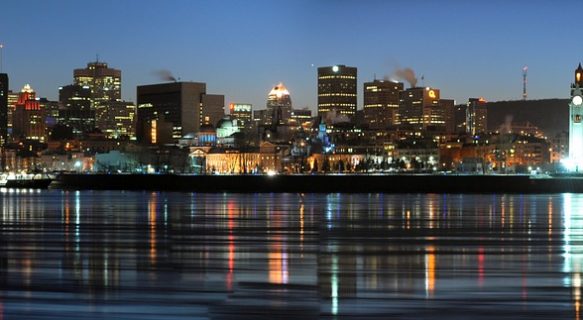
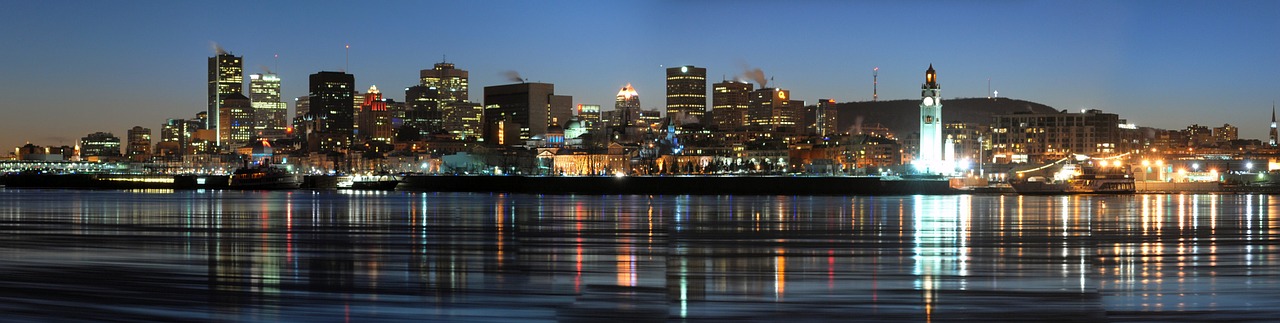
Montreal (French: Montréal) is the largest city in the Quebec province. While Quebec City is the capital, Montreal is the cultural and economic centre, and the main entry point to the province. With 1.7 million citizens in the city proper and 4 million in the urban area, Montreal is Canada’s second largest city, and the third-largest French-speaking city in the world, behind Kinshasa and Paris. Still, a quarter of the population speak English as a mother language, and most Francophones are conversant in English. Old Montreal has a heritage of colonial times. Though a large city, Montreal gives opportunities for outdoor life, as well as watching the legendary Montreal Canadiens ice hockey team.
Districts
Central Montreal

Ville-Marie borough
Neighbourhoods from west to east:
| Downtown Skyscrapers, shopping, museums, and the Parc du Mont-Royal. |
| Old Montreal The historic riverfront Old Town and Old Port manages to retain a quaint feel despite being mobbed by hordes of tourists. |
| Quartier Latin-Le Village Restaurants, boutiques, cafes, pubs near UQAM in the Quartier Latin, gay bars and clubs in Le Village, and the working-class neighbourhood of Sainte-Marie. |
| Parc Jean-Drapeau The islands of Île Sainte-Helene and Île Notre-Dame and the Montreal Casino. |
Plateau Mont-Royal district
| The Plateau Trendy area north of downtown and east of Parc du Mont-Royal. |
| Mile End Bagels, restaurants, coffee shops, the Rialto Theatre, and boutiques. |

Other Montreal districts and Montreal Island towns
| Rosemont–La Petite-Patrie Little Italy and Jean-Talon market. |
| Westmount–Notre-Dame-de-Grâce The upscale anglophone enclave of Westmount and the up-and-coming neighbourhood of Notre-Dame-de-Grâce. |
| Hochelaga-Maisonneuve Olympic Park, Botanical Gardens. |
| Côte-des-Neiges Multicultural neighbourhood northwest of the mountain. |
| Outremont Upscale francophone neighbourhood. |
| South West Including Lachine canal, Atwater Market (a must!), gentrifying St. Henri, and the emerging culinary hot-spot, Petite-Bourgogne. |
| Verdun Quiet neighbourhood with emerging cuisine scene and activities along the river. |
Elsewhere on the island
| West Island |
| East End |
| North Island |
Understand
On an island in the St. Lawrence River at the historically highest navigable point, Montreal has been a strategic location since before the arrival of Europeans in Canada. A thriving Iroquoian town called Hochelaga was on the site of present-day Montreal when explorer Jacques Cartier first visited in 1535. A hundred years later, in 1642, the tiny town of Ville-Marie was founded as a Catholic mission by Paul Chomedey, sieur de Maisonneuve. It soon became a centre of the fur trade. After its capture by the English in 1762, Montreal remained (until the 1970s) the most important city in Canada and was briefly capital of the province in the 1840s.
Prohibition on sales of alcohol in the United States during the 1920s and 1930s made Montreal a Mecca for cross-border fun seekers from nearby New England and New York. The city built up a seedy, yet playful, industry in alcohol, burlesque, and other vices. In the 1960s, an urban renewal drive centred around Expo 67. The World’s Fair in Montreal brought a subway system (the métro) and attractive urban parks and is considered to be one of the most successful World Fairs. Over 50 million visitors gathered in Montreal during this memorable summer. The 1976 Olympics left a strikingly idiosyncratic stadium and many other urban improvements.

The opening of the Saint Lawrence Seaway in 1959, though much-lauded as an economic boom, spelled the beginning of the end for Montreal’s economic dominance in Canada. Once the transition point between western railways and eastern sea carriers, Montreal watched helplessly as some of this business moved farther west, up the now navigable seaway, to ports in Ontario and on Lake Superior. The Quebec sovereignty movement, which began to pick up steam in the 1960s, further chilled the atmosphere for Canada-wide businesses, many of which moved their headquarters to Toronto.
Following an economic depression in the 1980s and 1990s, Montreal became more secure in its place in North America and the world. It remains a centre of culture, arts, computer technology, aerospace, the biotech industry, and media for all of Canada.
Orientation


It has been said that Montréal is the only city in the world where the sun “rises in the south”.
Montrealers use an unconventional compass, using the river and the mountain as cardinal points. When you are downtown, the St Lawrence River is “south” and Mount Royal is “north”; making the West Island and the East End correct in both their names and orientations. This tends to confuse visitors because the “East” End is really north and the “South” Shore is east, and the St Lawrence River runs almost north-south at this location.
Most local maps use this convention as do the highways around the city. For example, Autoroute 15 north actually runs northwest and Autoroute 40 east runs northeast.
To underscore this fact, a Montreal map will show that the “south end” of Victoria Bridge is in fact further north than the “north end”.
Climate
| Climate | Jan | Feb | Mar | Apr | May | Jun | Jul | Aug | Sep | Oct | Nov | Dec |
|---|---|---|---|---|---|---|---|---|---|---|---|---|
| Daily highs (°C) | -5 | -4 | 2 | 11 | 19 | 24 | 27 | 25 | 19 | 12 | 5 | -2 |
| Nightly lows (°C) | -30 | -30 | -20 | 0 | 10 | 15 | 18 | 17 | 12 | 6 | -10 | -25 |
| Precipitation (mm) | 74 | 71 | 80 | 77 | 87 | 88 | 106 | 101 | 101 | 84 | 94 | 102 |
The climate of Montreal is a true humid continental climate with 4 distinct seasons. The city has warm—and occasionally hot & humid—summers, generally mild spring and autumn, and often very cold & snowy winters. Montreal gets over 2,000 hours of sunshine annually. Precipitation is moderate throughout the year, with around 2 metres of snow per season.
Visitor information
- Centre Infotouriste de Montréal, 1255 rue Peel, bureau 100 (At rue Sainte-Catherine; metro Peel), ☎ +1 514 873-2015, toll-free: +1-877-266-5687, e-mail: info@bonjourquebec.com. Apr 1-May 7: 09:09-17:00; May 8-Oct 4: 09:00-18:00; Oct 5-Mar 31: 09:00-17:00; Closed: Dec 25 & Jan 1.
Get in
By plane
Montreal’s 1 Pierre Elliott Trudeau Airport (YUL IATA) (also known to locals as Dorval Airport) is west of the city centre on Expressway (Autoroute) 20. Travel time to the airport from the city centre can be as much as an hour, depending on traffic. The airport is served by all major Canadian and U.S. airlines and is a major hub for Air Canada, Air Transat, and WestJet. There are daily trans-Atlantic flights to and from (among others) London, Amsterdam, Paris, Geneva, Zurich, Athens, Doha, Frankfurt, Rome, Madrid, Lisbon, Munich, and Casablanca. The sole trans-Pacific flight is Air China’s thrice-weekly flight to Beijing.
The taxi fare to and from downtown is a fixed price of $40 (a sticker on the window behind the driver gives the boundaries of the zone where the flat fare applies; if you are going from or to places outside this zone, you will have to pay a metered fare with a minimum rate of $17).
STM Airport Express bus 747 offers service between the airport and Montreal 24 hours a day. A single fare will cost $10 (exact change in coins only when paid in the bus) and includes unlimited use of the STM bus and metro network for the following 24 hours. There is also a ticket booth in the airport where you can purchase fares (including a three-day pass for $18). The bus will stop at Lionel-Groulx metro station, and some buses continue to various downtown stops (the bus’s marquee will state which).
It is possible to go downtown by the cheaper regular public transit system. Late at night, it is all right, but during peak hours, you will need to complete several transfers with potentially crowded vehicles, so it is really only best to do so only if you are on a very low budget and/or have very light baggage.
Between 05:00 and 01:00, take STM bus 204 east (est) which leaves from outside arrivals every 30 min to Gare Dorval (Dorval Train Station). Check that the driver is not going west (ouest) as both ways are served from almost the same place, and the sign does not say. You can also use the 209 on weekdays to get to Gare Dorval. Also, be sure to keep the ticket that the driver will give you as it is a transfer which you will need later. From Gare Dorval, use your transfer ticket to catch any one of buses 211, 411, 405, 425, or 485 to Lionel-Groulx metro station. Also make sure it is going east as the same routes go west too. Your transfer will then let you into the metro. Take the Montmorency-bound orange line or the Honoré-Beaugrand-bound green line into downtown on the metro. This costs only $3.25, but exact change in coins only must be provided to the first driver.
Between 05:00 and 01:00, for the same price ($3.25, exact change in coins only), take bus 356 (again, check that the driver is going east, not west) directly into downtown via Sherbrooke. This bus runs relatively close to most downtown hotels. However, if needed, a transfer can be completed to access the rest of the city. See the STM’s trip planner or Google Maps for more details.
At Gare Dorval it is also possible to catch the AMT commuter rail to downtown (Direction Lucien L’Allier), during the day from 6AM to 8PM for a single one-way fare of $6, leading to the downtown station of Lucien L’Allier which is also atop the Lucien L’Allier metro station.
Plattsburgh International Airport and Burlington International Airport, both located in the US, are 1 hr 20 min and 1 hr 50 min, respectively, by car from Montreal. Adirondack Trailways offers a bus service between Plattsburgh International Airport and Montreal. Greyhound offers a bus service from Burlington International Airport and Montreal. For travellers from the US, these airports may offer a significant cost savings compared to Trudeau but at the added inconvenience of arranging ground transportation between the US and Canada.
By car
From Toronto, take Highway 401 east about 5 hr until it becomes Autoroute (Expressway) 20 on the Quebec side of the border. It will then take about an hour to get to downtown. Be alert for frequent speed-limit changes along this road. To reach downtown follow the Centre-Ville signs and take Autoroute 720 (Autoroute 20 continues over the Pont Champlain bridge to the South Shore).
|
Rideshare Save money with a rideshare. There are daily rides from Toronto to Montreal and back for $30-50, which is cheaper than any other means of transportation between the two cities. A good website for ridesharing in Canada and the USA is Craigslist. Dedicated rideshare sites include LiftSurfer and eRideShare Warning: Advertisement for a van (with a DVD player) that offers rides to Montreal and back every day has drivers that hardly speak any English at all (nor French). The service provider is unreliable. Service is also very poor. |
From Ottawa, it’s about 2 hours east along Highway 417 (which becomes Autoroute 40 in Quebec) to Montreal.
From Quebec City, it’s about 3 hours west on either Autoroute 40 or Autoroute 20.
From New York City, take Interstate 87 north through Albany and the eastern half of New York State for about six hours. After the border crossing near Plattsburgh, the freeway becomes Autoroute 15, which leads directly into downtown Montreal over the Pont Champlain, the most beautiful approach to the city. The drive time from Plattsburgh to downtown Montreal is approximately one hour.
From Boston, take Interstate 93 to Interstate 89 after you cross into New Hampshire. Follow Interstate 89 north to and through Vermont to the border crossing, where it turns into Highway 133. This secondary road continues to Autoroute 10, which leads directly into downtown Montreal. The whole trip takes about 5 hours. Once you cross the border it is about 1½ hours to Montreal.
By train

2 Montreal Central Station (Gare Centrale) is at 895 rue de la Gauchetière Ouest, one block west of rue University, and is served by the Bonaventure metro (subway) station. Prices are in Canadian dollars unless otherwise specified.
Via Rail Canada operates fast and comfortable passenger trains from Montreal along the busy Quebec-Ontario corridor and to destinations in northern Quebec, New Brunswick, and Nova Scotia. All fares below are five-day advance booking prices for one-way travel in “Comfort” (coach/economy) class, expect to pay almost 50% more if you book on the day of travel. Check the Via website for “express deals“, which are posted every Thursday. Highly discounted tickets are available, typically for long distance train routes or short distance trips at non-peak hours. Express deals on short distance trips (e.g. Montreal-Toronto) are typically offered only for the upcoming weeks, whereas long distance deals (e.g. Montreal to Winnipeg) may be available several weeks in advance. Business Class is available for a premium and includes a meal, alcoholic refreshments, snacks, and free wireless internet in station lounges and on board the train. An ISIC student card can obtain a discount on Via, and on Amtrak in the USA. Bicycles can also be brought aboard as is on certain Corridor trains during the summer months. See Rail travel in Canada for more information.
- 5 trains a day operate to and from Ottawa (2 hours, from $35).
- 6 trains a day operate to and from Toronto (4½ hours, from $85).
- 5 trains a day operate to and from Quebec City (3 hours, from $47).
Three evenings a week, Via’s “Ocean” service departs for the overnight journey to Moncton, New Brunswick (15½ hr, from $110 coach, $162 upper berth, $219 bedroom), and Halifax, Nova Scotia (20 hr, from $133 coach, $187 upper berth, $245 bedroom). The choice of sleeping accommodation varies according to the season. Along with trains between Montreal and Quebec, the Ocean is now almost exclusively operated by modern Renaissance trains that were built for the aborted Channel Tunnel sleeper services between Great Britain and France.
Three evenings a week, the Ocean also pulls the “Chaleur” train as far as Matapedia. The train divides in the early morning and the Chaleur follows the southern shore of the Gaspé peninsular as far as Gaspe (17½ hr, from $106 coach, $165 upper berth, $215 bedroom).
Via also offers three weekly round trips to Senneterre, in Abitibi (11½ hr, from $81), and Jonquière in the Saguenay (9 hr, from $55). Both trains operate as wilderness services: a request stop may be made at any point along the route for those who want to hike and kayak in the remoter regions of Quebec that the train passes through.
Amtrak operates the “Adirondack” service to New York City (11 hours, from US$61) which departs daily, with connections in Schenectady to (but not from) Chicago (24 hr, US$114) and in New York to Philadelphia (14 hr, US$97) and Washington, DC (16 hr, US$120). The train also passes through much of upstate New York and hugs Lake Champlain for a large part of the trip. South of Albany, the route follows the Hudson River and passes a number of historic sites. Reliability of the service has improved greatly since an extra hour was added to the previous 10-hr schedule, but one should still factor in the frequent possibility of arriving an hour later than scheduled.
The journey to New York is cheaper but slower than by bus (see below), which takes 7-9 hr, but the superior comfort, extra legroom and ability to walk around the train and visit the cafe car for food and drink at your leisure, as well as the good view from the train of the Lake Champlain and Hudson River scenery, make up for this.
Train passengers leaving from Boston may take the Regional Service to Penn Station, New York City, and transfer to the Adirondack line to Montreal, but this method requires significant layover times in New York.
The train station has no permanent lockers but it’s usually possible to keep it guarded by Via Rail for less than a day if travelling with it. There is Wifi and a few power outlets.
By bus
There are extensive services to Montreal from cities in Ontario, Quebec, New York, Vermont, and Maine. Buses arrive and depart from the Station Centrale d’autobus (not to be confused with the Gare Centrale or central train station) at 505 boulevard de Maisonneuve est (directly above the Berri-UQAM metro station). Call +1 514-842-2281 for schedules and prices.
Intercity bus services to Montreal are offered by Megabus, Coach Canada, Adirondack Trailways, Greyhound Canada, Greyhound Lines, Voyageur, and Orléans Express. Orléans Express is the principal bus carrier in the St. Lawrence Valley, including the Montreal—Quebec City route and connections in Rivière-du-Loup to Maritime Bus, which serves destinations in New Brunswick and Nova Scotia. Voyageur, a subsidiary of Greyhound Canada, provides service to Hull and Ottawa, connecting with other bus routes to points in western Canada. Coach Canada provides service via Kingston to Toronto, connecting with other bus routes to western New York, southern Ontario, Michigan and Illinois. Other regions of Quebec are served by various companies.
Greyhound Lines offers three daily direct services and Adirondack Trailways offers two daily direct services, from New York, with additional trips operated on weekends and in summer (8 hr, from US$76.50). Greyhound Lines also offers four daily direct services from Boston (7 hr, from US$72). There is no student discount on the Montreal-New York service.
For Montreal/US service, the train is slower but significantly cheaper; around C$62 compared to about C$75 for the bus. However, for about C$15 extra, the bus makes for a much quicker journey with a much quicker passage through customs; but for comfort and scenery, the longer train journey is more pleasantly spent.
By bicycle
Montreal is an island in the middle of the Saint Lawrence River, accessible only by bridge. Not all bridges are bike accessible; however, several are, including the breathtaking Jacques Cartier bridge. Prominent bike lanes exist throughout the city, most notably along the Lachine Canal, Rue Rachel, boulevard de Maisonneuve, rue Brébeuf, rue Berri, rue Cherrier and most recently along rue Laurier. The Plateau-Mont-Royal is where most of these bike paths are and is the neighbourhood, along with neighbouring Mile-End, where there are the most people who cycle and walk as a means of day to day transport. It has the highest density population wise and the lowest car ownership rate per household. However, bike theft is an issue, especially in the Plateau. Most locals can recall a time when they witnessed bike theft, though the situation is getting better now that the public bike share program, Bixi, has been implemented. It was not uncommon to have somebody offer you a stolen bike for sale on the street. Be equally aware of the peripheral articles of your bicycle; seats, baskets, and wheels can often be easily detached if not properly secured to the bike’s frame or locked with a u-lock.
From Montreal Central Station (Gare Centrale)
Upon disembarking the train, go to the baggage claim area and wait there for a baggage attendant to bring your bicycle to you. If you have checked other baggage, claim it at the conveyor belt. The easiest way to exit the station is at the main entrance near the baggage claim through the parking garage onto rue de la Gauchetière. All other exits require you to carry your bike up flights of stairs. At the west side of the station is the entrance to the Underground City and access to Bonaventure metro station on the Orange line. However, there is no elevator access to the metro from the train station, which means that you have to carry your bike and luggage down several flights of stairs.
From Montreal-Trudeau International Airport
The airport is on the western part of the island. From the main terminal, exit onto the main access road and turn right. Wind along the access road until the first major interchange and turn right. You will reach Albert de Niverville Boulevard and be forced to turn left (south) towards the main highway (Autoroute 20). At the end of this Boulevard, turn right on Cardinal Avenue. To your right, you will come to a pedestrian underpass that takes you under the railway tracks and leads to the Dorval Circle, a very busy traffic circle. This looks intimidating, but the traffic lights will allow you to ride safely under Autoroute 20 to Dorval Boulevard (Boulevard Dorval). Continue south down Dorval Boulevard until the end. Turn left on Lakeshore Drive (Chemin Lakeshore) towards the city. This road turns into Boulevard St. Joseph. You will eventually come to a bike path to your right that winds along the shores of Lac-Saint Louis (part of the Saint Lawrence river) through the town of Lachine. Continue down this path until you reach the entrance of the Lachine Canal. Cross the canal and continue down the Lachine Canal Bike Path (Piste Cyclable Canal Lachine) and follow the signs to the Old Port (Vieux Port) in Old Montreal (Vieux Montreal). The Lachine Canal Bike Path can be quite busy on weekends and holidays, so be ready to take your time. It is paved over its entire length.
From Ontario
Cyclists approaching Montreal from the west must take secondary highways to Dorion, where Autoroute 20, inaccessible to bicycles over most of its length, becomes accessible as it crosses bridges first to Île Perrot (Perrot Island) and then to the Island of Montreal (at Saine-Anne-de-Bellevue). Bicycles should use the sidewalk on these bridges as traffic is usually heavy. From here, cyclists may take Lakeshore Boulevard and the Lachine Canal Bike Path (see Airport section above) to Old Montreal and the downtown core.
The Isle-aux-Tourtes Bridge on Autoroute 40 is not accessible by bicycle.
From the United States
Cyclists approaching Montreal from the South Shore to the south and east of Montreal may access the Island of Montreal a number of ways (see map).
The surest (but not foolproof) way is using the sidewalk Jacques Cartier Bridge. When it is not closed for repairs, it is open year round and all day. A paved bike path along the shores of the Saint Lawrence River provides the most scenic approach to the bridge.
An equally popular route is from the Saint Lambert Locks (Ecluses Saint-Lambert) of the Saint Lawrence Seaway near the Victoria Bridge (Pont Victoria) east of Montreal. The bike drawbridge may be blocked by the entertaining spectacle of a ship passing through the seaway. From here, cyclists take the Grand Prix racing track (Gilles-Villeneuve circuit) on Île Notre Dame to the Concord Bridge to Montreal. This route is closed sometimes for car racing events [1]. In this case, cyclists can take a circuitous detour down a gravel causeway dividing the seaway and river to the Estacade, an ice boom that crosses the river parallel to the Champlain Bridge to Nun’s Island and eventually Montreal. A lesser known crossing involves one at the Sainte Catherine Locks (Ecluses Sainte-Catherine) at Saint-Catherine south of Montreal. These bridges cross the seaway to the same causeway as the Saint Lambert locks. In this case, the road to the Estacade ice boom is paved. These bike links from the South Shore are open from 15 April to 15 November, from 06:30 to 22:00. [2].
The Champlain Bridge, Mercier bridge, and Lafontaine Tunnel are definitely inaccessible to bicycles. These can be dangerous, even in a car. There is no bicycle path crossing the Mercier Bridge.
Get around
Montreal has historically been divided into east and west by boulevard Saint-Laurent, with the west side traditionally being Anglophone and the east side traditionally being Francophone. Numbered addresses on streets that cross Saint-Laurent start there and increase in either direction; most addresses are given as “rue ____ Ouest” (west) or “rue ____ Est” (east). Many streets are named after Catholic saints and figures from local history, both well-known and obscure. In Montreal street names, “east” and “west” refer to the direction parallel to the St. Lawrence River, and “north” and “south” refer to the direction perpendicular to the St. Lawrence River. Because the St. Lawrence River runs almost north-south near downtown Montreal, “east”, “west”, “north”, and “south” are actually northeast, southwest, northwest and southeast respectively. Confusingly, most maps displayed in the city have “Montreal north” on top which can be confusing with a satellite navigation that uses pole north. Also, don’t try to navigate by looking at the sun!
On foot
Walking is a favoured way to get around the densely packed downtown and the narrow streets of Old Montreal, especially during the warmer months. However, beware during winter months, as sidewalks can be icy and extremely hazardous after winter snow and ice storms. Winter boots with good grip are essential for surviving pavements that have not been cleared. Beware also (as much as you can) of thawing ice falling from overhanging balconies and roofs. But you can always take the stairs down to Montreal’s famous “Underground City” (Montréal souterrain), called RÉSO, a network of pedestrian corridors connecting Métro (subway) [3] stations, shopping centres, and office complexes.
Jaywalking is widespread and rarely punished. However, be aware that drivers will usually not stop or even slow down if a pedestrian steps out in front of them, even at marked crosswalks. At an intersection, however, a pedestrian will have right of passage before turning traffic and most drivers respect this. Despite Montreal drivers’ poor reputation for aggressiveness, they generally respect pedestrians.
Rue Sainte-Catherine is Montreal’s main commercial artery and busiest pedestrian thoroughfare. The “Underground City” and the Green Line (or line 1) of Montreal’s Metro is easily accessible from all the major office complexes, shopping malls, department stores, and theatre complexes that line it. Smaller chain stores and restaurants also vie for valuable commercial space. Well-kept historic churches with green space provide quiet oasis and contrast with the giant neon signs of strip clubs. Major hotels can generally be found one or two blocks north and south of Sainte-Catherine in the downtown core. Bars, restaurants, and dance clubs cluster within a block of Sainte-Catherine around Crescent and Bishop, catering to a mostly English-speaking clientele. Rue Saint-Denis, farther east, and the Gay Village between Berri and de Lormier, even more to the east, are mostly French-speaking. McGill College Boulevard in the downtown core from Saine-Catherine offers an open view of Mount Royal to the north and an impressive view of the Place Ville-Marie skyscraper to the south. Keep your head up and beware of following the flow of the crowd on this street: throngs of pedestrians often walk across cross streets against red lights, risking life and limb.
Rue Prince-Arthur, east of Saint-Laurent, is for pedestrians only. Another pedestrian-only locale is Montreal’s Chinatown, situated on Rue de la Gauchtière Est between Saint-Urbain and Saint-Laurent. A good trick for navigating downtown Montreal is to remember that streets slope up toward Mount Royal, which is just north of downtown and easy to see from most locations.
The districts surrounding downtown Montreal are especially delightful on foot. To the south is Old Montreal (Le Vieux-Montréal) (its narrow streets and buildings dating from the 17th and 18th centuries really can make you feel like you’re in Old Europe) and the Old Port (Le Vieux-Port), a waterfront strolling park with exhibits and boat tours, is very popular with the locals. To the north, the Golden Square Mile and the McGill University Campus is wedged between Mount Royal and Sherbrooke Street on the southern slope of the mountain. Old Victorian mansions and townhouses can be found along the sloping streets, many now housing McGill University’s offices and libraries. Just west of downtown is affluent Westmount, a perfect example of 19th-century English-style homes and gardens (inhabited to a great extent by English-speaking people) climbing the slopes of Mount Royal’s western part (the higher you climb, the larger the old mansions). Just east and northeast of downtown are the mostly French-speaking Gay Village (Le Village Gai) and Plateau (Plateau Mont-Royal) districts. Street after street displays turn-of-the-19th-century row duplexes and triplexes, replete with famous Montreal outdoor staircases, overflowing front gardens (or snow-covered gables, depending on the time of year), and tiny shops tucked into every nook and cranny. For people who like to see a culture where it lives, Le Plateau is the place to wander about in.
Mount Royal (Mont-Royal) is also accessible from the urban core on foot. Fit pedestrians can climb Rue Peel to the southern edge of the park. A series of renovated staircases will take you directly to the Chalet near the top of the mountain, with its classic view of the downtown core. A more leisurely climb to the top awaits those on Olmsted Road (6.5 km), a wide, gently sloping bike and foot path accessible from the Plateau in Parc Jeanne-Mance (also known as Fletcher’s Field). Smaller foot paths serendipitously branch off from this road. A cross-country ski path also winds to the top in the wintertime. Mount Royal’s park was designed by Frederick Olmsted, a landscape architect who lived from 1822 to 1903 and was also responsible for the design of Central Park in New York City and the Emerald Necklace in Boston.
By car
Driving (SAAQ) in Montreal can be a challenge for many North American motorists. Although turning right on a red light is allowed across the rest of Quebec (except at intersections where a sign indicates this is not permitted), right turns on red are strictly prohibited on the island of Montreal. The stop lights at most of downtown intersections are located on the opposite side of the intersection, not at the actual stop line as in some of Europe.
The use of road salt to keep roads ice-free during severe winters takes its toll on the roadways, which are either heavily potholed or subject to perpetual construction. Downtown traffic is dense. Street parking can be difficult. Parking meters are in use seven days a week in most districts (M-F 09:00-21:00, Sa 09:00-18:00, Su 13:00-18:00), including statutory holidays. The standard parking ticket cost is $52. Parking tickets may be appealed in court only by the owner of the car that was subject to the infraction, so if a rented car is ticketed, the person who rented may be unable to contest the charge. Car parking downtown is expensive at around $3 an hour at parking meters or $25 per day at commercial parking lots. Parking signs are all in French, and will describe a day and hour (based on 24-hr clock) along with conditions for parking. Many arterial roads prohibit parking on one side during rush hour, and vehicles are subject to $150 fine plus towing costs and other fees. Montreal does not paint curbs red next to fire hydrants, but it is still illegal to park there.
|
Days of the week
lundi — Monday |
There are also many private and public parking lots, and their prices vary widely. There may even be $15–20 differences between two parking lots just a few blocks from each other.
|
Sign Language
North — Nord |
During the winter months, heavy snowfalls are common. In the aftermath of a snowstorm, an intensively-prepared “déneigement” (snow removal) process begins with intimidatingly large snow plows and trucks clearing, chewing up, and transporting away the snow. If you leave your car parked on a street, pay close attention to any orange “no parking” signs that will appear on roads to be cleared. Tow trucks will sound a loud 2-tone horn siren just before clearing. This is an announcement that a street is about to be cleared and that all parked cars will be cited/and or towed if they are not moved. For this reason it’s important to be able to check your vehicle at least once daily after a snowfall. It is best to use indoor or underground parking if snow clearing is likely.
Many downtown streets are one way, which can complicate getting around. If you see a sign at an intersection that has direction arrows in a green circle, that means those are the only directions you are allowed to turn. Left turns are allowed on a green light provided there are no other signs prohibiting. Visitors should be familiar with the flashing green light, which indicates a protected left-turn (priority), which is equivalent to a green arrow in other parts of the world. Some signals are green arrows that flash, this is the same meaning. Autoroutes (expressways or freeways) can be challenging for visitors, as most signs are French, but most symbols are the same as in English Canada and the United States.
By bike

Cycling is the best way to visit the city, especially its central neighbourhoods like the Plateau Mont-Royal; it is a very popular mode of transportation once the coldest winter weather is over. The city is criss-crossed by 660 km of cycle paths, including some which cross the St. Lawrence onto the Island of Montreal. By far the nicest path is the Lachine Canal path that stretches from Lachine, along Lac St-Louis, down to Old Montreal along the canal. You can cross over to the South Shore either on the Jacques Cartier Bridge, Île Notre-Dame, or via the Estacade ice bridge from Île des Sœurs.
Even if you are on a bike path, beware of drivers especially if they are turning, as lines of visibility at intersections are not well enforced in the city. Generally Montreal drivers in the central neighbourhoods are used to sharing the road with bikes and so are courteous, there are always a few, usually from outlying neighbourhoods, who give all drivers a bad name. Some downtown bike paths are separated from the road by parked cars, which decreases visibility, both yours and the driver’s. The often crowded bike path on rue Rachel one is the worst for this, however the Plateau part of the path will be renovated soon to make it safer and greener. If one is comfortable driving in Montreal, one generally can feel comfortable biking there as well. Montreal pedestrians are known for not waiting for a light to change if there are no cars coming; cyclists are a bit like that too and often treat the many stop signs on residential streets more as yield signs than as stop signs. Wearing a helmet is not required under the law, though, for children especially, it’s better to be safe than sorry.
The Bixi system is a public bike-share system. Rated the best in the world, it was designed and developed in Montreal and has since been exported to many cities around the world including London, UK and Sydney, Australia. Major credit cards are accepted. The Bixi was conceived for local active transit but is accessible to tourists as well. For a flat $5 fee, you can use Bixi bikes as much as you like for 24 hours provided you don’t use a particular bixi bike for more than 30 minutes at a time before returning it to a docking station. After returning the bike to a docking station, you can get another bike (even at the same station) after a 2-minute waiting period. There are over 400 Bixi stations with over 5000 bikes around the city concentrated in the downtown and central neighbourhoods like the Plateau (though its expanding all the time). The tourist information centre has maps of the stations. Helmets and locks are not provided. You could use your own lock, but there is usually a station not more than a block away on a commercial strip so returning the Bixi to the nearest stand is always the safest and most cost-effective choice. Be aware that stations fill up and empty quickly; you may have to bike to the next station to find an empty docking spot. If you have a smart phone, there is an app that shows you real-time the nearest stations, how many bikes are docked, or whether there is a free docking spot available.
Skate and bike rental shops are common, particularly in the Old Port and the Plateau. Visit La Maison des Cyclistes (the cyclists’ house) at 1251 rue Rachel Est for all info on cycling in Montreal. (See Do for specific bike paths).
By metro or bus
|
Fanfare for Copland The sounds produced by electrical equipment when a Montreal Metro train is departing are the first three notes of Fanfare for the Common Man by Aaron Copland, although this is really just a coincidence. |


The public transit system, run by Société de transport de Montréal (STM), is safe, efficient, and is overall pleasant to use. Tickets have been replaced by cards with magnetic stripe containing one trip, called an à la carte ticket. These are valid for one trip (including unlimited transfers in the same way for 90 min) on the metro and buses, costing $3.25 each (exact fare in coins is required on the buses but not on the metro) but are also available for less when you purchase two for $6.00 or ten for $27.00 (OPUS card required) either from the metro agent or the automatic fare vending machine located in metro stations. Signs and announcements are only in French, though ticket machines are bilingual in French and English. Many, but not all, Métro counter staff are also able to speak English.
Montreal metro stations and train cars do not have air conditioning: the Metro can sometimes get uncomfortably hot, in every season. It is, however, still the best transport option in the city.
Only certain metro tickets are valid in Laval and Longueuil. 10-trip tickets, and weekly and monthly passes, are still not accepted. You may need to buy another ticket for the same price ($3.25) A full listing of all types of tickets and their validity can be found here.
You must keep your payment card as it is your transfer and your proof of payment (correspondance); fare inspectors may give you a large fine if you are unable to show it when they request it.
If you are using cash to pay your fare on the bus, it is important to have the exact fare since the driver does not give change; you will receive an à la carte ticket, your proof of payment and your transfer. Pictures and specific instructions can be found here.
Tourist passes offer unlimited travel on the bus and metro for periods of one day ($10) or three days ($18) and are well worth it to avoid fumbling for change, checking transfer times and restrictions, and worrying about getting off at the wrong stop and having to repay. There is also an option for unlimited evenings ($5), valid between 6pm and 5am the next morning, which can be practical on a night out, since it’s cheaper than buying a two-way ticket (which would cost $6). They are available for purchase at all metro stations (pay cash or use Canadian credit or debit cards only). Weekly ($25.50, valid for one calendar week running Monday through Sunday) and monthly ($83, valid by calendar month) passes are also available; unlike one day and three day passes, weekly and monthly passes must be loaded onto an OPUS card (see below) and are not available in paper ticket form.
The OPUS card is a smart card with a chip that contains your fare and transfer information. The OPUS card can be purchased at all metro stations and transit fare points of sale. As of January 2017, the card costs $6. You can find your nearest seller here.
OPUS cards can be refilled at metro stations using the automated machines or at the ticket booth.
The STM website offers an online trip-planner service. Trip planning can also be done using Google Maps. Free bus and Metro system maps are available from the ticket booth at most metro stations. These are useful to find where you are on the island.
At each metro station, directions are not indicated by compass directions, such as westbound or eastbound. Instead, trains go in the direction of a metro line’s terminus. The green line runs from Angrignon in the west to Honoré-Beaugrand in the east. If you were to travel eastbound, for example, you would look for Honoré-Beaugrand on the platform. If you were to travel westbound, you would look for Angrignon. There are four interchange stations at which commuters can change subway lines without extra charge: Snowdon (blue/orange), Lionel-Groulx (orange/green), Berri-UQAM (green/yellow/orange), and Jean-Talon (orange/blue).
Bicycles are permitted aboard metro trains outside of the rush hours such as: 10:00-15:00 and 19:00 to end of service on weekdays and all day Saturdays, Sundays, and legal holidays. Bikes are only allowed in the lead car of the train up to a maximum of 6. STM staff may deny bikes aboard the metro for safety reasons such as special events that might generate a high level of ridership. Lists of such events are posted on the STM website and at the entrances to metro. During festival season in Montreal, bikes are seldom allowed at all.
Bike riding inside stations or the Underground City is strictly prohibited.
By train
Montreal has a commuter train system run by the Réseau de transport métropolitain (RTM, formerly the “AMT”) with termini at the Montreal Central Station (Gare Central) and at Lucien-L’Allier (both are accessible from the metro). Commuter trains are handy for getting to suburbs and neighbouring towns.
Commuter train stations are divided into six zones that radiate out from downtown. Stations have automated machines from which you must purchase a ticket appropriate to the zones of the station you are traveling to or from, whichever is farther (for example, a trip from Zone 1 to Zone 3 or vice versa would require a Zone 3 ticket). A prepurchased ticket card (SOLO) must be validated at the card scanners at the entrance to the platform. In general, reduced fares (for students and seniors) require ID that is not available to travelers, but if you are staying in the area, ask an employee for more details as the rules are complicated, but you can get good savings.
There are no ticket machines on the train and ticket inspections are random. Incorrect tickets sometimes go unnoticed because inspectors check only occasionally. However, it is best to avoid taking chances as if the ticket is not valid, the customer can get a fine of $400. The ticket machines should now all be bilingual in English and French. The two downtown stations have staffed ticket booths Monday to Friday, but not in the evenings. Other stations may also have booths but generally only during either the morning or afternoon rush hour.
Map
MapArt produces an excellent map in book-form of downtown Montreal and environs, including Vieux Montréal, Mount Royal, the Plateau, and areas as far north as the University of Montreal and as far south as Parc Jean-Drapeau. That form is handy as you can avoid always folding a map of the whole island.
Below is a basic map of the primary areas of interest to visitors.

See


- Old Montréal contains the vast majority of historical buildings, most dating from the 17th – 19th century, and many museums. At night several of the buildings are beautifully lit up. A Tourist Office brochure lays out a walking map. Consider following it once during the day, and again at night.
- Le Plateau combines scenic residential streets with hip shopping and dining.
- Downtown Skyscrapers, McGill campus, churches, and museums. Several blocks are connected by 30 km of underground arcades and malls, allowing comfortable walking and shopping when the weather is foul.
- Parc Jean-Drapeau, site of the 1967 World’s Fair, now devoted to green spaces and a large outdoor concert venue. The Gilles-Villeneuve racing circuit, home of the Montreal Formula 1 Grand Prix. An artificial beach, a huge outdoor pool complex, and the Montreal Casino are also located on or around the park.

- A few kilometres Metro ride to the north, Hochelaga-Maisonneuve offers the Olympic Stadium, Insectarium, Jardin Botanique, and Biodôme. Allow four hours to see all four.
- Churches – Montreal is home to four Roman Catholic basilicas, all of which have interiors that are among the most impressive in North America. Downtown Montreal is home to Saint Joseph’s Oratory (Oratoire Saint-Joseph), the largest church in Canada, Mary, Queen of the World Cathedral (Cathédrale Marie-Reine-du-Monde) and Saint Patrick’s Basilica (Basilique Saint-Patrick), which was built to serve Montreal’s Anglophone Catholic community. In Old Montreal, the Notre-Dame Basilica (Basilique Notre-Dame) at Place d’Armes is undoubtedly the most famous in Montreal, and is known throughout the world for its lavishly decorated and colourful interior. Although rather small and not a basilica, another church of note in Old Montreal is the Notre-Dame-de-Bon-Secours Chapel (Chapelle Notre-Dame-de-Bon-Secours) near the Bonsecours Market, the first church to be founded in Montreal, which is known for its maritime theme and beautiful frescoes on the inside.
- Rialto Theatre, 5723 ave du Parc. The Rialto Theatre is one of the most iconic buildings of Montreal. Its graceful proportions and elegant details are a delight to behold. For too long the theatre had laid dormant and unused. Recently, it has been reanimated and revitalized. It is a centre for the performing arts: open and inclusive, multilingual and multicultural. The Rialto hosts tours, events, plays, bands, and movies.
- Mosaicultures internationales, seasonal
Do
- 1 Casino de Montréal, 1, avenue du Casino (metro Jean-Drapeau), ☎ +1 514 392-2746.
- La Ronde (member of the Six Flags family), 22, chemin Macdonald (metro Jean-Drapeau). Discounts are readily available: a Coca-Cola tin is worth an $8 discount on any rides ticket.
Cross-country skiing
During the winter, many parks offer the possibility to do cross-country skiing with groomed paths.
- Parc regional de l’Ile-de-la-Visitation — Ski rental available.
- Parc du Mont-Royal. Ski rental available and usually the best ski conditions.
- Parc Maisonneuve and Jardin Botanique — No ski rental.
Ice skating
- Year-round ice-skating, 1000, rue De La Gauchetière (metro Bonaventure).
- Free skating, Lac aux Castors (Beaver Lake), in the Parc Mont-Royal.
- Free skating, Connected ponds of Lafontaine Park, in Plateau Mont-Royal.
- Winter skating, in the Old Port (Vieux-Port) in front of the Bonsecours Market and many parks.
|
Montreal Island’s Grands Parcs The greater Montreal area offers large parks for year-round outdoor recreation. The most accessible are Parc du Mont Royal and Parc Lafontaine in the Plateau, Parc Jean-Drapeau offers the closest beach park, and Parc Maisonneuve, next to the Olympic Sports complex and Botanical Gardens. Further afield, Parc des Rapids and Parc Angrignon are in Le Sud-Ouest and Parc René-Lévesque further West, with miles of bike paths and access to river surfing. |
Water sports
- River surfing — Although the Saint Lawrence River is frozen nearly solid for four to five months out of the year, the waterway has become a magnet for aficionados of this new sport. Unlike their oceanic brethren, river surfers ride the standing waves in fresh waterways. The Saint Lawrence has two main hot spots for the sport: Habitat 67 is close to the bridge between Montreal and Île des Soeurs, the site of the 1967 Expo and the Montreal Casino. (This wave is also known as Expo 67.) The Surf 66 Boardshop at the 1952 rue Cabot offers lessons.
- Kayaking — Just off the shore of the park in Lasalle are the Lachine Rapids. Huge waves, fast water, and loads of fun for kayaks. Lessons are available on site in the huge eddy formed by the peninsula. Annual surf (rodeo) competitions at “Big Joe” (still called “Beneath the Wheel” by old schoolers). Other famous play waves on this set of rapids on the St. Lawrence river are, Istambul and Constantinople, Pyramid, Slice and Dice, Black and Decker, and HMF on the other side of the islands. For those seeking less of an adrenaline rush, there is always the Bunny Wave (La Vague a Guy) upstream near the bike path at Park Rene Lesvesque. Rafting these same rapids is also a fun option.
Bike
An interactive map of the cycle path network is available at the Vélo Québec website. Particularly pleasant places to cycle and skate include:
- Parc Maisonneuve — A large park with smooth paths.
- Parc Jean-Drapeau — Particularly the Île Notre-Dame on the Formula One race track: a fantastic view across the water to downtown Montreal.
- Lachine Canal — Bike paths west of the Old Port.
- Rivière-des-Prairies — You can ride across Montreal Island from west to east along the river on the north of Montreal. Many sites have incredible views. A stop at Perry Island is a must.
Parks
- Square Saint-Louis, corner of rue Saint-Denis and rue Prince-Arthur, slightly north of rue Sherbrooke (metro Sherbrooke). A charming little park with majestic trees and a lovely fountain, lined with charming houses on three sides (the Institute of Hotel Techniques of Quebec hotel school is the fourth side). This was the site of the first water reservoir in Montreal.
- Parc Jean Drapeau — The former Expo 67 fairgrounds, Parc Jean Drapeau is spread across two islands (Ile Ste-Helene and Ile Notre Dame) in the Saint Lawrence River. On Sundays in the summer, join thousands of Montrealers revelling in the sunshine and music outdoors at Piknik Électronique. People enjoy riding a bicycle around the Circuit Gilles Villeneuve race track on Île Notre Dame. La Ronde and the Montreal Biosphere are located here. (metro Parc Jean Drapeau)
- Parc Lafontaine, from avenue Papineau to avenue du Parc Lafontaine and from rue Rachel to rue Sherbrooke. Ice skating on the lake in the winter, baseball, boules, and outdoor theatre in the summer. (metro Sherbrooke)

- Parc Maisonneuve and Jardin Botanique de Montreal (from rue Sherbrooke to boulevard Rosemont and from boulevard Pie-IX to avenue Viau (metro Pie-IX or Viau)). The Jardin Botanique is one of the largest botanical gardens in the world and features the First Nations Garden, the Insectarium, the Tree House, and 16 different themed gardens and greenhouses.
- Parc du Mont-Royal, ☎ +1 514-843-8240, e-mail: info@lemontroyal.qc.ca. North of avenue des Pins, between avenue du Parc and chemin de la Côte-des-Neiges. This beautiful, immense urban park tops the “mountain” (at 232 m (761 ft), it’s more like a hill) that overlooks all of Montreal and lends the city its name. Designed by Frederick Law Olmsted, creator of Central Park and Prospect Park in New York, the park is elegant and accessible, and has hundreds of nooks and crannies to explore. A broad and gradual 8-km (5-mile) bike and pedestrian path begins at the Monument Georges-Étienne Cartier (on Avenue du Parc, opposite the western end of rue Rachel, where the bike path continues), winding its way around the mountain and culminating at the Belvédère (lookout) and Chalet Mont-Royal, with incredible views of downtown, the St. Lawrence river, and the Eastern Townships. The Belevedere and Chalet are also accessible from downtown by the newly restored staircase, access via the path at the top of rue Peel. Many smaller paths and trails crisscross the park. For lazy visitors, or those with limited mobility, you can enjoy a wonderful view from the mountain by taking bus route 11, which stops at the lookout on Chemin Remembrance, as well as Beaver Lake. Every Sunday during the summer, thousands of people get together at the monument on Avenue du Parc to enjoy the big tam-tam jam.
- Parc Jeanne-Mance, bordered by avenue du Parc, avenue Duluth (with a small extension south as far as avenue des Pins), rue de l’Esplanade and avenue Mont-Royal, directly across from Parc du Mont-Royal. Includes tennis courts, baseball/softball diamonds, a soccer/football pitch, beach volleyball courts, a skating rink in winter. Also a very popular dog-walking venue.
- Parc de l’Ile-de-la-Visitation, ☎ +1 514 280-6733. Rue d’Iberville and boulevard Gouin, (metro Henri-Bourassa, Bus 69 east). This regional park is along the Rivière-des-Prairies. Quiet and enjoyable place to bring a lunch and relax for an afternoon. Good starting point for a cycling tour along the river.
Festivals
Montreal has a bewildering variety of festivals, ranging from one-day ethnic fairs to huge international productions running two weeks or more. They are generally held in the summer and autumn, though increasingly they can be found throughout the year. Here are some of the larger ones:
- Just For Laughs Festival. Comedy festival with three main components: indoor paid shows (usually stand-up, but not always), free street theatre/comedy, and a mini film festival called Comedia. July.
- Shakespeare-in-the-Park. During the summer in parks around Montreal, Repercussion Theatre puts on outdoor performances of Shakespeare plays free of charge.
- Festival du Monde Arabe. In November, an annual festival celebrating the music and culture of the Arab world takes place in Montreal. Many Arab performers, traditional and modern, take the stage.
- Festival Mondiale de la bière, 2018: inside – Palais des congrès de Montréal, 201 Viger Street West (Place-d’Armes métro station); outside – Palais des congrès Esplanade, de la Gauchetière Street between Cheneville and Côté Street. June 6-9, 2018: 12:00-23:00. Annually, in early June: Five days of tasting beers, ciders, and other beverages from all over Quebec, Canada and further afield. 2017’s event boasted over 529 different beers from 9 countries. There is no admission fee (but you can buy a souvenir sampling mug for about $8) and samples typically sell for 2-8 tickets ($1 a ticket) for a 150-200 ml sample. There are also scheduled musical performances and food kiosks. The festival can get very busy at peak times (Friday and Saturday evening of the event), so it is advisable to arrive early to avoid possible long queues.
- Montréal en lumière. A relatively new wintertime affair, attempting to transplant the city’s festival magic to the cold season. Includes three main categories of activities: food and wine, performing arts, and free activities both indoor and outdoor. February.
- Montreal International Fireworks Competition, ☎ +1 514-397-2000, e-mail: info@internationaldesfeuxloto-quebec.com. In La Ronde amusement park (in Parc Jean-Drapeau). This fantastic festival features full-length fireworks displays, accompanied by orchestral music, by national teams from about a dozen countries around the world. Although the hot seats are inside the La Ronde theme park, the fireworks are visible from pretty much any clear space or rooftop in the centre of the city. Pedestrians can watch from Jacques Cartier Bridge, which is closed from 8PM on fireworks nights. Another good spot is the promenade west of the Old Port. $35–45 (seats in La Ronde, free everywhere else). Saturdays 22:00 from mid-June to late July, and Wednesdays 22:00 from mid-July on.
- Fete de St-Jean-Baptiste. June 24 is Quebec’s national holiday (Fête nationale). During the evening, a huge show takes place at Maisonneuve park. This is the show to go to hear made-in-Quebec music. Free. Street parties can also be found all over the city.
- International Festival of Film on Art. Devoted to the promotion and presentation of the finest productions on art and media art. A ten-day competitive festival, it is the most important annual event of its kind in the world. FIFA has become a focal point for artists and artisans from the art and film communities, as well as for art and cinema enthusiast.

Music festivals

- Montreal International Jazz Festival. The world’s largest jazz festival, this festival is a major international event, attracting many big name artists. Many streets in downtown Montreal are closed off to traffic for two weeks and several concert stages are set up. There are many free outdoor shows and indoor concerts (paid). Late June – early July.
- POP Montréal International Music Festival, ☎ +1 514-842-1919. A massive feast of up-and-coming bands in a variety of popular genres. In early fall, host to more than 80 events, more than 300 artists, a conference, and an arts fair. POP Montreal showcases emerging and innovative artists alongside rising international stars and is committed to encouraging vibrant indie communities.
- Francofolies. A festival celebrating French music. Similarly to the jazz festival, many free outdoor concerts are offered in a section of downtown that is closed off to traffic for a week. June 7-16, 2018.

- MUTEK. An annual gathering, held in Montreal, during the first week of June. The MUTEK festival showcases emerging forms of electronic music and the latest trends in sound creation.
- Heavy Montréal. A two-day heavy music festival taking place in Parc Jean-Drapeau on Île Sainte-Hélène.
- Osheaga Music and Arts Festival. A three-day indie & alternative rock festival held annually in Parc Jean-Drapeau on Île Sainte-Hélène. Aug 4-6, 2017.
Film festivals
- World Film Festival. The festival is open to all cinema trends. The eclectic aspect of its programming makes the Festival exciting for the growing number of participants from the five continents. Every year, films from more than 70 countries, including well-known and first-time filmmakers, are selected. There are usually free outdoor projections every night. Late August to early September.
- Fantasia (Asian and fantasy). July.
- Festival du nouveau cinéma de Montréal (new filmmakers, well-known auteurs, new media). October.
- Cinémania (French cinema with English subtitles). November.
- Les Rencontres internationales du documentaire de Montréal (documentaries). November.
- Les Rendez-vous du cinéma québécois (Quebec cinema). February.
Sports to watch
- Canadiens, Ice hockey, Canada’s national winter sport: Bell Centre (Centre Bell), 1260 rue De La Gauchetière (metro Lucien-L’Allier or Bonaventure), [4]. One of the greatest institutions in Quebec culture. If you want to see a game, it helps to know someone with tickets, as they generally sell out within minutes of going on sale. They are widely available through unofficial channels and scalpers, but be prepared to shell out as they don’t come cheap! You can also get cheaper tickets if you’re a resident of the HI youth hostel. You can also stay in front of the hostel and ask a resident to buy a ticket for you if you aren’t staying at the hostel!
- Alouettes, Football (Canadian Football League), Percival Molson Stadium (Stade Percival-Molson), avenue des Pins at University (playoffs: Olympic Stadium), [5]. A dominant team in recent regular seasons, the Als have won the Grey Cup three times since being reborn in 1996, including back-to-back in 2009 and 2010. Molson Stadium is an excellent place to see a game, but tickets can be hard to come by. Before the stadium was expanded in 2009, the Als had sold out all of their home games for more than a decade, and even after the expansion sellouts are still common.
- Impact, Association football (soccer), Saputo Stadium (Stade Saputo) located at 4750 Sherbrooke street East and Viau in the Olympic Park (metro Viau), [6]. One of the newer teams in Major League Soccer, and the league’s third team in Canada, joined MLS in 2012. The previous version of the Impact was a consistent contender in several different leagues (including three in the last three seasons before the team joined MLS) at the U.S./Canada second level. The Impact occasionally use nearby Olympic Stadium for matches that are expected to draw unusually large crowds.
- Formula 1 Grand Prix — Circuit Gilles Villeneuve hosts the Canadian Grand Prix weekend every year, with pre-race practice and qualifying on Friday and Saturday and the race on Sunday. The event gathers about 100,000 spectators and is considered a motor racing classic.
Buy

Although Montreal’s economy has been booming, the city remains remarkably affordable compared to other major cities in Canada and the United States. Shopping in Montreal ranges from eclectic budget stores to high-end fashion, with a wide spectrum in between.
General
Rue Ste-Catherine, between rue Guy and boulevard St-Laurent, has many of the big department and chain stores as well as a few major malls. Avenue Mont-Royal has funky consignment and gothic clothing stores from boulevard St-Laurent to rue Saint-Denis and a mixed bag of neighbourhood stores, used record shops, and gentrified boutiques heading east towards avenue Papineau. Rue St-Viateur is one of the city’s most interesting streets, with its amazingly varied range of businesses crammed into the short stretch between Boulevard St-Laurent and Avenue du Parc.
St-Laurent remains one of the city’s prime shopping streets, more or less along its whole length. Just about anything can be found there, with different blocks having different clusters of businesses (Asian groceries and housewares near de La Gauchetière, cheap electronics a little farther up, hip boutiques between Prince-Arthur and Mount Royal, anything and everything Italian between Saint-Zotique and Jean-Talon). Rue Sherbrooke ouest, west of the Autoroute Décarie, has an increasingly interesting concentration of largely food-oriented businesses. Jean-Talon market, located near the intersection of Jean-Talon and St-Laurent has a wide variety of local produce and food products (maple syrup, cheese, etc.) at very good prices.
For electronic stuff, the largest chain store is BestBuy. You can also find many smaller ones on Boulevard St-Laurent (between Ontario and Sherbrooke).
Budget
- Village des Valeurs, 2033 Pie IX (Métro Pie IX). They have shops inside and outside of Montreal
- Le coffre aux trésors “Chainon”, 4375 Boulevard St Laurent (Métro Sherbrooke).
- L’Aubainerie Concept Mode, 1490, av du Mont-Royal E (metro mont royal).
- Friperie St. Laurent, Friperie St. Laurent, ☎ +1 514-842-3893.
- Some military equipment shops around St-Laurent and Ste-Catherine.
For trekking and outdoor, you also have many options
- MEC, 8989, boulevard de l’Acadie, ☎ +1 514-788-5878. Mountain Equipment Co-op is a co-operative with staff who know the stores merchandise well.
- Altitude Sports, 4140 Saint-Denis St. (Métro Mont-Royal).
- La cordée, rue Ste-Catherine.
- Kanuk, 485 Rachel St E.
Splurge
Trendier boutiques can be found on rue Saint-Denis, north of rue Sherbrooke and south of avenue Mont-Royal est, and on rue Saint-Laurent (continuing as far north as Bernard). The latter is becoming more upscale, so the range of shopping is highly variable and lower in density as one goes north of Mont-Royal. Rue Sherbrooke has a number of high-end stores (notably Holt Renfrew) and commercial art galleries in a short strip running approximately from McGill University west to rue Guy. Farther west, Sherbrooke intersects with Greene Avenue in Westmount, which has a short, but luxurious retail strip. Avenue Laurier, between St-Laurent and its western end, is one of the city’s prime spots for eating and shopping in high style, though there are still a few affordable spots here and there.
Furniture and antiques
On boul. St-Laurent, a cluster of high-end home furnishing stores has grown up in recent years. It starts roughly at the corner of rue Marie-Anne and is very prominent in the block between rue Marie-Anne and avenue Mont-Royal, with sparser, but still interesting stores as far north as rue Saint Viateur. Antique buffs will find interesting stores all over the city, but they’ll want to make a special pilgrimage to rue Notre-Dame Ouest, when you head east from avenue Atwater. Rue Amherst, in the Gay Village, also has a significant concentration of antique dealers.
Eat

Montreal is a culinary mecca and has a huge variety of food options, from diners and fast food to low-cost ethnic restaurants to haute cuisine. The city was recently ranked 2nd best dining city in North America after San Francisco and ahead of New York. The large local Jewish population has contributed local specialties including huge smoked meat sandwiches (beef brisket) (Schwartz’s is undisputably the most authentic smoked meat restaurant) and small, crusty bagels (the undisputed classic bagel places are St-Viateur’s and Fairmount Bagels). Other specialties are “all-dressed” pizza (pepperoni, mushrooms and green peppers), pizza and spaghetti with smoked meat, and Québécois favourites like split pea soup and poutine.
|
Poutine  No visit to Montreal is complete without at least one plate of poutine. This unique dish is a plate of french fries drowned in gravy and topped with chewy curds of white cheddar. There are variations on the theme — adding chicken, beef, vegetables, or sausage, or replacing the gravy with tomato sauce (poutine italienne). Every Montrealer has their favourite poutine restaurant where it says that you can get “the real stuff”, but La Banquise, on the Plateau at 994 rue Rachel est, usually tops the list. |
Many Montreal restaurants are “apportez votre vin” (bring your own wine). This may sound like a hassle, but you end up paying much less for wine with dinner if you bring it yourself. There’s usually a SAQ (government liquor store) or a dépanneur (convenience store, with a limited selection of typically inexpensive wine) nearby; ask your waiter where it is. Your waiter will open your wine for you; corkage fees are rare, but don’t forget to factor this service into your tip so make sure to ask. If you are driving from the United States, you may find Canadian liquor prices quite frightening. Even the duty-free shops along the border are rarely cheaper than an American liquor store (although these are still cheaper than the SAQ). Visitors can bring in 40oz of hard alcohol, 1.5L of wine, or a 24-pack of beer.
Separate bills (l’addition or “facture” in French) are common and you may be asked ensemble ou séparément? (together or separately?) The standard tip for acceptable restaurant service is 15% and is not included.
Never call a waiter “garçon”! Use “monsieur” or “madame”.
Montreal originals
There are several Montreal original foods.
- The Montreal-style bagel, where bagel worshippers flock Saint-Viateur Bagel and Fairmount Bagel, and pontificate about which is better. Both are within blocks of each other in the Plateau Mont-Royal district, on Saint-Viateur and Fairmount streets, respectively.
- Montreal-style smoked meat, a type of corned beef, distinct from other forms such as pastrami, is available at many restaurants, but by far the most highly esteemed is that available at Schwartz’s on the Main (Boulevard Saint-Laurent) in the Plateau Mont-Royal district.
- Steamé (steamie), a steamed hotdog on steamed bun, with mustard, sauerkraut and onions. Some locations may replace sauerkraut with coleslaw.
- Montreal-style pizza, a pizza where the meat component is smoked meat
- Montreal-style Michigan hotdog, a steamed hotdog on steamed bun covered with a tomato-based meat sauce, where the meat is smoked meat, or where after application, is covered in ground smoked meat, and then topped with onions.
- Montreal-style spaghetti, spaghetti with tomato-based meat sauce, where the meat is smoked meat, or where after application, is covered in ground smoked meat.
- Montreal-style egg rolls, a specialty of the Chenoy’s Montreal area deli restaurant chain, replaces the meat in an egg roll with smoked meat
- Smoked meat poutine, a regular poutine or Italian poutine topped with ground smoked meat.
Ethnic restaurants
As Montreal has a very ethnically diverse population, it has various quality ethnic restaurants.
- Indian: The Indian community in Montreal is located around Parc metro station where many Indian restaurants can be found. An example is Bombay Mahal.
- Portuguese, Portuguese and Latino community are located around Quartier Latin neighborhood.
- Persian: An Iranian cafe-resto is Byblos cafe.
- Arabic
- Haitian
- Chinese: Mainly located in Chinatown (near Place d’Armes metro), as well as near the Anglophone universities.
- Japanese: A Japanese non-sushi restaurant is Kazu.
Montreal variants
Several local variants of foods are found in Montreal.
- The Shish Taouk, is the local styling of the chicken shawarma
- “Montreal-style” are where the meat is augmented, replaced by, or sprinkled on top with smoked meat.
Markets
To buy your own food or regional products, the public market at Jean-Talon, 7075 avenue Casgrain (metro Jean-Talon or De Castelnau), is the place to go. Open daily 08:00-18:00, the market is especially noteworthy for its selection of produce. Even though they’re not strictly part of the market, the many stores lining it on the north and south sides complete it wonderfully with superb selections of cheese, meat, and just about anything edible. The surrounding streets are heavily Italian-flavoured and have excellent grocery stores, butchers, bakeries, and restaurants.
Across town, the Atwater Market is also superb, though quite different from (and much smaller than) Jean-Talon. Here, you’ll find the city’s best butchers, as well as good selections of cheese, fish, and produce. Located on avenue Atwater, just south of rue Notre-Dame Lionel-Groulx station
Restaurants
Montreal claims to have the most restaurants per capita in North America.
With delis and bakeries and diners galore, Montreal offers great budget dining. Venues are scattered all over the city, but the largest concentration of restaurants is along boul Saint-Laurent, rue Saint-Denis and ave du Mont-Royal in the Plateau. Tasty and cheap ethnic food, lots of Indian buffets, can be found around the Jean-Talon market.
Two Montreal classics, poutine and the smoked meat sandwich, can make a filling meal for under $10. Pizza by the slice can be had for a toonie ($2), and there’s always the option of rolling your own picnic with fresh produce from Atwater Market or Jean-Talon Market.
Several kosher restaurants can be found within a few blocks of each other on Queen Mary road not far from the Snowdon Métro station in and boul Décarie near Villa-Maria-des-Neiges in Côte-des-Neiges. The other greatest concentration of kosher food in along Bernard in Outremont.
Smoked-meat and sausage poutine aside, Montreal is vegetarian-friendly with several veggie and vegan restaurants and veggie options on most menus.
Montreal has excellent ice cream parlours, many of which make their own ice cream. There are also restaurants dedicated to desserts.
Restaurant chains
Local restaurant chains that travelers might not be familiar with, with various locations throughout the city, include:
- Bâton Rouge. Steakhouse. Renowned for their fall-off-the-bone ribs. Casual ambiance.
- Brasserie La Cage. Sports bar & grill. Great place to watch Montreal Canadiens hockey games, the atmosphere gets crazy during the NHL playoffs!
- St-Hubert. Rotisserie chicken, some locations have a bar/bistro section. Family friendly.
- Les Trois Brasseurs (The Three Brewers). Microbrewery with a pub-style menu and a European flair.
- Juliette et chocolat. Specialised in chocolate desserts and famed for its very rich drinking chocolate.
- Rockaberry. Enormous portions of cakes, pies, crumbles and brownies.
Alternate
If you are really on budget, there are a few community restaurants (like Chicrestopop) which serve very cheap meals. Usually these locations are reserved for the homeless.
If you are staying in Montreal, there are several collective cooking locations where a group of people cook larger portions to freeze and stock for worker’s lunch breaks.
Drink
The legal age to purchase alcohol in Quebec is 18 and the Québécois are now much more rigid in enforcing this age limit. All retail alcohol sales stop at 23:00 and bars and clubs stop serving at 03:00.
Quality wine and liquor (but only a small selection of imported beers) can only be purchased at SAQ shops, most of which are open until 18:00 Sunday to Wednesdays and 20:00 or 21:00 on other days; the smaller SAQ Express outlets are open daily from 11:00 to 22:00. Beer and a small selection of lower-quality wine are also sold at convenience stores (dépanneurs) and grocery stores. Some supermarkets have partnered with the SAQ to offer a few selection bottles, so if you are caught outside business hours or are in a hurry, places like IGA Extra and Métro generally offer a better variety of wine than the local dépanneur.
The selection of beer to be found in grocery stores and even the humble corner store have exploded in the last decade in and around greater Montreal. Two micro-breweries in particular are world-class: McAuslan (brands include St-Ambroise and Griffon) and Unibroue (Belgian-style ales such as Blanche de Chambly, Maudite, La Fin du Monde, as well as simpler, more affordable U lagers). Boréale makes a good, if unspectacular range of brews, while Rickard’s and Alexander Keith’s domestics are gaining popularity among locals. Most stores also sell a few major imports such as Stella Artois, Sapporo, Guinness, Leffe and of course, Heineken.
Bars
Montreal has three main strips for bar-hopping. Rue Crescent, in the western part of downtown, caters mostly to Anglophones and tourists. It tends to be trendy and expensive. On the edge of the bar-heavy Plateau, Boulevard Saint-Laurent gets extremely busy when McGill and Concordia students are back in town for a new session. Between rue Sherbrooke and avenue des Pins you’ll find trendy clubs and bars with more of a Francophone clientele. Farther up St-Laurent, it’s relatively downscale and linguistically mixed. Rue Saint-Denis, between rue Sherbrooke and de Maisonneuve, is the strip with the strongest Francophone feel. There are also many good bars away from the main strips, like on Avenue Mont-Royal, and even nowadays on Rue Masson et Rue Ontario in the eastern part of town. You should never have to line up to go have a drink, because there’s virtually an unlimited choice. Depending on the day of the week, the best events vary. For example, on Tuesday you should go to Les Foufounes Électriques for cheap beer and a unique experience in a Montréal institution.
Dance clubs
Dance clubs can be found all over the downtown area, with hotspots on boulevard Saint-Laurent and rue Crescent.
- 1 Time Supper Club, 997 rue St Jacques. The first Supper Club in the city, Time Supper Club starts as a restaurant and slowly turns into a night club.
- Saphir, 3699 Boulevard Saint-Laurent. Goth and punk nights on two floors.
- La Boom, 1254 rue Stanley. One of the trendiest club in Montreal. Be well-dressed and have a well-dressed wallet.
- Cafe Campus, 57 rue Prince-Arthur est. Best known for its Tuesday night $7 pitchers, retro music, and lack of memories.
- Club Tokyo, 3709 St-Laurent. Dress to impress. Offers various rooms with comfortable couches and an outdoor terrasse. Plays a mix of club music/retro/hip hop that will keep you dancing all night long.
- Muzique 3781 Boulevard Saint-Laurent. Montreal’s new high-end destination, 2 rooms and a rooftop patio overlooking Mount Royal
- La Tulipe, 4530 Papineau Ave.
After-hours clubs
After-hours clubs, for those who aren’t tired out by 03:00, are open to 10:00. They do not, by law, serve alcohol at this time.
- Stereo, 858 rue Sainte-Catherine est. Mainly plays house music and occasionally trance/techno. Stereo was once voted #5 of the top 10 clubs in the world by Muzik magazine, as it has welcomed several of the top DJs from around the world. The venue is known to have one of the best sound systems in North America. The crowd is mostly gay/lesbian depending on the night, the age ranges between 20-35, and is often at full capacity. A great place to end the night if you’re still not tired after 02:00.
- Circus, 915 rue Sainte-Catherine est. Electronica and hip-hop. The most recent and most luxuriously decorated after-hour in Montreal. Lots of space and hidden corners. The crowd is a bit younger (18-25), and doesn’t always pack to full capacity. The venue has welcomed a number of big DJs.
Karaoke
- Pang Pang Karaoke Bar, 1226 rue Mackay, ☎ +1 514-938-8886. Very comfy rooms in a range of sizes can be hired by the hour.
- K-Karaoke, 2110 Rue Crescent, ☎ +1 514-903-7799. Large rooms with clean decoration.
- K-100, 1231, rue Sainte-Catherine O, ☎ +1 514-284-4288. Many rooms. Can be hired by the hour or at a happy hour rate.
Sleep
For the budget traveller, Montreal offers youth hostels with dorms or private rooms and budget bed and breakfasts (sometimes with very skimpy breakfasts). The densest collection of budget hotels are in the Latin Quarter, in the streets east of Berri-UQAM metro and the intercity bus station. Old Montreal has a couple of quality hostels, but you’ll pay more to be there. Montreal is also the city with the most Couch Surfing members, so it is easy to find a hospitable local host for a few nights.
Mid-range options include Downtown chain hotels to “gîtes”, guest houses that range from a single room in an apartment to elegant historic homes with three to five rooms. Gîtes are usually found in the more residential neighbourhoods like the Plateau.
On the upper-end, four and five-star luxury and boutique hotels are mostly concentrated in Old Montreal and Downtown.
Montreal is home to four major universities and numerous smaller schools. Students routinely sublet apartments in the summer months.
Connect
Phone
Montreal has four area codes: the long-standing 514, the newer 438, 450 and 579 for surrounding, off-island areas. The area code must be used for all calls: even if it’s the same one you’re calling from and even if calling next door. For example, calling a 514 number from within 514, use “514-123-4567”. Dialling the same number long-distance would be 1-514-123-4567.
Internet
Photocopy shops often have internet terminals available, as do many cafés and some bookstores. The Bell phone company has installed public internet terminals (cash or credit cards) in McGill and Berri-UQAM metro stations.
There are also long-standing cyber/internet cafés (minus the café part) such as Battelnet 24 at many locations in Montreal including one at mezzanine level in the rue Guy entrance of Guy-Concordia metro.
Of course, free internet access is the best kind of internet. The organization Île Sans Fil provides free wireless internet in cafés and other locations throughout the city. Look for the sticker outside participating venues. The Eaton Centre downtown offers free wireless access in the food court.
Also, the Grande Bibliothèque (Great Library) has many free Internet terminals: you can get a library card (free to Québec residents with proof of address) to use it there.
Red Canada Post mailboxes are found along most main streets. Post offices are often located inside pharmacies: look for the Canada Post logo.
Stay safe
For emergencies call 9-1-1.
Although Montreal is Canada’s second largest city, it shares Canada’s low violent crime rates making it relatively safe. However, property crimes, including car theft, are remarkably high: make sure to lock your doors and keep your valuables with you. Take extra care if you want to visit Montréal-Nord or Saint-Michel. These neighbourhoods are the worst of the city and shootings are not unheard of in these areas. There is, however, little for tourists to do and they are unlikely to enter by accident.
Part of Montreal’s Sainte-Catherine downtown corridor is arguably the grittiest part of the city, especially east of Place des Arts. There are homeless people panhandling during the summer and fall. Although most of them are polite, there are some that are more aggressive. Avoid individuals wandering on the streets that appear intoxicated. The street is at its most dangerous around 03:00 when closing clubs and bars empty their drunken crowds into the street. You may also come across occasional pockets of street prostitution, especially around strip clubs.
In Montreal, pickpockets are not very common, but keep an eye on things when watching street performances in the Old City or in other crowds.
If you are concerned about safety on the metro, use the first metro car where the driver is. Emergency intercoms are on every metro car. Emergency phone booths are on every platform throughout the metro system, which is generally safe. While written instructions are in both English and French, most announcements (usually about delays) are in French only so if you think you heard something in the announcement that may affect you, just try asking a fellow passenger for a translation.
The STM offers a “between stops” (entre deux arrêts) service that allows women travelling alone at night to get off the bus between two regularly designated stops if the bus driver feels they can stop the bus safely.
Pedestrians and bike-riders should be especially careful. Crosswalks are rarely respected. Motorists have a general contempt for pedestrians, especially when they are trying to make a right turn at an intersection.
Wasps are a considerable menace during the height of summer. Consider carrying vinegar on your person in case of stings to help neutralize the sting. Otherwise, see below if you are allergic for the nearest hospital.
Weather
Montreal is often icy and cold in winter, be careful by dressing appropriately for the conditions and be mindful of ice or snow anytime you are driving or walking. Street clearing of snow is generally effective. Summers are warm to hot and can be quite humid. Being surrounded by rivers adds to this effect.
Hospital
The closest hospital to Pierre Elliott Trudeau Airport is the Lakeshore General Hospital at 160 avenue Stillview in Pointe-Claire. (+1 514-630-2225)
The Montreal General Hospital is at 1650 avenue Cedar. (+1 514-934-1934)
The McGill University Hospital (Glen site) (https://muhc.ca/ MUHC) is located at 1001 Decarie Boulevard (+1-514 934-1934)
The Jewish General Hospital is at 3755 rue Côte Ste-Catherine. (+1 514-340-8222)
If you do not have Quebec Health Insurance, be prepared to pay by credit card at the door as it does not accept traveller’s insurance (but you will be reimbursed when you return home). (+1 514-630-2225)
Several hospitals offer service in French and English.
Cope
Consulates
 Egypt, 1000 De La Gauchetiere Ouest, ☎ +1 514 866-8455, fax: +1 514 866-0835, e-mail: egypt.consulate@videotron.ca. 09:00-15:30.
 Greece, 1170 Place du Frere Andre, ☎ +1 514 875-2119, fax: +1 514 875-8781, e-mail: info@grconsulatemtl.net.
 United States, 1155 rue Saint-Alexandre, ☎ +1 514 398-9695, fax: +1 514 398-0973, e-mail: usconsulatemtl@state.gov;Montreal-ACS@state.gov.MULTIPLE-EMAIL
GoAbroad.com [9] has a mostly comprehensive list of all consulates in Canada listed by country indicating which cities have a consulate. The consulate’s contact information, address, phone, fax e-mail and web page, is included.
Newspapers
The Gazette is the city’s English-language daily.
If you have some French, hit the voir.ca website for good resto reviews and an overview of what is happening.
Respect
As in the rest of Quebec, language politics and Quebec sovereignty are contentious issues in Montreal. Don’t make the assumption that all French Canadians are in favour of Quebec’s separation from Canada as many (especially in bilingual Montreal) are against it. If you really want to discuss those topics with locals, be sure you are well-informed. It is still safer to avoid the subject, as it is still a very emotional issue. Use common sense and be respectful.
The main language in Montreal, as in the rest of Quebec, is French. Making an attempt to use the language is a great way to show respect for locals, whether or not they can speak English, even if you can manage only a few words with a very strong accent. However, Montreal is considered to be one of the world’s most bilingual cities with many residents whose primary language is English, and you will often hear locals code switching between French and English when having a conversation. In case of doubt, you may want to open with a warm “Bonjour!” (Good day) and see what language is used in response. Most likely you will be answered in English, if your French accent does not sound local. Try not to be offended if you are trying to speak French and locals respond to you in English. Since most Montrealers speak both French and English, they are simply trying to make things easier for you.
Many people working in the tourist and service industries are completely bilingual without accents. But don’t make jokes about French people (especially since Francophones in Montreal are mostly Québécois with a few Acadiens and Franco-Ontariens, all of whom consider themselves different from the French from France and from one another). Also, do not assume that all Québécois are Francophones. Montreal has a significant English-speaking community with a long history in Quebec and many immigrants whose first language is neither English nor French (“Allophones”).
See also Quebec#Talk, Quebec#Respect and the French phrasebook.
Go next
Montreal makes an excellent entryway for visiting other cities and destinations in Quebec and the northern United States. Remember that you will have to pass the border control if you go to the US, and arm yourself with the appropriate visas and papers. Add at least one extra hour for the border control.
- The Adirondacks are a 2½-hour drive to the south. These mountains make up the largest park in the contiguous US and offer outdoor activities like hiking, rafting and skiing.
- Boston is a 5-hour drive to the southeast.
- Mont Tremblant lies less than two hours north in the Laurentides.
- The Eastern Townships are two to three hours straight east.
- The Laurentians and in the Eastern Townships between December and March offer good downhill skiing. There are some very good night-skiing centres such as Ski Bromont and Mont-St-Sauveur.
- The Monteregie townships, a short drive east of Montreal.
- New York City is a 6½-hour drive directly south.
- Ottawa is two hours west by car.
- Quebec City, about 3 hours to the north east on Highway 40, is almost but not quite a day trip. You’ll want to stay over, anyway.
- Tadoussac, about 6 hours away by car, has great whale-watching
- Toronto is more distant, but still a doable 6-hour drive (or a faster 4½-hour train trip).
| Routes through Montreal |
| END ← | W   E E |
→ Drummondville → Lévis |
| END ← | W  E E |
→ Drummondville → Quebec City |
| Kingston ← Dorval ← | W  E E |
→ END |
| END ← | N  S S |
→  → Rouses Point → Albany (Rensselaer) → Rouses Point → Albany (Rensselaer) |
| END ← | W  E E |
→ Brossard → Sherbrooke |
| Boisbriand ← Laval ← | N  S S |
→ END |
| Mont-Tremblant ← Laval ← | N  S S |
→ Brossard → Becomes  → Albany → Albany |
Kingston ← Cornwall ← Becomes  ← ← |
W  E E |
→ Brossard → Quebec City |
Ottawa ← Becomes  ← Hudson ← ← Hudson ← |
W  E E |
→ Trois-Rivières → Quebec City |
Best of Montreal Video